

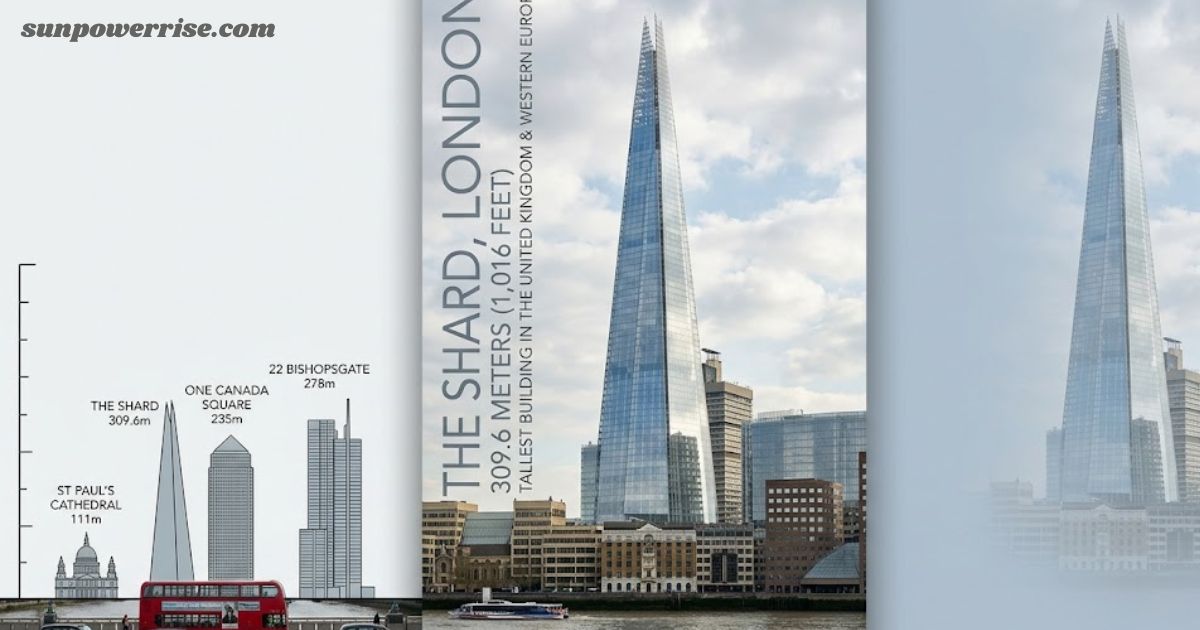
Ask anyone who is walking along the river which building currently stands out as the tallest in London’s skyline, and they will point directly to the Shard, the tallest building in London today. However, the story of this title goes back much further than many people realise.
Tallest Building In London
Before the Shard, the pyramid-shaped 1 Canada Square in Canary Wharf held the title, and before that, St Paul’s Cathedral was the tallest for centuries. This means that London has actually had 14 different buildings that have taken turns as the city’s tallest over its history.
People have built upward for various reasons throughout history: early fortresses were constructed higher to display power and deter enemy attacks, while churches grew taller spires to honour God.
Height Regulations
Today, the tallest skyscraper near London Bridge is limited to just over 1000 feet. This cap was set by the Civil Aviation Authority to ensure the safety of low-flying aircraft.
The same 300 metres rule also applies to One Undershaft, the upcoming tower in the City, which will eventually open a viewing platform and an education centre operated by the London Museum, formerly the Museum of London, starting in 2029.
Architectural Choices, Skyward Expansion, and European Records
Not every high-rise project makes the list of the tallest buildings, however. For example, Michael Bloomberg’s office on Queen Victoria Street was intentionally designed to be low, with architects instructed to use British materials and respect the traditional rule that limits building height to twice the width of the street.
Even now, the Shard cannot claim the outright European record, since the Varso Tower in Warsaw, completed in 2022, is just one foot taller.
This detail is often noted by locals, yet since 2012, the collective memory of what came before the Post Office Tower and the broader understanding of what constitutes a building has become unclear. This has left the Shard as the undisputed tallest building in London and the tallest structure in Western Europe.
The Shard
Designed by Renzo Piano, the Shard is now the defining feature of London’s skyline and is expected to remain so for years to come, though the planned One Undershaft could eventually challenge it. Piano’s design draws inspiration from both sailing ships on the Thames and old church spires, bringing the story back full circle to where it began.
Standing at 310 metres or 1016 feet, the building houses a hotel, restaurants, and penthouses priced between £30 million and £50 million, along with office space and a viewing gallery that can be booked through the-shard.com.
Measured at either 309.6 metres or 1016 feet, the Shard remains the tallest building in London and the tallest structure in western Europe, just slightly behind the Varso Tower in Warsaw, which was completed in 2022. However, it has held the title since 2012.
The London Basilica / Forum (Roman era)
The history of tall buildings in London begins in 47 AD, when the banks of the Thames were home to only a few shacks, jetties, or temporary camps before the Romans arrived and turned the settlement into a proper trading port.
That early city, known as Londinium, was burned down by Boudicca within a decade, yet it recovered and flourished. Its grandest structure became the basilica, a large administrative centre that extended across what is now Cornhill and Leadenhall.
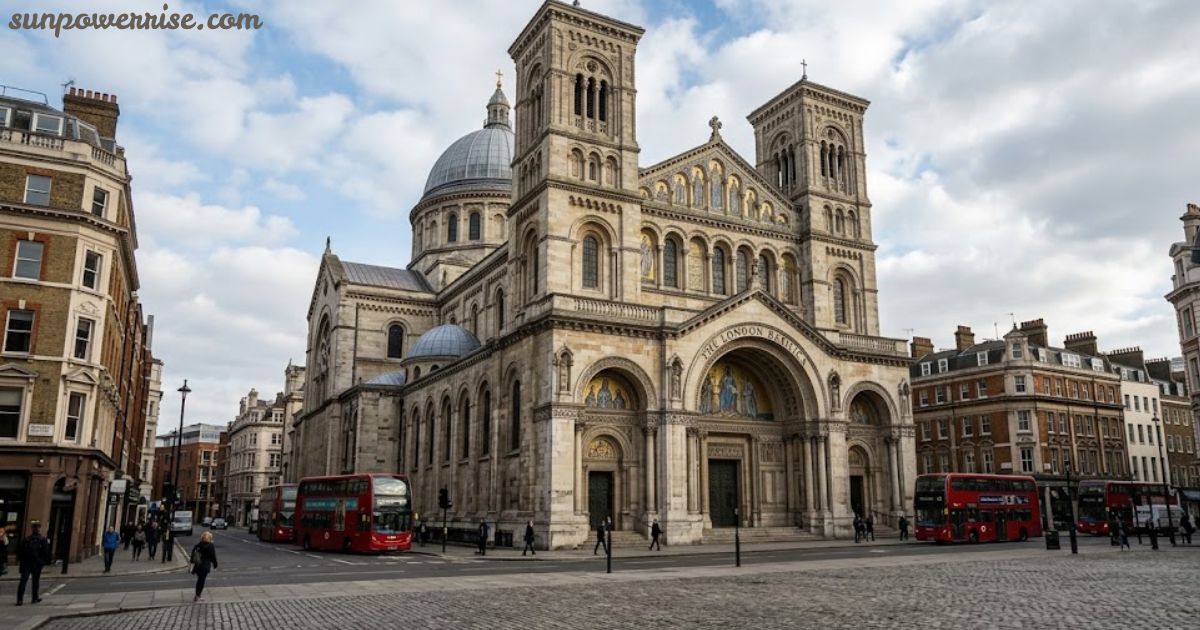
The first version of the basilica was built around 70 AD, but a much larger one followed 20 years later. By the second century AD, the complex had grown to three storeys, making it the tallest structure anywhere in the Roman Empire north of the Alps.
It burned down early in the fourth century, and after that, pinpointing the tallest spot in the city becomes more difficult, though some historians suggest the stands of the old amphitheatre, now buried beneath Guildhall, might have been the tallest at the time.
Old St Paul’s Cathedral
William’s other major project was St Paul’s Cathedral itself. The third church on Ludgate Hill, which had origins dating back to AD 604, was destroyed in 1087. This prompted the construction of the fourth cathedral, which started that same year and was finally consecrated in 1300.
There is some disagreement about the exact height, but it is believed that New St Paul’s likely stood between 460 feet and 498 feet. This may have made it the tallest building in London and possibly the tallest in the world for a period during the 14th century, just slightly behind Lincoln Cathedral. This dominance lasted for about three centuries, but the cathedral faced two major disasters.
First, a lightning strike in 1561 damaged the structure so badly that it lost a third of its height, reducing it to approximately 285 feet. Then, the Great Fire of London in 1666 left the building destroyed, leading to its eventual demolition.
St Paul’s Cathedral (rebuilt, current)
Christopher Wren’s rebuilt masterpiece officially reached its full height in 1708. However, in reality, it had already surpassed all competing churches a few years before, reaching 65 metres by January 1696 when work on the dome at that height began.
Within a few months, this unfinished structure became the dominant feature of St Paul’s skyline. Eventually, it settled at a final height of 365 feet. This height was chosen to represent the number of days in a year and reflected Wren’s interest in astronomy.
This version of St Paul’s, standing at 111 metres, remained the tallest building in London for nearly two and a half centuries. It easily surpassed the previous Old St Paul’s by 100 feet, maintaining its title until 1956 when the Crystal Palace transmitting station, at 719 feet, overtook it.
London Eye
The London Eye attracts more than three million visitors each year, making it the UK’s most popular paid attraction. It consists of thirty-two pods, each capable of carrying up to twenty-eight passengers. Visitors pay £28 or more for a ride.
Cheaper Fast Track tickets, priced from £15, help reduce waiting times. Bookings can be made through londoneye.com at County Hall, SE1 7PB, where the wheel reaches a height of 443 feet, or 135 metres.
The Gherkin
Although reports suggest that architect Norman Foster dislikes the nickname, the official website at thegherkin.com now embraces it as the preferred name over the formal title of 30 St Mary Axe.
This building was once known as the Swiss Re Tower. There is no dedicated viewing gallery, but visitors can still enjoy panoramic views from the top-floor restaurant inside this iconic structure. The building is located at EC3A 8BF and reaches a height of 590 feet, or 180 metres.
Victoria Tower, Houses of Parliament
When considering only the habitable floors and ignoring church spires and other rooftop features, the title of the tallest building actually belongs to Victoria Tower. It is located at the southwest corner of the Palace of Westminster and held the record from 1860 to 1961, standing at a height of 323 feet.
One Canada Square (Canary Wharf Tower)
The title then moved to the growing Docklands area, where One Canada Square became a standout due to its distinctive pyramid-shaped roof.
Standing at 235 metres or 770 feet, this Canary Wharf Tower does not have a public viewing gallery, although one is planned for the nearby HSBC Tower once it is redesigned, located at Canary Wharf, E14 5AB. From 1990 to 2012, some records listed its height as 771 feet or 231 metres. It was the tallest building in London from 1991 until the Shard took over.
Horizon 22
Situated at a height of 254 metres, the 58th-floor free viewing platform at 22 Bishopsgate is the highest public spot in London. Visitors are welcome to walk in, although it is advisable to book tickets in advance. This venue is also available for private events during the evening, with an official height of either 912 feet or 278 metres.
The ‘Walkie Talkie’
Officially named 20 Fenchurch Street, this building is nicknamed ‘Walkie Talkie’ because of its bulging top. It is best known for housing the free Sky Garden, where a reservation is strongly recommended, even though entry is free.
Owned by the Lee Kum Kee Group, the company paid £1.3 billion for the building in 2017. It has 37 office floors and gained notoriety after a parked Jaguar was set on fire by reflected sunlight. The building stands at 525 feet or 160 metres, and its address is EC3M 8AF.
Millbank Tower
St Paul’s Cathedral dominated the skyline for two centuries until the rise of skyscrapers. Early signs of this shift included buildings like Senate House and 55 Broadway before the war. A pair of electricity pylons between Dagenham and Crossness reached 148 metres or 486 feet and overtook the cathedral as early as 1932, when the area still belonged to Essex and Kent.
Soon after, Battersea Power Station came close with its tall chimneys. However, the true giant of the era was the Crystal Palace transmitter, a 219 metres or 719 feet, mast on Sydenham Hill.
The first genuine building with habitable floors all the way to the top was Millbank Tower. Though it was once very famous, it has since been classified as a B-list London skyscraper. It held the title of the tallest building in London for just one year, standing at 390 feet in 1963 before the Post Office Tower, at 581 feet, took over in 1964.
FAQs
What is the tallest building in London now ?
The Shard, designed by Renzo Piano, still holds the crown as London’s (and the UK’s) tallest habitable building, a title it’s kept since completion in 2012.
Is Horizon 22 higher than the Shard?
As a viewing gallery, yes. Horizon 22 (on the 58th floor of 22 Bishopsgate) sits at 254m, beating The Shard’s viewing point at 243m. But as a building, The Shard is still taller overall.
Who owns 22 Bishopsgate?
It was developed and is managed by AXA IM Alts, on behalf of a joint venture of international investors including PSP Investments, QuadReal Property Group, Temasek, and AXA. Lipton Rogers Developments served as the development partner.
Is 22 Bishopsgate a success?
By most measures, yes. The skyscraper became fully let by January 2025, drawing strong occupier demand thanks to its sustainability credentials, wellness amenities, and prime City location.
What is the oldest skyscraper in London?
That title belongs to Tower 42 (originally the NatWest Tower), completed in 1980 and designed by Richard Seifert. It was London’s and the City of London’s first true skyscraper, and held the UK’s tallest building title until One Canada Square overtook it in 1990.