

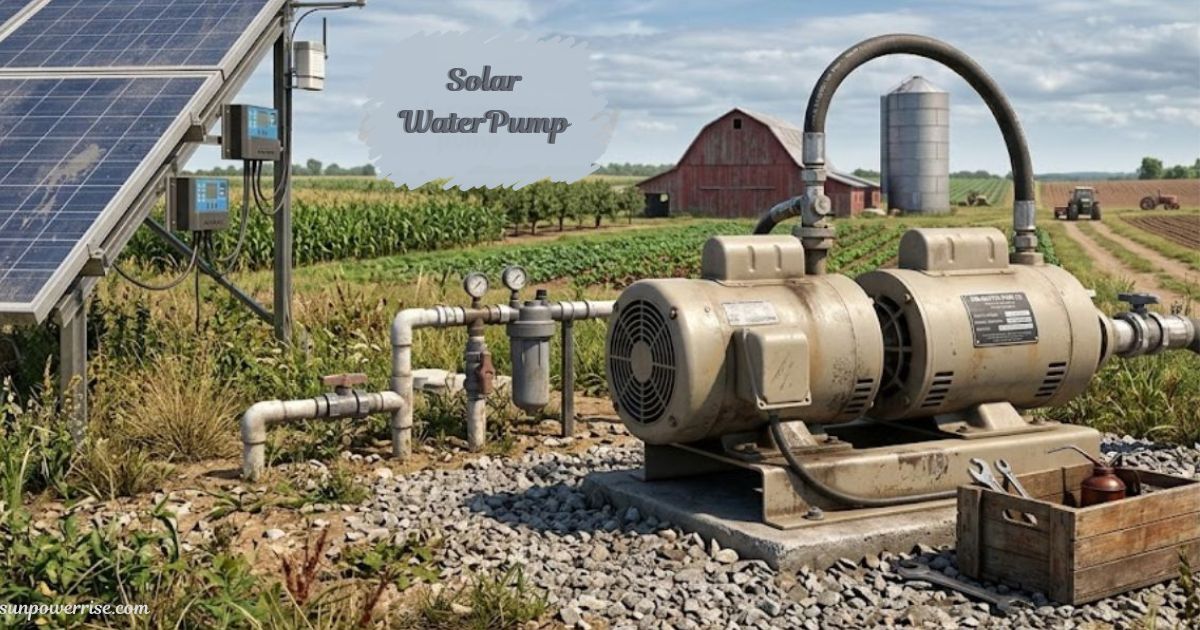
A solar water pump runs entirely on solar-panel electricity instead of mains power or a generator, drawing water from a well, borehole, pond, or stream and delivering it to a tank, trough, or irrigation line with no fuel cost and no grid connection required.
Most systems like the SE1 unit pair a solar panel with a deep-cycle battery, so water keeps flowing overnight and through cloudy stretches instead of stopping the moment the sun dips behind a cloud. For farms, livestock operations, and off-grid properties where running mains cable or an inverter-fed 230V line is either impractical or expensive, a solar pump replaces that entire setup with a system you can install in an afternoon.
How Solar Water Pump Works
Place the unit near your water source, drop the suction hose in, and the pump does the rest. On the SE1, that’s a 7.5m suction hose feeding a self-priming pump, backed by a manual handle for when you need water and the battery’s flat.
The pump pulls water through a foot-valve and filter keeping debris out and the line primed then pushes it out at pressure into your tanks or troughs. A pressure switch handles the rest automatically: once the tank’s full and pressure in the vessel rises to the cut-out point (typically 40psi), the pump stops; it kicks back in around 30psi. No manual intervention, no float switch to babysit.
Getting the Sizing Right: Flow, Head, and Daily Demand
Before you buy anything, you need three numbers: how much water you use per day, how far it has to travel vertically (total head), and how far horizontally. Flow is measured in litres or gallons per minute; head in metres or PSI. The relationship between them is inverse push water higher and flow drops, because the pump is spending more energy fighting gravity and pipe friction instead of moving volume.
A rough sizing method: take your daily water need in litres, divide by your expected sunlight hours (4–6 in most of the UK and northern US; 6–8 across the southern US), and that gives you your target flow rate in litres per hour.
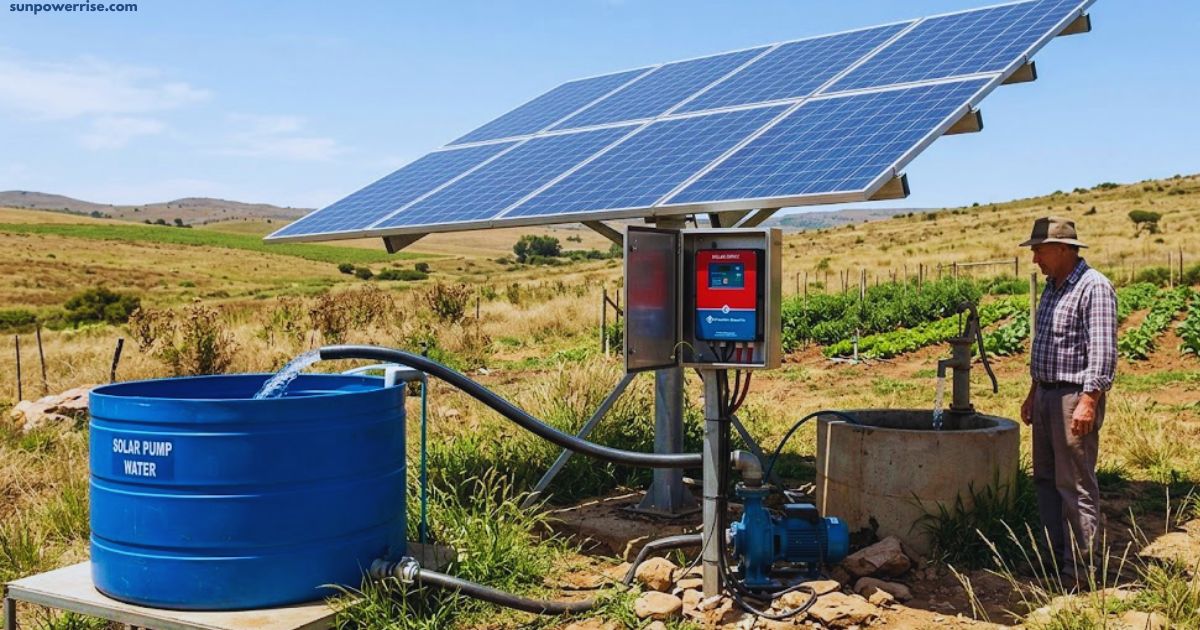
A household needing 1,000L a day with 5 usable sun-hours needs a pump capable of roughly 200L/h at your specific head not at the pump’s best-case rating, which manufacturers usually quote at zero head. Horizontal distance matters too: pumps can’t push water sideways by suction alone, so for long runs, keep the pump close to the source and oversize the pipe diameter rather than relying on pressure to overcome friction loss.
One thing worth flagging that often gets skipped: sizing shouldn’t be based on head and demand alone if you’re pulling from a well. If your well’s sustainable yield is lower than your pump’s draw rate, you’ll pump it dry faster than it recharges damaging the pump and leaving you without water exactly when you need it. Check your well’s yield before matching a pump to it, not after.
Direct Solar vs. Battery-Backed: Which One You Actually Need
Solar pumps split into two architectures. A direct system pumps only while the sun’s out, filling an elevated tank sized to cover you through the night and cloudy days cheaper to build and simpler to maintain, since a tank lasts longer than a battery and needs no charge controller logic. A battery-backed system, like the SE1, stores energy so the pump can run on demand, any time, and can push water to points above the source something a gravity-fed tank system can’t do without an extra pumping stage.
The trade-off: battery systems cost more upfront and the battery itself needs replacing every few years, but you get pressurised, on-demand water rather than relying on elevation and timing. For most farms and remote homes, that flexibility is worth it. For simple livestock troughs or irrigation that can run during daylight, a direct system with a well-sized tank is often the cheaper, lower-maintenance choice.
For larger-volume or long-distance jobs, DC pumps running straight off the panel or battery are the simplest option for small systems, while higher-capacity setups often use AC pumps run through an inverter the same approach traditional 230V systems use, minus the running cost.
What It Actually Saves You
A typical mains-wired pump circuit can cost several thousand pounds/dollars just to extend a cable run to a remote field, before you’ve paid a penny of electricity. A diesel generator avoids the cable cost but adds ongoing fuel, maintenance, and noise. A solar pump has a higher day-one cost than a basic electric pump but no fuel bill, no cable trenching, and on a well-sized system a payback period that’s often well under five years versus running a generator continuously for irrigation or livestock water.
Keeping It Running
Solar pumps are low-maintenance, not zero-maintenance. Expect to clean the intake filter and foot-valve every few months (more often in silty or algae-prone water), check hose connections for wear, and replace the deep-cycle battery roughly every 3–5 years depending on usage and climate. Most well-built systems run 5–10 years before major component replacement, and controllers that regulate charging stopping once the battery’s full are what protect that lifespan.
Where Solar Pumping Isn’t the Right Fit
It’s not universal. Very high continuous water demand, extreme pumping heads, consistently poor sun resource, or a requirement for guaranteed nighttime flow without a battery all push the economics and reliability against solar. In those cases, a hybrid setup solar plus grid or generator backup usually beats a solar-only system forced beyond its limits.
The Bottom Line
Match the pump to your actual head, daily demand, and well yield not just horsepower or price and a solar water pump will outlast the payback period and keep running with minimal upkeep, rain or shine, bill or no bill.
FAQs
Are solar-powered water pumps any good?
Yes, solar-powered water pumps are genuinely good. They use renewable energy from sunlight to move water without relying on grid electricity, making them a cost-effective, eco-friendly, and reliable solution for irrigation, domestic use, and off-grid properties.
Which solar water pump is best?
The best solar water pump depends on your water output needs, pump capacity, and installation location, submersible solar pumps suit deep boreholes and wells, while surface solar pumps work better for shallow water sources and garden irrigation systems.
What is a solar water pump system?
A solar water pump system consists of solar panels, a pump controller, and a water pump that work together to convert sunlight into DC electricity or AC electricity to move water from a source like a well, borehole, or reservoir directly to where it is needed.
What are the cons of a solar water pump?
The biggest drawbacks of solar water pumps are their weather dependency, output drops significantly on cloudy days and during winter, along with higher upfront costs compared to conventional pumps and reduced water flow during low sunlight hours.
What are the top 3 water pumps?
The top three solar water pumps widely recognised for reliability, pump efficiency, and flow rate are the Grundfos SQFlex, the Lorentz PS2, and the Shurflo 9300.