


You can request a solar quote Davenport online in a few minutes, and a clear solar quote shows your real numbers first. I have helped neighbors read these papers for years, and the free solar quote step clears up most worries. This guide explains every part in simple words.
What does a free solar quote include?
A free solar analysis gives you a custom solar quote, an itemized solar proposal, and a solar savings report. You can get a free quote and still owe nothing, because a no obligation quote carries no fees. Most firms add a savings projection to the solar proposal.
I always ask for a solar consultation first, since a no pressure consultation lets me ask blunt questions. A custom solar layout shows where each panel sits on your roof. Good companies promise honest local pricing and send a quote within 24 hours.
How do I request a quote online, step by step?
Open a solar estimate form, type your address, and upload a recent power bill from your utility. A solar cost calculator helps, and many let you get results in 3 minutes. Then request a quote and wait for the call.
Try a free solar calculator before you talk to anyone, so you know the rough range. Next, schedule your appointment for a site assessment. A certified site assessment includes an onsite inspection of your roof and meter.
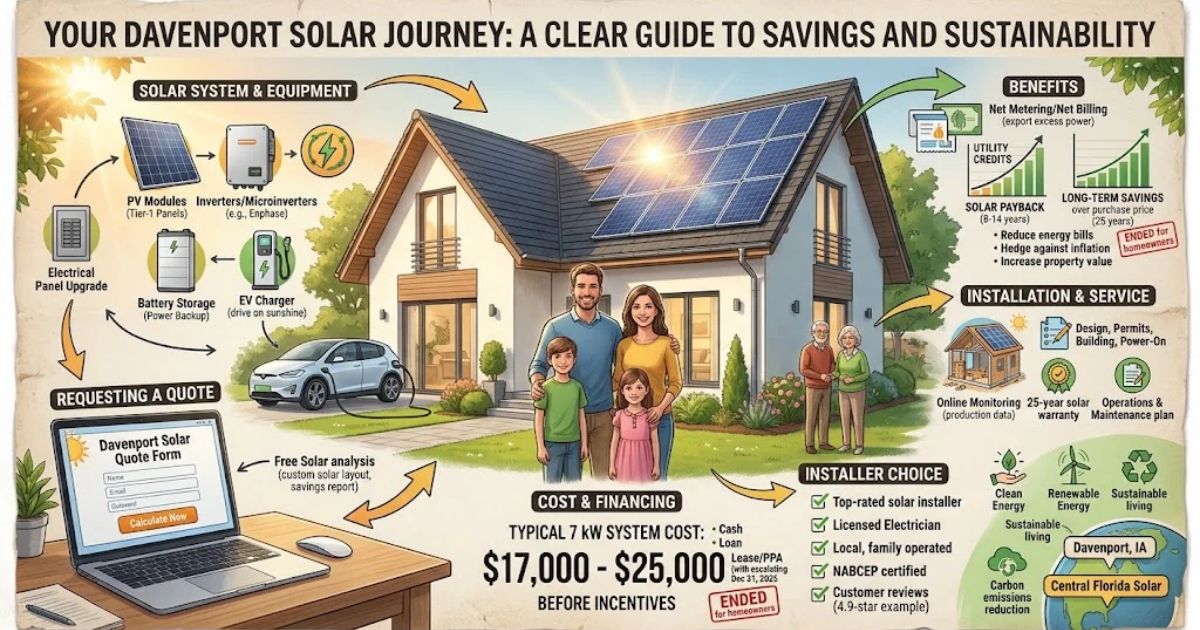
How much does solar cost in Davenport?
The cost of solar panels depends on size, and a typical solar system cost for a 7 kW home runs about $17,000 to $25,000. That number is the cost before incentives. Your upfront cost shrinks when you choose a monthly payment over cash.
A locked-in low payment protects you from surprise bills. Affordable solar does not mean the cheapest bid, so I compare best value solar offers by cost per watt. Ask every installer for that number in writing.
Is solar worth it, and when does it pay back?
Most owners see a strong return on investment, and the payback period often runs 8 to 14 years. Solar helps you reduce energy bills and hedge against inflation. Many owners say their system will pay for itself.
Long-term savings add up, and savings over 25 years can top the purchase price. Your avoided costs grow as rising utility rates climb. Steady output lets you budget your utility costs, and some homes reach a $0 electric bill while most get a lower monthly electric bill.
What financing options can I choose?
Your financing options include cash, a loan, a lease, or a PPA. Many homeowners pick solar financing with no money down, which some lenders call $0 down. Some offers include 0% interest financing, such as 0% interest for 24 months.
Ask whether the deal has $0 installation fees, and compare each payment plan line by line. Check loan options and energy grants for extra help. Some lenders advertise no credit card required at pre-qualification, but financing approval usually still checks your credit.
Should I lease, sign a PPA, or buy?
A solar lease and a power purchase agreement (PPA) let you rent the system, while buying solar panels gives you full solar panel ownership. Compare leasing vs. buying solar before you sign anything. When you own your solar system, you also claim equipment depreciation if you run a business.
Watch for escalating lease payments, because many contracts raise them 2% to 3% each year. I reviewed one lease where the bill climbed every spring, and the owner felt trapped. Read every page before you sign.
Does the federal tax credit still apply?
The solar tax credit, formally the 30% federal tax credit and the Residential Clean Energy credit, ended for homeowner spending after December 31, 2025. The One Big Beautiful Bill set that tax credit deadline. A purchase you sign today does not qualify for that credit.
Business buyers follow a separate Federal Investment Tax Credit with its own dates, and the placed in service date matters. Ask a tax pro about solar incentives before you sign. State and utility tax credits and incentives may still help, so check both.
How does net metering work in Davenport?
Net metering pays you for extra power your panels send to the grid, while net billing pays a lower rate for that power. Your utility sets the rules, so ask which one applies. An avoided cost rate is what some utilities pay for exports.
At the true-up month, the utility settles your account. Leftover excess credits may roll forward or expire, depending on the plan. Review the utility credits on your first bill and compare them with your estimate.
Which panels and equipment should I ask about?
Ask about solar panels, the solar PV modules, and the full photovoltaic system. Many shops install PV panels such as ACPV panels, short for alternating current photovoltaic units with built-in electronics. Pick premium solar panels from Tier-1 solar panels brands for better support odds.
Each of the solar modules holds solar cells, usually silicon cells, that make direct current (DC) power. An inverter converts it to alternating current (AC), and microinverters, like an Enphase system, do that at each panel. Sturdy solar racking holds it all down, whether you choose roof-mounted solar or ground-mounted solar.
Do I need battery storage, a generator, or an EV charger?
Solar battery storage gives you battery backup during outages, and solar plus storage keeps your lights on. A standby generator, such as a Kohler generator, can back up the battery. Most homes do not need all three.
An EV charger or a few EV charging stations let you drive on sunshine. Some cars offer EV to home backup, which feeds your house. Add an electrical panel upgrade if your box is full, and confirm electrical grid integration with your utility.
How does solar panel installation work?
Solar panel installation follows four steps: design, permits, building, and power-on. A solar installer with expert solar installation skills handles the details, and a turn-key solar solution means one company does everything. I call it a solar journey from concept to commissioning.
Custom solar design and system design and engineering come first. Your crew then handles permitting requirements and utility paperwork, and waits for permission to operate (PTO). After system commissioning, you switch on your panels.
How long does installation take, and what do crews check?
The roof work itself is a fast installation, often a 1–2 day installation with minimal disruption for your family. Permits and utility approval take weeks longer than the crew’s visit. Plan on two to four months from signing to switch-on.
Crews check mounting and orientation for maximum sunlight capture, and they plan panel placement around vents. They study roof condition, sun exposure, peak sun hours, and your energy consumption. Expect HOA approval, local regulations, rapid shutdown compliant equipment, and, with old shingles, roof replacement and panel re-install.
What service and warranty come with solar?
Online monitoring shows real-time solar data and production monitoring on your phone, so you spot dips fast. A yearly system check confirms that the numbers match your estimate. Ask for solar maintenance under an operations and maintenance plan, and get the price in writing.
Solar service and repair teams offer panel cleaning, regular inspections, and a 24/7 service line. A production warranty guarantees output, and a workmanship warranty covers labor. Look for a 25-year warranty or 30-year solar warranty that works as a transferable warranty, plus insurance coverage.
How long do solar panels last, and do they survive storms?
Most panels last 25 to 30 years, and the system lifespan can reach 40+ years of use with slow output loss. A hurricane-resistant design matters most in Florida. Battery-backed power outage protection matters wherever storms hit the grid.
Iowa installers rate racking for heavy snow and strong wind. Florida installers add stronger tie-downs, and inspectors in both states check them. I check those details on every proposal I read.
What else do people ask about solar in Davenport?
Who can use solar besides homeowners?
Home solar and residential solar fit most houses, and solar for homeowners is the largest market. Business solar and commercial solar suit shops and offices. Agricultural solar and farm solar cut costs on barns and pumps.
Municipal solar, academic solar, and nonprofit solar serve public groups, while utility-scale solar feeds the grid from big fields. Solar roofing blends panels into the roof itself. Solar can increase home value and property value, and a 2019 Zillow study found solar homes sold for about 4% more, a perk when you sell your home.
How does solar help the planet?
Solar gives you clean energy and renewable energy from unlimited sunlight. That helps you reduce carbon footprint at home and supports carbon emissions reduction across your community. Each kilowatt-hour you make replaces grid power that often comes from coal or gas.
It also drives greenhouse gas reduction and a CO2 offset you can track on your monitor. Many families call sustainable living and energy independence the real win. Together, those steps build a greener planet.
How do I pick a trusted solar installer?
Choose a top-rated solar installer or top solar contractor that acts as a trusted solar company with NABCEP certified staff. Hire a licensed electrician for the wiring. Prefer locally owned, family operated firms that answer the phone.
Read customer reviews and testimonials, and treat a 4.9-star rating as a clue, not proof. Ask for proven results from satisfied homeowners who live nearby. Then call two references yourself.
Which Davenport does my search mean, and who serves me?
Iowa buyers should search Davenport solar company or solar company Davenport, IA, because two cities share the name. Quad-Cities solar teams and an Iowa solar installer know local rules. Florida buyers want Central Florida solar (Davenport, FL) crews instead, since climate and rules differ.
Typing solar installers near me or solar panel companies works too. A firm serving Davenport homeowners knows the local permit office. Always confirm which state a website targets before you submit anything.
What should I do next?
Gather your last twelve power bills, then fill out one form and ask for two more bids. Compare each estimate line by line: system size in kilowatts, price per watt, warranty length, and payment size. Give yourself a week to decide, because a calm choice beats a rushed one.
I follow the same routine whenever a friend asks for help: I read the proposal twice, then call with three questions. I listen for patient answers, because rushed replies often predict rushed work. A good company never pressures you to sign on the spot.