

Solar Power Purchase Agreement Cost Waterloo is the search I hear most from neighbours who want solar for home without writing a huge cheque. A solar power purchase agreement lets a company install rooftop solar and sell you the power. This guide explains the costs, the risks and your financing options in plain words.
How does a solar power purchase agreement work and what does it cost?
What is a solar power purchase agreement?
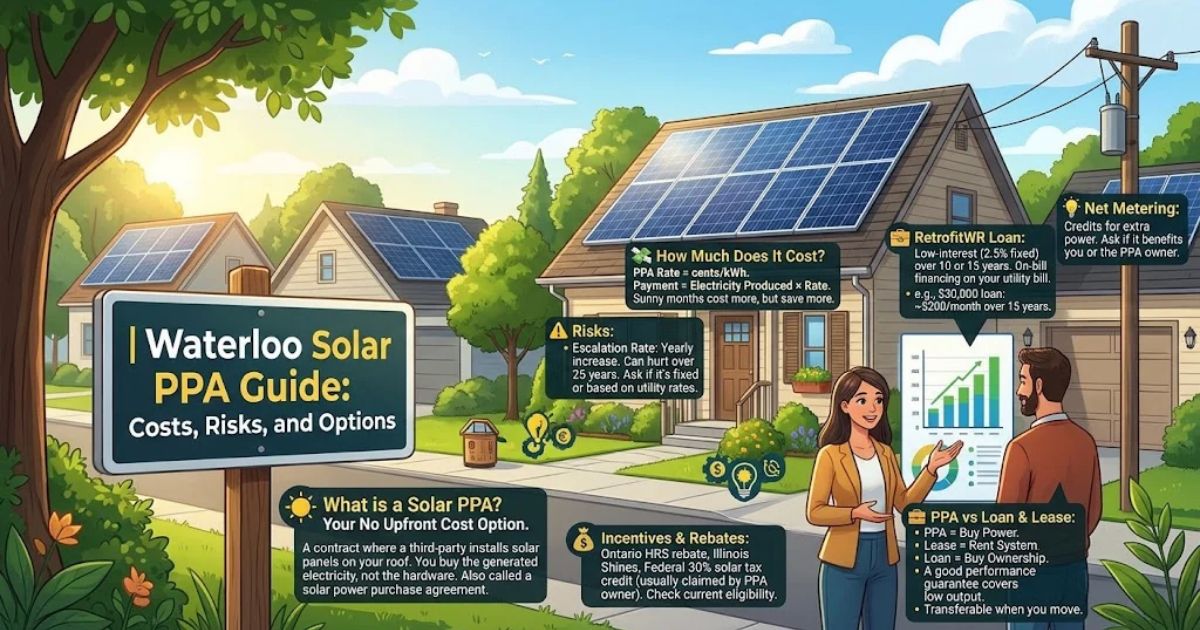
A solar power purchase agreement is a contract where a third-party system owner installs rooftop solar panels and sells you the power. You pay for electricity, not equipment, so you never buy the hardware. People also say solar PPA, power purchase agreement or residential solar PPA.
The PPA company keeps equipment ownership, so you buy output from its solar PV system and never become the system owner. This third-party ownership model skips the cash purchase and the solar loan. In Illinois, an Illinois residential solar PPA follows the same pattern under local rules.
How much does a solar PPA cost in Waterloo?
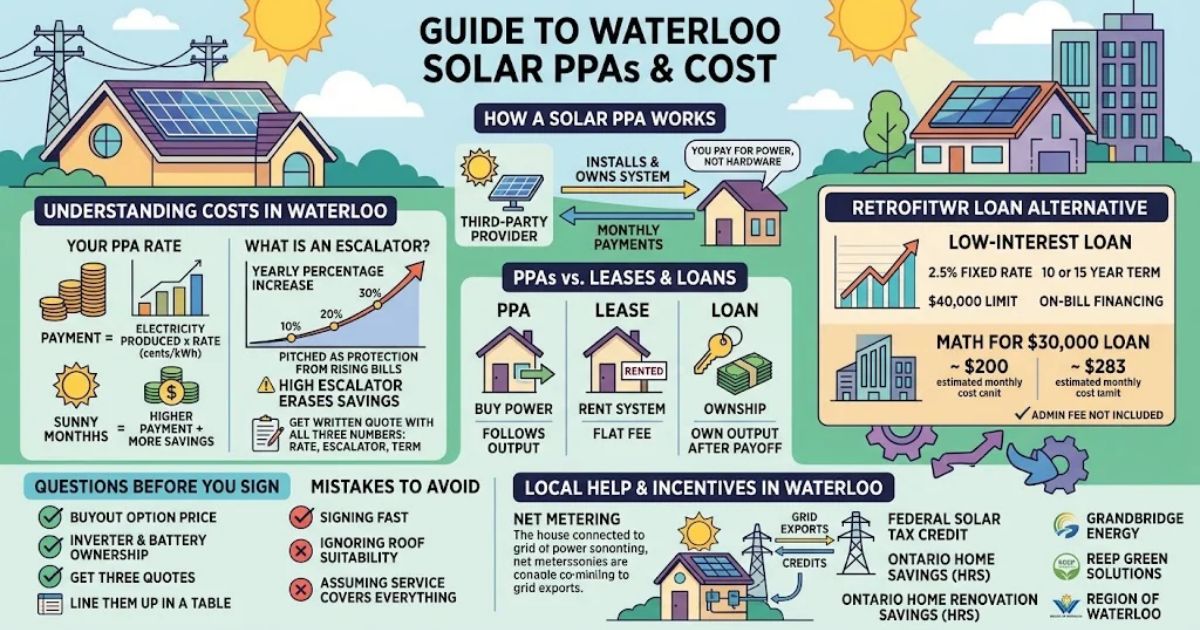
Your PPA rate is the price per unit of power, quoted in cents per kWh. I cannot give a verified Waterloo number, because the sources I reviewed publish none, so request written PPA pricing. A fair solar quote shows the rate, the escalator and the PPA term on one page.
One kilowatt-hour equals a 1,000-watt appliance running for an hour. Your monthly payment equals the electricity produced times that rate, so sunny months cost more but save more. Some firms sell a fixed monthly payment, so compare it against estimated annual production and real solar production records.
What is an escalation rate?
An escalation rate is the yearly percentage that raises your price. At 3% a year, a price roughly doubles in 24 years, which hurts across a 25-year agreement. Ask whether the annual escalation is fixed or follows utility rate increases.
Sellers pitch the escalator as protection from rising electricity bills, promising predictable energy rates. They say you lock in utility rates and gain energy stability, yet a high escalator can erase your energy cost savings. Compare every offer with your current utility rates and check that lower electricity bills truly appear.
Does a PPA really cost nothing to start?
Yes, most deals advertise no upfront cost solar, because the PPA company pays for the install. You still take on commitments, since the PPA contract binds you for years. Read the contract term and the termination clause first.
A good performance guarantee covers low output. Ask about the panel degradation rate, which often runs around half a percent a year. Also ask about a buyout option, the system buyout price and whether you get a transferable PPA when you move.
How does a PPA compare with other ways to pay?
Is a PPA better than a lease or a loan?
With a PPA you buy power, while a standard lease rents the system for a flat fee. A prepaid lease bundles that rent into one upfront payment, and a solar loan buys you ownership. In a PPA vs solar lease comparison, the key question is whether your payment follows output.
A PPA vs loan comparison often favours the loan when you can borrow cheaply, because you own the output after payoff. A PPA suits people without savings or credit. Weigh every one of these financing options and still price a cash purchase.
What does the RetrofitWR loan offer?
RetrofitWR, short for Retrofit Waterloo Region, offers a low-interest loan at a 2.5% fixed interest rate. It covers up to a $40,000 loan over a 10 or 15 year term. It is a loan, not a PPA, so it publishes no PPA price.
You make loan repayment through on-bill financing, with repayment on utility bill so one payment covers both. Costs include an administration fee plus total interest. The program also uses an initial disbursement and a Property Owner Agreement, so read both.
What would a $30,000 loan cost?
By my own math, a $30,000 loan at 2.5% over 15 years costs about $200 monthly and roughly $6,000 in interest. Over 10 years, it costs about $283 monthly and roughly $3,900 in interest. Those figures exclude the administration fee.
Use that as a yardstick for any solar financing Ontario offer. Check the energy reduction target, because upgrades may help you meet it. Then compare the loan with a PPA over the same years.
What questions should I ask before I sign?
Start with the PPA rate, the escalation rate and the PPA term, because those three numbers drive your total cost. Then ask for the buyout option price in writing. Finally, confirm who owns the solar inverter and any battery storage hardware.
I tell friends to request three solar quote documents and line them up in a simple table. Differences in monthly payment and annual escalation show up fast that way. Walk away from any seller who refuses to share estimated annual production figures.
What else changes my price?
Which upgrades pair well with solar?
A home energy retrofit shrinks your usage before you size the solar array. Start with a home energy assessment, then price a heat pump, insulation upgrades and energy-efficient windows. Smaller usage means a smaller system and a smaller contract.
Some homes need an electrical panel upgrade, a building permit, an EV charger or a smart panel. Add battery storage or battery backup if outages worry you, though extras raise the price. Tell the installer early so system design includes them.
What should a good installer do fo r me?
A good solar installer handles solar installation of solar photovoltaic gear, from roof suitability checks to utility connection approval. Hire a licensed electrical contractor and a NABCEP certified designer. In Ontario, an ESA inspection confirms the work, so insist on code-compliant installation.
Strong PPAs include operations and maintenance, system monitoring and service and repair, so you get maintenance-free solar. Check the solar warranty and ask who handles panel removal and reinstall during roof work. Use a solar calculator and a free solar quote to compare, and ask who pays when the solar inverter fails.
How does net metering change the math?
Net metering credits you for extra power your panels send back to the grid. Your net metering agreement sets how your export credits work. Credits help only after load displacement, meaning your panels power your own home first.
Grid exports pay off only when your utility credits them fairly. Ask whether the net metering benefit goes to you or the PPA owner, because that answer changes your solar savings. Illinois customers should ask Ameren Illinois or ComEd how they treat credits.
What mistakes should I avoid?
The biggest mistake is signing fast because no upfront cost solar sounds easy. Compare the PPA contract with a solar loan and a cash purchase first. Take at least a week to read the fine print.
Another mistake is ignoring the roof, since an old roof forces panel removal and reinstall later. Check roof suitability before you sign anything. Also confirm that service and repair covers the solar inverter and the wiring.
Which incentives and local help can I use?
Which solar incentives and rebates exist?
Solar incentives vary by place, and government incentives change often. In Ontario, the Home Renovation Savings program offers a HRS rebate for efficiency upgrades through Save on Energy and the IESO. Always confirm program eligibility before you sign.
In Illinois, Illinois Shines and Solar for All support renewable energy credits and income-eligible households. The federal solar tax credit, often called the 30% solar tax credit, has a tax credit expiration date that has shifted, so check current rules. Under a PPA, the owner usually claims it, so ask how that lowers your price.
Can I stack incentives?
Often yes, but incentive stacking has rules. Get written approval before work starts, because some programs refuse projects already underway. Check your rebates and energy efficiency program for overlaps.
The PPA owner’s incentive capture should lower your rate, so ask for proof. The Green Municipal Fund has supported community retrofit programs in Canada. Bring these answers to every installer.
Who helps locally around Waterloo?
Waterloo Region solar shoppers should confirm which utility serves them, since the Region of Waterloo has several. GrandBridge Energy serves Cambridge solar and North Dumfries customers, while Kitchener solar shoppers should check their own. A solar Waterloo Ontario search also turns up Ontario solar programs.
Reep Green Solutions works with an Energy Coach who guides Ontario homeowners through retrofits. Gather your electricity bill, hydro data and 12-month hydro usage before you request quotes. Canada solar rules differ from Illinois solar and Missouri solar rules, so check local ones.
How should I read my own electricity bill first?
Pull your latest electricity bill and note the per-kilowatt-hour price and the fixed charges. Your hydro data also shows seasonal swings, which help size the system. A 12-month hydro usage report gives the cleanest picture.
Ask your installer to match solar production to that history, not to a guess. Oversized systems waste export credits, and undersized ones leave you exposed to utility rates. A solar calculator gives a quick first check.
Who funds PPAs, and is one worth it?
Who pays for these solar deals?
Behind each PPA sits renewable energy finance, where capital providers and investors fund distributed energy assets. Many deals sit in a special purpose vehicle (SPV), and SPV management tracks the cash. Project finance lets the PPA company repay over many years.
Embedded financing and asset-backed financing lower the cost of capital, which can lower your rate. Portfolio financing pools many homes, so investment managers and asset management teams spread risk. Sound underwriting and financial modeling create bankable projects, and gap financing covers any shortfall.
How do developers and investors measure these deals?
Project developers use project origination to build a developer pipeline of homes, commercial and industrial solar and multi-tenant solar sites. Distributed energy resources also include community solar, energy storage and e-mobility. Larger plans reach utility-scale renewable projects.
Investors study unit economics, yield compression and return on investment before they commit. A SaaS platform acts as financial infrastructure and system of record, with ERP integration and data aggregation for compliance and reporting and risk management. Some firms add AI-enabled underwriting, and the Greenhouse Gas Reduction Fund has backed projects that support net-zero emissions.
Is a solar PPA worth it for my home?
It is worth it when your solar payback period beats your contract length and your solar cost stays below utility prices. A PPA suits owners without cash or credit, while a loan suits those chasing long-term returns. Test solar affordability by comparing 25 years of payments side by side.
Selling a solar home gets easier with a transferable PPA, but buyers often value owned systems more, which affects home value. Tell buyers early and share the contract term. Ask a lawyer to review the paperwork.
Does solar help the environment and the grid?
Yes. Clean energy from renewable energy sources delivers real carbon reduction, because panels make power without burning fuel. That supports wider decarbonization and feels like an environmentally responsible choice.
Panels add energy independence, and a battery helps grid reliability during outages. Businesses use a commercial PPA too, where the offtaker signs an energy offtake deal. Those buyers should check the same termination clause and performance guarantee.