

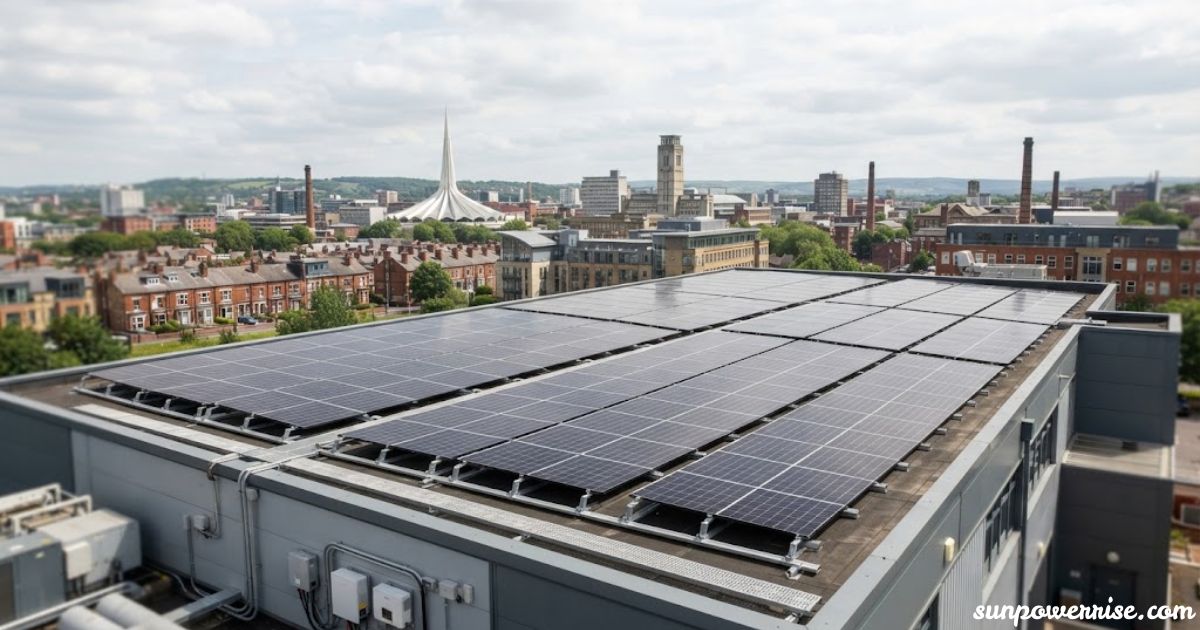
A standard 4-6kW solar panels Leeds costs £6,000-£10,000, and despite doubts about the city’s weather, real-world experience shows it’s a genuinely worthwhile investment for homeowners.
With electricity sitting around 24p/kWh, and the Smart Export Guarantee paying anywhere from 4-15p for surplus energy sent back to the grid, a standard 4kW system on a normal semi-detached house can bring in combined savings plus SEG income that add up quickly over a year.
Leeds City Council declared a climate emergency back in 2019 and locked in a target of carbon neutrality by 2030, which makes it one of the boldest plans of any UK core city.
That is not just a slogan either there is real policy behind it, and genuine financial support for residential solar keeps getting renewed. Sitting at roughly 53.8°N, the Leeds district picks up around 985 kWh/m²/year of irradiance, and from what I have seen on site visits, that is more than enough to produce solid commercial returns for the average household.
Solar Panels Leeds Permitted Development and Exceptions
There is also a financial confidence in this city that you notice the moment you start quoting jobs, and it’s part of why solar panels Leeds UK searches keep climbing year on year.
Leeds is often called the UK’s largest financial centre outside London, and the people living here tend to treat energy investment decisions the same way they treat any other investment: carefully, and with the numbers checked twice.
The city gets around 1,350 hours of sunshine every year, and a typical 4.85kW solar system will generate somewhere between 3,700-4,150 kWh per year. At today’s rate of 24.5p per kWh, that works out to annual savings of roughly £750-£860, and that figure does not even include what you earn from surplus exported electricity.
Suburban Variations and Performance across Leeds
Location genuinely changes the outcome for Leeds solar performance, and I say this from experience standing on plenty of roofs across town. The elevated northern suburbs, think Alwoodley, Chapel Allerton, Moortown, Headingley, and Roundhay, sit on higher ground with natural south-facing aspects, so their roofs catch the sun beautifully.
Properties up there tend to post the strongest generation figures, and their large roof areas can often take premium 14-20 panel systems, which, paired with battery storage, can deliver savings of £1,400-£2,200 a year.
Down in the flat southern suburbs and eastern suburbs, places like Garforth, Cross Gates, Rothwell, Morley, and Beeston still perform reliably well, thanks to their open unshaded sky exposure and reliable year-round generation.
Leeds Community Energy CIC has proven this point many times over with strong solar performance across its city-wide installations, and honestly, I have never met a postcode in Leeds postcodes that could not make a decent case for solar.
Planning Permission in Leeds
Permitted Development Rights and Exceptions
One of the first things I explain to every customer is that planning rules in Leeds are far friendlier than people assume. The vast majority of Leeds properties fall under permitted development rights, meaning most domestic solar panel installations simply do not need planning permission at all.
There are a few exceptions worth knowing if your home is a listed building, sits inside a designated conservation area, or the panels would stick out more than 200mm from the roof plane, then a little extra paperwork is needed.
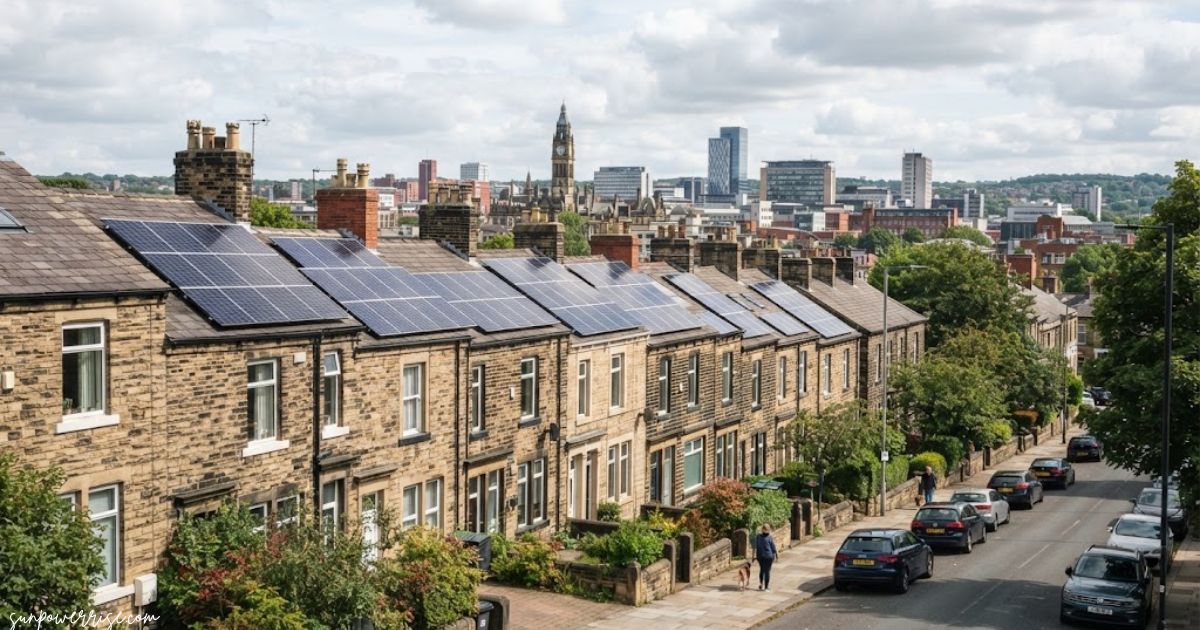
Even then, in most conservation areas a prior approval application is all that is required, not full planning permission, and in my own dealings I have watched these applications get approved in Leeds time and again without drama.
Free Surveys, Conservation Areas
As one of the more established solar panel installers in Leeds, I always build a free survey into the process at no obligation, because it gives people peace of mind before they commit to anything.
This is where our Free Planning Check Included promise comes in: we look at the planning requirements for your specific property and, if a prior approval application turns out to be necessary, we manage the whole application process on your behalf.
Chapel Allerton, Headingley, Roundhay, Adel, Horsforth, and parts of Wetherby all carry conservation status, along with the historic core of the city centre, and this matters most for front-elevation installations, since solar panels visible from the street mean the front elevation or roof slopes seen from public roads need a bit more scrutiny before work starts.
Listed Building Consent
Listed buildings are a separate story, and Leeds has plenty of them, particularly around Headingley, Roundhay, and the city centre. These require Listed Building Consent, a process that typically takes around 8 weeks and involves working with the local planning authority.
We handle every stage of this ourselves as part of our installation service, including submitting applications and liaising directly with Leeds City Council, so you are never left chasing paperwork.
Checking the planning status of a property during a free home survey has saved more than one client from an unexpected restriction that would otherwise have derailed their plans.
Solar Panel Costs in Leeds (2026)
System Sizing, VAT Relief, and Battery Options
Cost is always the first real question when people look into solar panel installation Leeds pricing, and I like to keep the answer simple. Every solar panel system fitted in Leeds currently benefits from 0% VAT, which genuinely changes the maths for most households.
A 3kW system with 8 panels suits smaller homes or couples who use less power day to day, a 4kW system with 10 panels remains the most popular size for a typical 3-bed semi, and a 5kW system with 12-13 panels fits larger households comfortably.
Many of my customers also add a battery storage system, usually a GivEnergy 9.5kWh unit or a Tesla Powerwall 3, depending on how much capacity they actually need. Every installation we carry out includes scaffold hire, the electrical connection, DNO notification, and a proper system handover, and because every roof is different, each job is quoted individually through a free, no-obligation quote.
Annual Energy Yields and Market Pricing
To put figures on it, a 3kW system with 8 panels produces around 2,600-2,900 kWh a year, a 4kW system with 10 panels produces 3,400-3,800 kWh, a 5kW system with 12-13 panels manages 4,200-4,700 kWh, and anything 6kW+ with 14-16 panels can push past 5,000+ kWh.
More broadly, market pricing across 2026 shows solar panel system prices in Leeds run from around £5,500 for a basic 4.85kW system with 10 standard panels on a straightforward semi-detached home, up to £16,000+ for a premium 8kW system paired with battery storage on a large detached property.
In my experience, the most popular system size these days sits at 10-12 panels, or 4.85-5.8kW, costing roughly £5,500-£8,000 installed and generating around 3,700-4,400 kWh annually. Every one of these domestic installations qualifies for the effective cost reduction of 20% against the standard rate, thanks to the VAT relief mentioned earlier.
Battery Upgrades, Household Savings, and Packages
Adding a battery does raise the upfront costs, usually by £2,500-£7,000 depending on capacity, but it also pushes annual savings up to £1,000-£1,500 for standard-sized properties.
For the bigger houses out in Alwoodley and the Roundhay homes that can carry 16-20 panel systems, a complete solar and battery package typically costs £14,000-£22,000 and returns annual savings of £1,600-£2,400.
Property Types in Leeds
No two roofs in this city look the same, and that variety is actually one of the things I enjoy most about fitting solar panels in leeds. Across the housing stock of Leeds, solar suits almost every style of home once you understand the roofline.
The most productive installations tend to sit on elevated 1930s semis in ridge positions around Roundhay, Oakwood, and Moortown, where south facing roofs or south-west facing roofs with unshaded aspects produce yields running 10-15% above city average.
Over in Chapel Allerton and Meanwood, the Edwardian villas often have generous roof areas capable of holding 12-16 panel arrays, while the new-build estates at Thorpe Park, Kirkstall Forge, and Germany Beck arrive practically pre-designed for solar, with roof pitches and structural capacity already sorted from the start.
Assessment Criteria and Neighborhood Installation Challenges
When I am assessing a property, I always check four things: roof orientation, ideally south, south-east, or south-west; roof pitch, where 30-40 degrees is close to optimal; shading from trees or neighbouring buildings; and the general structural condition of the roof itself.
The city’s diverse housing stocks keep our engineers busy across the full range of building types found in this UK city. Installing on the Victorian back-to-back terraces of Harehills, Armley, and Holbeck counts among the more challenging installations, mostly because of shared rooflines and party wall access requirements, though 6-8 panel systems are still very much achievable there.
By contrast, the standard 1930s-1960s semis spread across Horsforth and Pudsey make for genuinely straightforward installations, since their generous south-facing roof areas and solid construction happily support 10-14 panels.
Character Properties, Modern Estates, and Executive Homes
The stone-built character properties of Rawdon, Guiseley, and the Wharfedale villages are another favourite of mine to work on they suit modern panel mounting systems despite their traditional appearance, and our team knows the specific fixing requirements for Yorkshire stone roofs inside out.
Modern estates across Garforth, Cross Gates, and Rothwell, along with the newer South Bank developments, usually feature optimised roof pitches and south-facing orientations baked in from their original construction.
And for the biggest jobs, the executive detached homes in Alwoodley, Shadwell, and Boston Spa can carry the largest systems we install, sometimes 16-24 panels, generating enough power to cover nearly all household needs through the summer months.
Council Support & Incentives
Leeds City Council does not just talk about supporting solar, it puts money behind it. Through its Community Climate Grants, funding reaches community groups and social housing projects, and the council has invested heavily in domestic solar as part of its wider climate emergency programme.
Individual homeowners across the city may also qualify for ECO4 funding if their property carries an EPC rating of D E F G, or they may be eligible under the Great British Insulation Scheme.
On top of that, the national 0% VAT scheme covering domestic solar panel installations is confirmed to run until at least March 2027, which is a meaningful saving compared with the pre-2022 position, before the relief existed.
Smart Export Guarantee payments are handled directly by energy suppliers, and there is no application needed on your part you simply sign up after installation and the payments follow.
Leeds declared its climate emergency in March 2019 and committed to becoming carbon-neutral by 2030, and the council has stuck with that promise. The Climate Emergency Advisory Committee has consistently pushed for accelerating domestic solar uptake, supported by wider government-funded energy improvement programmes that have reached the city.
For homeowners ready to invest in a solar panel installation, the current incentives are genuinely simple to understand: 0% VAT on the install itself, Smart Export Guarantee payments for surplus electricity, and flexible finance options if you would rather spread the cost.
Faqs
Are solar panels actually worth it in Leeds, given the weather?
In my opinion, yes. Leeds gets enough sunshine and irradiance to deliver strong annual savings, even without constant sunshine. The numbers hold up better than most people expect.
Do I need planning permission for solar panels in Leeds?
Most of the time, no. I’d say permitted development rights cover the vast majority of homes, and even conservation areas usually just need a quick prior approval application.
Is battery storage worth adding to a solar panel system?
I think it’s worth it if you can stretch the budget. Battery storage pushes annual savings up noticeably and helps you self-consume more of what you generate.
How long does it take to see a return on solar panels Leeds?
Based on real customer experience, payback often lands under 5 years, especially for higher electricity users. That’s faster than most people assume going in.
Which areas of Leeds get the best solar performance?
From what I’ve seen on site, the elevated northern suburbs like Roundhay and Alwoodley tend to outperform, thanks to their natural south-facing aspects and higher ground.