

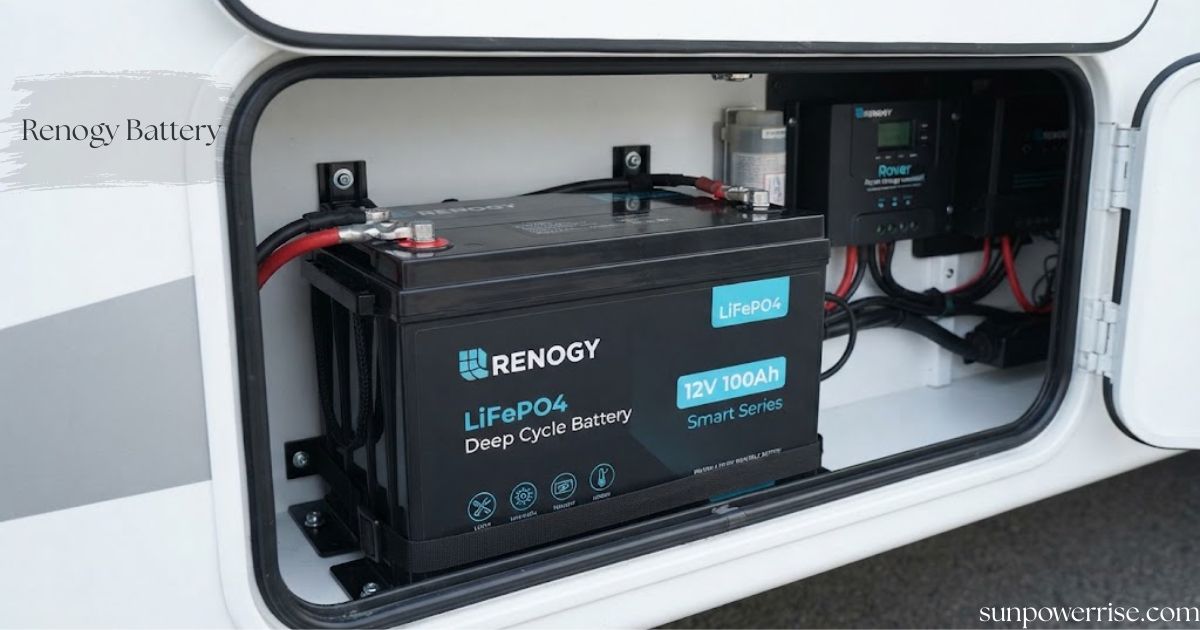
A Renogy battery is a lithium iron phosphate battery, or LiFePO4 battery, made by Renogy for off-grid power needs like RVs, campers, vans, cabins, and solar setups.
When I first picked up a Renogy battery years ago, I never expected to fall down a rabbit hole about battery safety. Lithium batteries power almost everything today, and a single battery fire on the news can turn power cells into perceived time bombs, sparking a heated debate among owners.
UL Solutions has tracked nearly 16,000 lithium-ion incidents worldwide since 1995, and most trace back to thermal runaway caused by electrical faults, short-circuit events, over-discharging, sustained vibration, mechanical stress, manufacturing defects, or improper use, where hidden damage quietly builds toward a failure event.
Renogy Battery Pro Specifications
Renogy batteries use a built-in battery management system (BMS) for battery safety, offer strong cycle life, and include features like IP67-rated shells, heating pads for cold weather performance, and models ranging from standard lithium batteries to newer solid-state batteries in the Pro S1 series.
That’s why Renogy Pro batteries rely on layered protections and disciplined manufacturing instead of a single fix. My own 100 amp hour unit, a smart lithium iron phosphate battery, ships with an activation switch and long terminal bolts, built from high-quality cells rated for 4000 cycles and a 100 amp continuous discharge current for real-world use.
Renogy Pro Batteries
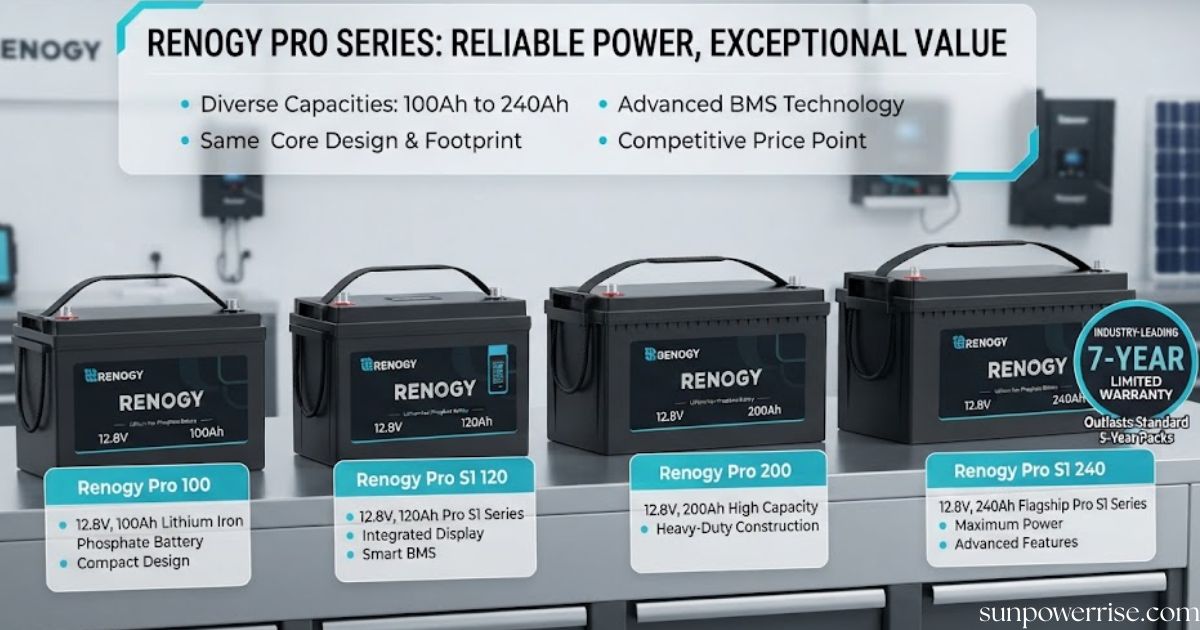
Renogy’s lineup covers plenty of ground, from the entry-level Pro 100 and Pro 200 up through the Pro S1 120, Pro S1 240, and the newer Pro S1 20, each priced at a genuinely competitive price against a third lithium battery on the market.
Across the whole line, renogy batteries share the same core design language, so a 12.8V battery rated at 240 amp hour or 100 amp hour slots neatly next to a 314Ah liquid state battery or a 300Ah battery in the same footprint, and a 240Ah battery at $869.99 still beats a standard warranty pack once you weigh in the extra cycle life value Renogy backs its top models with a 7-year limited warranty, well past the usual 5-year warranty window.
Electrolyte Levels in Semi-Solid Packs
On the other end sits a 12.8V 240Ah pack that blurs the line between a liquid-state battery and a semi-solid state battery. A true solid-state battery would carry 0% electrolyte, while newer packs sit closer to 5% electrolyte or 25% electrolyte for older chemistry, and Renogy’s own version lands near 10% electrolyte.
Call them solid-state batteries if you like, since the whole industry does the same, and understand that this semi-solid state shift matters for anyone comparing lifespan and power cells across brands, as Cade explains in one of Renogy’s own walkthroughs.
1. Solid-State / Semi-Solid Cell Technology
The Pro S1 series carries solid-state cell technology built around a semi-solid approach, and Renogy avoids pretending it has reached a unified definition the whole industry agrees on. There is no industry-wide solid-state certification yet, since testing conditions still vary company to company, but the safety credentials speak for themselves through CE, FCC, RCM, R10, and UN38.3 approval for safe transport.
Hybrid Design & Reduced Electrolyte
Under the hood sit hybrid solid-liquid cells made from oxide polymer solid materials, cutting the flammable liquid electrolyte load from 35% by weight in traditional lithium-ion cells down to roughly 10% by weight, a 70% drop in electrolyte percentage that lowers the odds of ignition or explosion during damage scenarios like punctures.
LiFePO4 Chemistry & Low-Temp Charging
Paired with proven lithium iron phosphate chemistry, also known as LiFePO4, used instead of older lead-acid alternatives, this semi-solid materials approach on the Renogy 12.8V 240Ah solid-state battery brings improved stability and lets it charge at lower temperatures without drama.
Market Availability
Different brands take different technical routes under this umbrella term, but Renogy’s method balances manufacturability with availability, since mass-produced solid-state packs still need to reach real customers, not just lab shelves.
2. Cold Weather Performance
Anyone who has parked an RV or camper through a frosty night knows cold weather performance decides whether the morning coffee happens on time.
Self-Heating
The Pro S1 240 carries an onboard heater and a proper heating pad inside its IP67 case and steel case build, and it restores battery temperature and cell temperature back above freezing roughly 70% faster than rival self-heating batteries.
Most liquid-state lithium iron phosphate batteries refuse to charge below the freezing point, usually needing heaters to climb past 32°F or even 42°F before accepting current, while this pack keeps working down to minus 4°F, or minus 20°C, thanks to its self-heating capability.
Its storage temperature rating sits far below the typical 23°F mark too, so leaving it plugged in through winter isn’t required, and it still performs at low temperatures other packs simply cannot handle.
3. Durability / Casing / Environmental Protection (IP67)
Durability starts on the outside, and Renogy leans on IP67-rated shells to block water and dust completely, making the pack both waterproof and dustproof for environmental protection in any outdoor battery box.
Salt air destroys cheap batteries fast, so passing salt spray tests matters a lot if you live near coastal environments where corrosion eats through weak seals within months.
Renogy calls its build an adaptive case, and while most rivals settle for plastic casing, the metal casing and steel case options here feel closer to an armoured battery than a consumer product, staying thermally stable, fire-resistant, impact-resistant, and offering real puncture resistance for year-round durability.
4. Vibration Resistance / Mobile Install Stability
Mobile install stability is where a lot of budget batteries quietly fail once the road gets rough. Renogy battery uses metal bracing to keep cells secured and hold their alignment, giving superior strength compared to plain foam, which loosens with time and creates loose connections.
Every pack ships with pre-drilled bottom holes for mounting brackets, and it passes vibration tests that beat normal industry standards, so whether you’re deep into van life, chasing overlanding trails, running an off-road rig, or just bouncing down a rutted backroad, the cells stay right where they belong.
5. BMS / Safety Protections
Inside every pack sits a battery management system, or BMS, and Renogy’s version skips the one-size-fits-all approach many rivals still rely on with only 10 to 20 protections.
Its Intelligent Power Armour technology stacks 60 safeguards grouped by risk levels, covering overcharge protection, overdischarge protection, thermal protection, and current protection against overcharging, over-discharging, and over-voltage.
MOSFET switches normally interrupt abnormal current flow during a short circuit, but standard fuses react too slowly if those switches fail, so active backup protection brings in self-control fuses that fire within seconds anyway. On top of that layered defence, Bluetooth and CAN bus connectivity let you watch electrical faults in real time, and the whole system carries a 7-year limited warranty for genuine peace of mind.
6. Cycle Life
Cycle life tells you how long a battery actually survives real use, and Renogy’s top pack rates at 6000 cycles to 80% depth of discharge, well past the 4000 cycles you’d expect from a standard liquid battery built with less than the best cells.
Run it at full 100% depth of discharge and you still land near 20,000 cycles at lighter loads; if daily habits stay closer to 40% usage, expect even more life before any replacement rate kicks in.
That works out to a 50% greater cycle life than typical competitors, meaning two of these packs can outlast three ordinary ones across a theoretical 12,000-cycle comparison a massive jump up from something like a Renogy deep cycle agm battery 12 volt 100ah, which simply can’t compete with lithium chemistry on cycle count.
7. Discharge Current / Power Output
Raw power output separates a hobby battery from one that can run real appliances, and this pack delivers 240 amps continuous discharge current alongside continuous power of 3,000 watts without breaking a sweat.
Push it briefly and it handles 450 amps for 30 seconds, which covers sudden appliance startup spikes most packs choke on. Compare that to the smaller unit’s 100 amp continuous discharge current, and you can size your setup based on actual discharge current needs rather than guesswork.
8. Closing / Contact Info
No energy system for RVs or any mobile off-grid living space is ever completely risk-free, but smart design and correct installation cut that risk down a lot. If questions come up about compatibility or sizing, Renogy’s service team stays reachable, and the official website has details on every pack built for long-term reliability.
FAQs
Is Renogy a good battery brand?
Yes, Renogy builds lithium batteries with layered protections, a strong battery management system, and year-round durability, backed by real cycle life and a 7-year limited warranty.
Is Renogy a Chinese company?
Renogy designs its products in the USA but manufactures many Renogy batteries, including the lithium iron phosphate battery line, through factories in China, like most global battery brands do.
How long do Renogy battery last?
Most Renogy batteries offer 4000 cycles, while newer solid state batteries like the Pro S1 series reach up to 6000 cycles, giving genuine long-term reliability for years of honest use.
Where are Renogy batteries made?
Renogy batteries are made primarily in China using high quality cells, then tested against safety credentials like UN38.3, CE, and FCC before reaching customers worldwide.
Is Renogy better than Eco-Worthy?
Renogy generally wins on battery safety, BMS sophistication, and cold weather performance, though Eco-Worthy can feel like the friendlier budget pick for smaller, simple setups.
What are the top 3 battery brands?
Renogy, Battle Born, and Victron are widely seen as leaders, each praised for solid battery management system design, strong cycle life, and dependable off-grid power performance.