
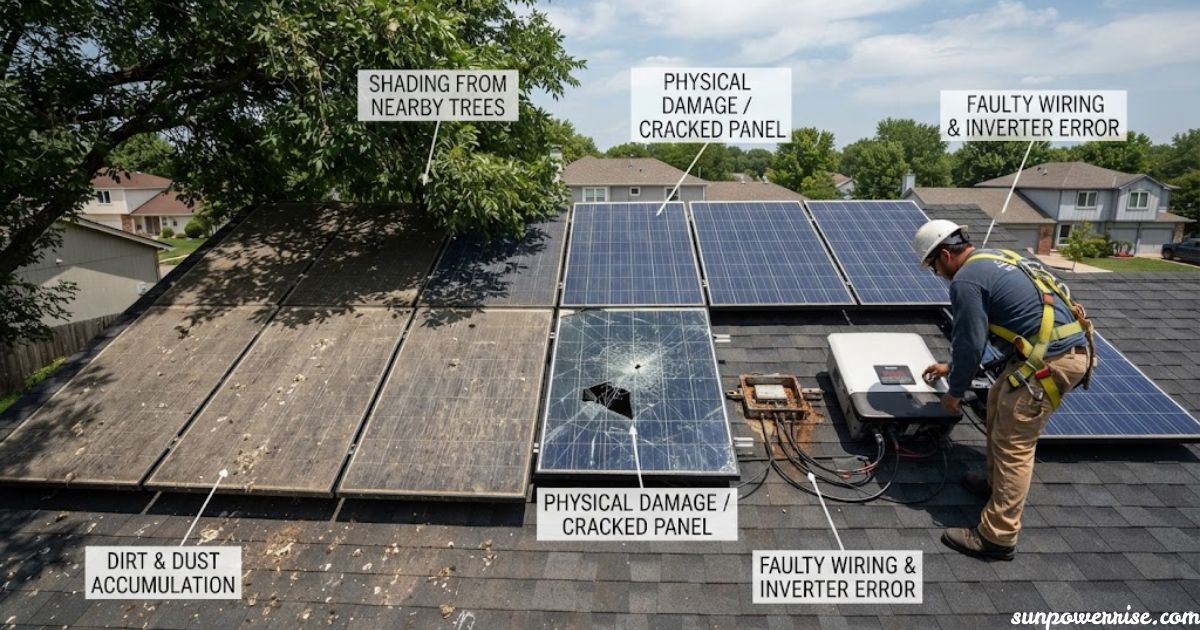
Problems with solar panels simply refer to the general category of faults, defects, and performance issues that can affect any solar PV system.
Anyone who has owned an array for more than a year knows that problems with solar panels rarely show up all at once; they creep in quietly. I’ve walked more roofs and fields full of solar arrays than I can count, and one thing never changes: panels look simple from the ground, but small, quiet issues build up underneath the surface.
This guide walks through the real, everyday problems with solar panels that owners run into, written the way I’d explain it to a neighbour over a fence, not the way a textbook would.
Problems With Solar Panels
Problems with solar panels on flat roofs refer to the specific set of issues that affect solar arrays installed on flat, low-slope roofing as opposed to problems seen on pitched or sloped roofs. Flat roofs don’t naturally shed water or debris, and panels usually sit on ballasted mounts rather than being bolted through the roof.
Physical Damage & Wear
Every panel starts life going through PV module production, and even with strict testing standards, tiny hairline fractures can slip through unnoticed.
Micro-Cracks
During transit and shipping, rough handling at any stage can stress the glass, and careless handling on site during installation does the same damage in seconds. These micro-cracks hide from the naked eye, which is exactly why proper electroluminescence imaging, often shortened to EL imaging, exists as the only honest way to catch them before they spread.
Temperature Changes
Once a crack forms, environmental factors take over the story. Temperature changes and everyday weather push the panel through constant thermal cycling, expanding and contracting the glass with every warm afternoon and cold night through the UK seasons.
This slow heating and cooling widens the crack bit by bit, shrinking the effective cell area and quietly reducing energy output. Panels built from conventional solar cells and conventional panels feel this the most, because their quality and material degradation resistance simply weren’t designed with this kind of daily stress in mind.
Storms bring their own trouble too. Storms, hail, and general extreme weather conditions, alongside typical UK weather conditions, can chip and stress roofs as well as the panels sitting on them, and falling debris after a bad night is common.
Visual Inspection
A visual inspection after any rough weather is worth the ten minutes it takes, especially since damage is rarely visible from the ground. Once cracked, a panel usually can’t be fixed, and it gets replaced rather than repaired, which is why I always tell people to check the MCS-approved status of their kit and work with an MCS-certified installer in the first place.
Hot Spots
Picture a single bird dropping sitting on one cell for a week. That small patch blocks light, causes partial shading, and triggers localised overheating in that one spot. This is what people mean when they talk about hot spots, and it’s genuinely one of the most common headaches in the industry.
Bird droppings, general dirt accumulation, and even hidden cell defects or outright structural defects in the cell architecture all lead to the same outcome: heat building up where it shouldn’t.
Here’s the mechanism, in plain terms. When current meets resistance in that damaged patch, it creates current resistance that has nowhere to go, so excess heat and intense heat build up fast.
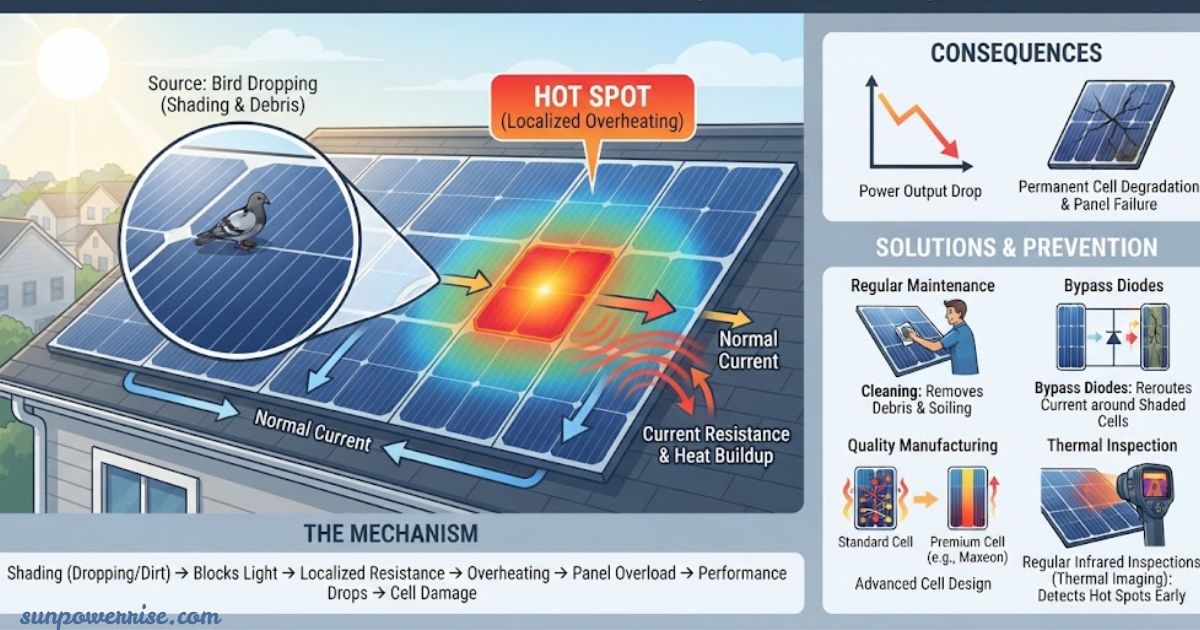
The panel becomes overloaded, its energy production pathways get disrupted, and its power output drops along with its overall panel performance. Left alone, a hotspot causes permanent damage to the surrounding cell temperatures, and in bad cases the panel becomes irreparable and needs to be replaced entirely; there’s rarely a middle ground once it reaches that stage.
The good news is that the fix starts with the basics. Regular maintenance, clearing surface debris and soiling, keeps most hot spots from ever forming. For the shading side of things, a working bypass diode or a full set of bypass diodes reroutes current around the shaded cell so the damage doesn’t spread through the panel like a chain reaction, avoiding wider section shutdowns.
Inverter Faults
If solar panels are the lungs of your system, the inverter is the engine it takes raw DC power from the roof and handles the entire electricity conversion into usable AC electricity for your home. Because it works constantly, it deals with real thermal stress, and it’s sensitive to grid disturbances coming in from the wider network.
Over the years, older units especially suffer from capacitor degradation, and things like grid isolation failures and general overheating become more common the longer the unit runs, particularly in cramped plant rooms with poor airflow.
You’ll usually get warned before total failure. Watch for strange error messages, flashing warning lights, a stuck blank display, or output that suddenly drops to zero generation these are the clearest signs something’s wrong.
Loose connections and tired wiring cause a good share of these issues too, so a simple visual check of the cabling around the unit catches problems that would otherwise turn into minor issues becoming expensive repairs down the line.
Because inverters typically run for 10-15 years, they’ll often need replacing at least once during the life of your commercial solar PV system. Investing in high quality equipment from day one, paired with system health checks roughly every 3-5 years, stretches that lifespan further than most people expect.
Wiring & Electrical Issues
Behind every panel sits a web of cabling, and it ages faster than most people realise. Corrosion, oxidation, and simple loose connections creep in over time, and moisture getting into a joint speeds the whole process up.
Out in the open, rats and other pests aren’t shy about chewing through insulation, and this kind of rodent damage turns up constantly at ground mount sites where cabling runs closer to the ground.
Left unchecked, corroded connectors and general wiring faults don’t just cause decreased generation they create real safety risks. Arc faults are the headline concern here, since they’re a documented cause of solar-related fires, and any fault touching electricity production deserves urgent attention rather than a wait-and-see approach.
The DC connectors, commonly known as MC4 connectors, take a beating from UV radiation and constant temperature cycling across the seasons, and poor installation at the outset makes every one of these problems worse.
My rule of thumb is simple: never DIY this part. DIY electrical work and a casual DIY repair on electrical wiring are two of the fastest ways to turn a small fault into a genuinely dangerous one.
Soiling & Reduced Energy Output
This is the one nobody notices until their bill goes up. A thin layer of dirt builds on the panel surfaces over weeks, and general dust, pollen, and even patches of lichen settle in and cause real sunlight blockage.
Add bird droppings, and you get classic soiling that quietly grows into measurable soiling losses, sometimes cutting electricity generation by 10-25% before anyone thinks to look up.
Location makes a big difference here. Homes near coastal areas, close to agricultural land, or downwind of chimneys and buildings in urban pollution zones see faster panel degradation and efficiency reduction.
Across the UK, weather plays its part too: rainfall followed by dry spells leaves behind stubborn mineral deposits that plain rain won’t wash off on its own.
The fix, honestly, is routine rather than clever. Regular cleaning every 12-18 months keeps most of this at bay, and a simple visual check for new shading issues from nearby trees that have grown taller, needing trimming, to structures nearby stops shading changes before they cost you real reduced output.
Watching your inverter or monitoring platform daily helps you notice a dip in system performance the moment it happens, especially if you live somewhere with high pollution, because catching it early is always cheaper than catching it late.
Shading, Pests, Birds & Vegetation
Wildlife causes more problems with solar panels than most people expect. Birds love nesting underneath array structures, and rodents chewing cables is a genuine, recurring cause of failure it’s not an exaggeration to say animal interference ranks among the top field complaints I hear.
Rabbits gnaw at cable insulation, foxes dig in for shelter, and once any creature finds a comfortable nesting habitat under the array, it tends to stay.
Vegetation tells a similar story. During UK spring and UK summer, grass and scrub grow fast, and vegetation shading creeps across the lower rows of a ground mount arrays setup before anyone trims it back. This creates its own hot spots, feeds into a wider ground mount problem, and adds to overall performance loss across the system.
Elsewhere, HVAC installations, communication masts, and other roof equipment installed after the fact bring unexpected shading design issues into the mix, sometimes wiping out generation through the string effect even when the shadow itself looks small.
Prevention
Prevention here is refreshingly practical. Fitting bird mesh early, ideally as part of the original solar panel installation, keeps birds nesting from ever starting and make solar bird proofing.
Roof-Related Issues
Flat Roofs
Not every roof behaves the same way under solar. Flat roofs and metal roofs generally offer the easiest path to sun exposure optimization, while tiled roofs and hip roofs bring extra installation requirements and a few installation challenges along the way none of which rule them out, but all of which need a skilled professional to plan around properly.
In fact, problems with solar panels on flat roofs tend to look different from pitched-roof issues altogether, since flat surfaces trade easier access for their own set of drainage and mounting headaches.
Commercial Roofs
Structure matters just as much as roof type. On warehouse roofs and industrial roofs, standing water collecting near mounting feet speeds up mounting system corrosion, and this slowly threatens the structural integrity of the entire array. Rainwater pools forming around racking systems make the problem worse over time.
Where ballasted panels avoid piercing the roof membrane, some setups instead rely on mechanical fixings, and if these are fitted badly, or the membrane simply ages, you end up with real water ingress and roof membrane penetration into the building fabric below a pattern that shows up again and again wherever problems with solar panels on flat roofs get reported.
FAQs
What is the biggest problem with solar panels?
The most costly problems with solar panels are the ones you can’t see micro-cracks, hot spots, and inverter faults quietly eat away at your energy output long before your bill shows it.
What are the cons of getting solar panels?
Beyond the upfront cost, owners deal with soiling, shading issues, wiring faults, and gradual panel degradation, plus the ongoing need for maintenance to protect system performance.
What are the five most common problems with solar panels?
The top five are micro-cracks, hot spots, inverter faults, wiring issues, and soiling. Each one chips away at energy output if left unchecked, and they’re problems with solar panels every owner will eventually face.
What are the signs that my solar panels are faulty?
Watch for a sudden drop in energy output, strange error messages on your inverter, visible discoloration or cracks, and unusually high energy bills. These are the clearest warning signs of trouble.