

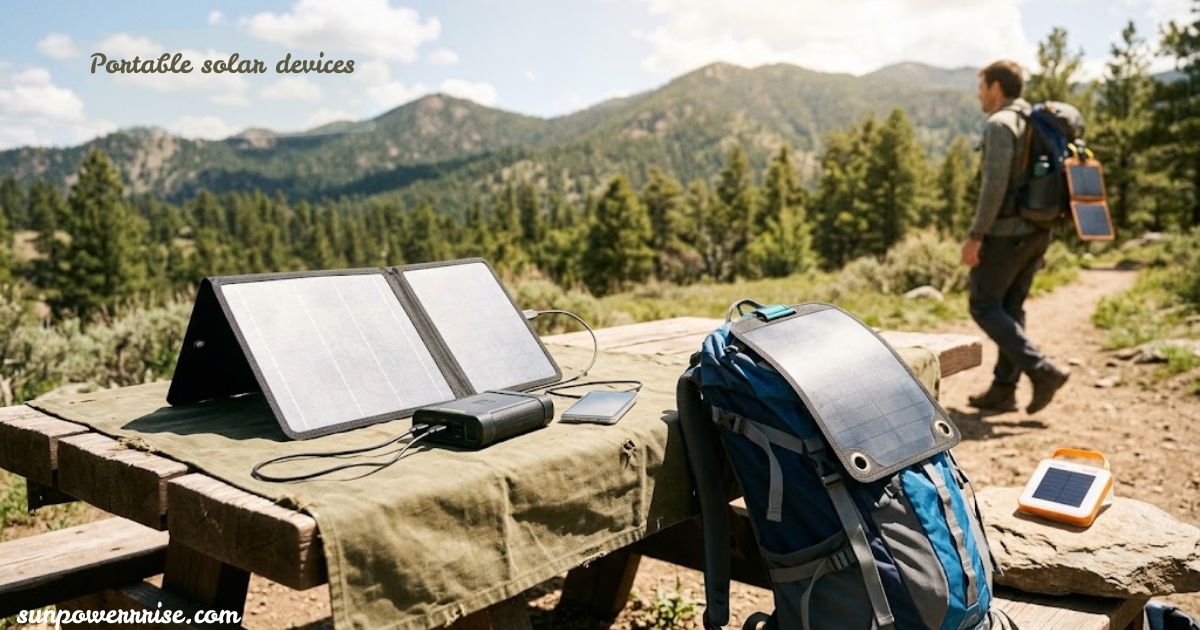
Anyone who has ever watched a dead device die in the middle of a hike knows why portable solar devices matter, and that curiosity is exactly what pushed me to dig deep into a full round of charging tests covering eight panels across 14 criteria, including price, protection, handling, and raw charge speeds under both sunny and overcast conditions.
Choosing the right portable solar devices really comes down to matching the panel to your lifestyle, whether that’s daily commuting or full-time van life.
Portable Solar Devices
Big Blue 28W Solar Charger
At $70, the Big Blue stands out with its 28 watts of maximum wattage spread across three ports with 12 watts per USB-A port, and its real standout feature shows up in low-light charging, where it produced 2.4 watts even in shadow, well above the average of 1.63 watts recorded on a bright day.
Among budget-friendly portable solar devices, this one earns its place simply by handling both direct sun and shade without falling apart.
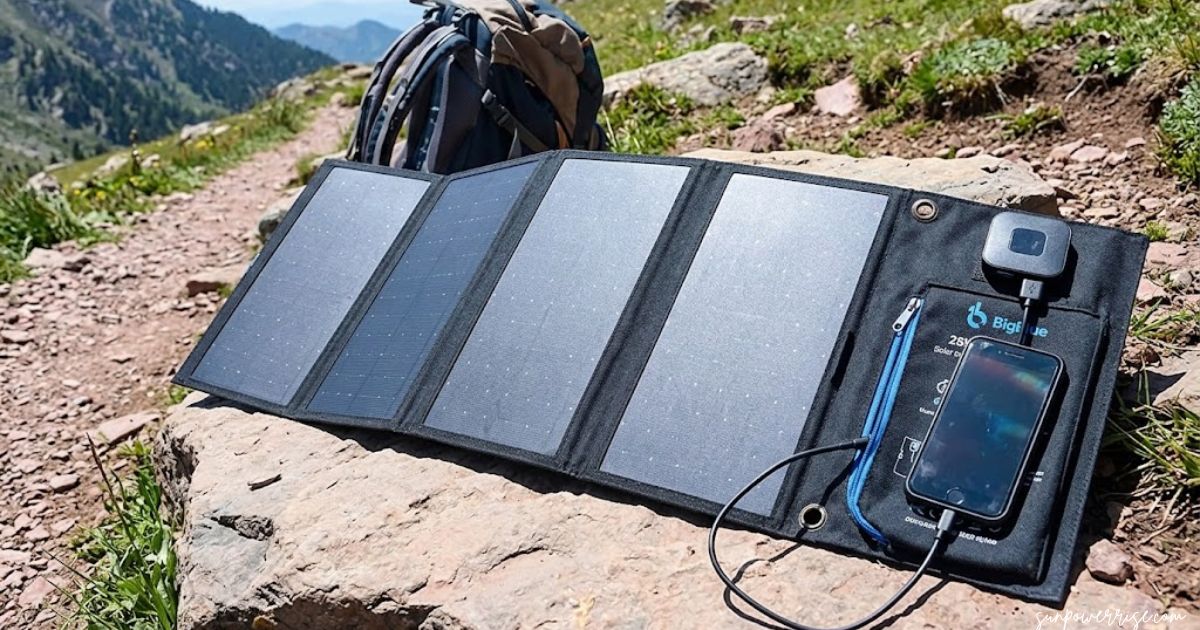
During overcast days, it managed 8 watts, and it hit its single-port wattage ceiling near 55 kilolux, the kind of early morning sun most people underestimate; thanks to four panels working together, it kept charging even with covered panels.
This solar charger folds flat because of its canvas-like material, ships with a USB-A to USB-C cable and four carabiners attached to metal grommets, and needs a moment to warm up before reaching full charging speed, a small trade-off I’d happily accept given how much environmental protection it still delivers for the price.
X Dragon XD-SP001
The X Dragon XD-SP001 costs $120, a steep price for a maximum output of 70 watts, split between two ports rated 12 watts each through its USB-A ports and a DC output delivering 54 watts, which means a chunk of energy goes unused unless you tap the DC output heads for a car battery through the included car battery clamps.
With nine panels folding into one unit, this panel struggled in direct sun, producing only 1.9 watts, yet it thrived during overcast and midday sun, quickly hitting 12W max on both ports, and its ability to daisy-chain with other units adds real functionality despite the risk of total shutdown if a third of the panels get blocked.
This is one of the few portable solar devices I’ve tested that lets you combine multiple units for serious off-grid power. Weighing 1500g, it still folds compactly, arrives with a carrying pouch, USB cables, rope-based carabiners, and a canvas fabric shell rated only IPX4.
Jackery Solar Saga 40W Mini
The Jackery Solar Saga 40W mini panel ranks as the toughest panel in the lineup thanks to its IP68 waterproof rating, and it delivers strong charging speeds in direct sunlight while slowing down noticeably during overcast conditions.
It comes with a long cable for flexible setup, landed just outside the top three, and at $150 feels genuinely expensive, which is the only reason it finished ranked fourth instead of higher on price alone. If durability tops your list of priorities in portable solar devices, this one is hard to beat despite the higher cost.
Flex Solar S20
The Flex Solar S20 sits under $50 and stays super light, making it easy to toss in a bag without a second thought.
With only two panels on board, it delivers limited power, so it works best as a quick top-off rather than a primary charging source. It’s proof that not all portable solar devices need to be expensive to be useful.
Goal Zero
Goal Zero simply isn’t worth the money at $140, since it charges terribly compared to almost everything else tested. It’s an expensive option that doesn’t earn its keep, and I’d skip it entirely if given the choice again.
Reno-G 30W Portable Solar Panel
The Reno-G portable solar panel costs $75 and pulls off 30 watts, split cleverly between an 18W USB-A port and a 20W USB-C port, the only panel in the group offering that much through USB-C, and this balance of price performance, and usability earned it the clear winner title with a lower score of 2.4, far ahead of rivals sitting between 3.4 and 3.6.
Out of every set of portable solar devices I reviewed, this is the one I’d recommend first to a beginner. In shadow, it tied the leading numbers at 2.4 watts, climbed to 9 watts in overcast weather, and reached close to 20 watts during midday sun, well above the 3W average, though plugging in two devices at once means neither reaches max speed.
Its biggest flaw is a complete shutdown the moment two panels covered block the array, and while its protection rating of IP54 blocks dust and handles a light splash, it can’t take much more, yet the roomy pouch.
Bluetti PV420 Solar Panel
The Bluetti PV420 solar panel delivers 420 watts of output through four panels joined as one large panel unit, coated with ETFE to fight yellowing and boost efficiency to a leading 23.4%, and it folds down using metal legs with snap settings at 35 degrees, 45 degrees, and 55 degrees, plus a flat position for storage.
It comes with a water-resistant zipper pouch, a thick cord stretching 10 feet, and pairs with a 20-foot extension cord ending in MC4 connectors, connecting straight into a power station like the AC200P, with grommets allowing it to hang from a vehicle, wall, or barn.
Output climbed from 80 watts and 83 watts up through cloud cover to 230 watts, then 240 watts, and finally 300 watts to 325 watts by 10:54 am, even without full sun, and while it isn’t built for a full downpour, it holds up fine against light rain thanks to that highest-efficiency.
Heavy-duty setups like this show just how far portable solar devices have come in terms of raw output and reliability.
FAQs
Do portable solar panels actually work?
Yes, portable solar panels genuinely deliver real power, and after testing several units in both sunny conditions and overcast conditions, I can say they truly rescue you when your dead device needs life again.
What is the best portable solar system?
Based on price performance usability, the Reno-G portable solar panel stands out as the clear winner, offering strong charging speeds and reliable maximum wattage for the cost.
Is there a portable solar system?
Absolutely, options like the Sun Jack 60 Watt solar panel and the Bluetti PV420 solar panel prove that a complete off-grid portable solar system is very much real and ready to use.
What are some uses for portable solar panels?
They’re perfect for camping, backpacking, hiking, outdoor adventures, and emergency preparedness gear, keeping your smartphone, laptop, and power stations charged wherever you roam.
What is the best portable solar panel in the UK?
While testing conditions vary, the Sun Jack 60 Watt solar panel remains a dependable, durable choice thanks to its waterproof, shockproof, and dustproof build suited for the UK’s unpredictable weather.