


Last month I needed a quick mm to in conversion for a small metal part in my workshop, and my ruler showed 50 millimeters. I stopped and asked myself, how many inches is that equivalent to? To convert millimeters to inches, I need two conversion factors, and I start with millimeters to centimeters.
Then I take the second step, centimeters to inches, and the answer appears. I use the same mm to in method when I convert in the other direction, from inches to millimeters. I always keep inches, centimeters, and millimeters labeled, and I start with a simple number like 50 so the math stays friendly.
Definition of Millimeter and Inch in mm to in Conversions
A millimeter is a metric unit of length, and its symbol is mm. It belongs to the SI, short for the International System of Units, and it equals one thousandth of a meter, or 1/1000 of a meter. Scientists link the meter to the distance traveled by light in 1/299 792 458 000 of a second, so the second shapes this standard too. People all over the world trust this unit of measure every day.
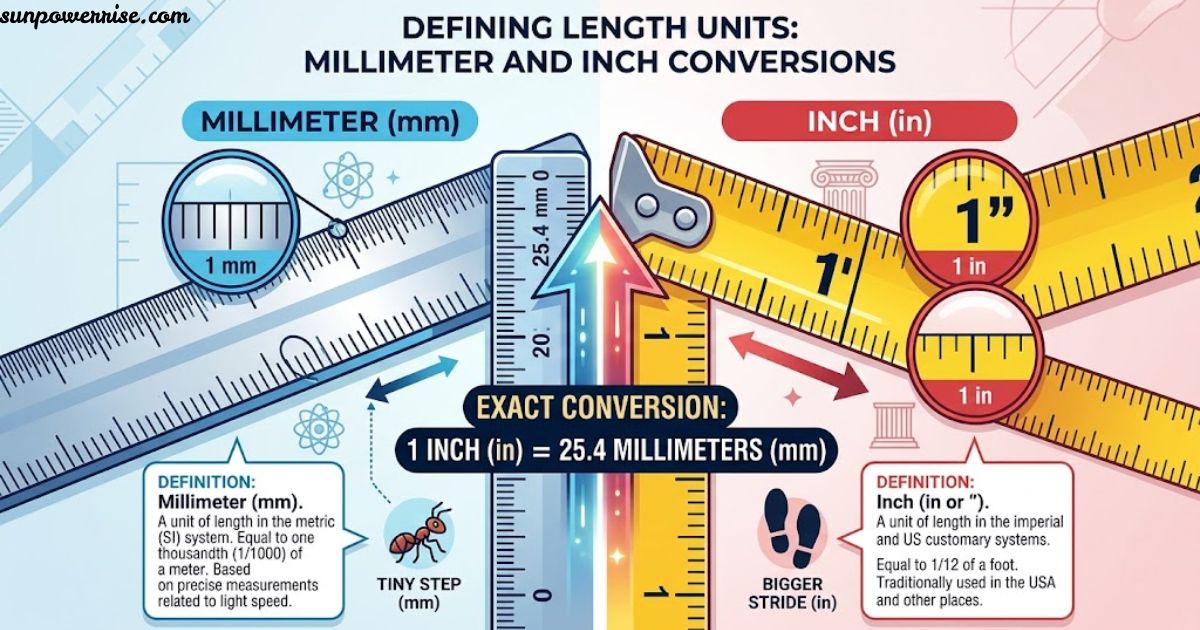
An inch is another unit of measure, and it belongs to the imperial and US customary systems. Most people in the United States follow the U.S. customary way of measuring. Its symbol is in, though I often draw a quotation mark after the number instead. In 1959, experts fixed one inch at exactly 25.4 millimeters.
You can count 12 inches in a foot and 36 inches in a yard, so the foot and the yard both rest on inches. I picture millimeters as tiny steps and inches as bigger strides.
Conversion Factor / Ratio (mm ↔ in)
The magic number for every mm to in job is 25.4, and people call it the conversion ratio. Some also call it the rate of millimeters per inch. One inch equals 25.4 millimeters, so every measurement links back to that single fact.
When I go from millimeters to inches, I divide by 25.4. When I go back, I multiply. I keep one simple rule in my head: I multiply to reach a smaller unit, and I divide to reach a larger unit.
The longer path uses two conversion factors. One centimeter equals 10 millimeters, and one inch equals 2.54 centimeters. I follow millimeters to centimeters first, then centimeters to inches, and I check that my inches, millimeters, and centimeters all line up.
How to Convert Mm in to Inches (Steps and Examples)
Let me show the long way with 50 millimeters. I write each conversion factor as a fraction. I put 10 millimeters on the bottom of the first one so the units cancel out. Then I set up the second fraction with centimeters on the bottom and inches on the top.
Next, I multiply the numbers on the top and divide by the numbers on the bottom. I divide 50 by 10, and I get 5. Then I divide 5 by 2.54 and reach 1.9685. I round that number, so 50 millimeters comes out approximately 1.97 inches. That second part of the trip is the classic centimeters to inches step.
The shortcut makes mm to in work faster, and I use it most days. With 95 millimeters, I divide 95 by 25.4 and get 3.74, so 95 millimeters equals 3.74 inches, or about three and three quarters of an inch. With 230 millimeters, I divide 230 by 25.4 and get 9.06, so I write 9.06 inches. A quick check with 25.4 keeps me honest every time.
Converting Inches to Millimeters
Now let me go the other way, which reverses every mm to in step. I take three inches and multiply by 25.4 to get 76.2 millimeters, or simply 76.2 on my notepad. For 12 inches, I get 304.8 millimeters, so I write 304.8. These inches to millimeters jobs feel easy once I trust the rule.
History and Origins of the Inch
The history and origin of the inch surprised me. The word comes from the Latin word uncia, which meant one-twelfth of a Roman foot. Old standards used barleycorns, and three grains of dry round barley laid end to end made one inch. Another idea came from the human thumb, where people measured the width of small, medium and large thumbs and then used averaging to find one length. Today the international yard sets the standards for the inch.
Defining the Millimeter
The milli- prefix belongs to the metric prefixes, and it means one thousandth of a base unit. So a millimeter is one thousandth of a meter. The definition of the meter changed over time. A prototype meter bar came first, and later scientists used the distance traveled by light. In 2019, they redefined the meter through the second, yet the millimeter stays constant.
Global Usage and Spelling Variations
For current use, the inch shows up in the United States, Canada, and the United Kingdom. Japan uses it for electronic parts and display screens, so people there run mm to in checks often. One last spelling note: millimetre with re is the official spelling, and writers use it often outside of the US, while American writers use er.
FAQs
How many inches are in 1 millimeter?
One millimeter equals about 0.0394 inches. That tiny number comes from dividing 1 by 25.4. Because a millimeter is one thousandth of a meter, you will usually work with bigger numbers like 50 millimeters, which equals 1.97 inches.
What is the formula for mm to in?
The formula is simple: divide the millimeters by 25.4 to get inches. For example, 95 millimeters divided by 25.4 gives you 3.74 inches. I use this conversion ratio for every mm to in job because it works every time.
How do I convert inches to millimeters?
Go the other way and multiply the inches by 25.4. Three inches times 25.4 equals 76.2 millimeters, and 12 inches equals 304.8 millimeters. A simple rule helps here: multiply to reach a smaller unit, and divide to reach a larger unit.
Why do some guides use 2.54 instead of 25.4?
Some guides take two steps and use centimeters in the middle. They first divide the millimeters by 10, then divide that answer by 2.54, because one inch equals 2.54 centimeters. With 50 millimeters, you get 5 first and then 1.97 inches, which matches the shortcut answer.
Is it millimeter or millimetre?
Both spellings are correct, but millimetre with re is the official spelling. Writers use it often outside of the US, while American writers prefer er. The symbol stays mm either way, so your mm to in math never changes.