


People searching for managed IT services Phoenix usually want one thing: an outside provider that runs daily technology work for a recurring fee. A managed service provider (MSP) monitors devices, answers staff tickets, and protects the network under one agreement. Small and medium-sized businesses (SMBs) in Phoenix, AZ often choose outsourced IT services because an in-house team costs more.
I read nine provider and directory pages while preparing this guide, and I noted only the services each page states. Seven belong to individual brands, and each brand offers the services listed on its own website. This article explains what to look for in a provider.
What do managed IT services include?
A managed plan usually bundles help desk support, proactive monitoring and maintenance, patch management, and cybersecurity. Providers add backup and disaster recovery and vendor management so one contact handles the whole environment. Confirm the written scope before you sign, because each provider words its bundle differently.
Behind the scenes, remote monitoring and management (RMM) software and a network operations center (NOC) watch servers and laptops around the clock. Technicians handle endpoint management, server management, network management, and workstation support from those dashboards. Good providers also keep IT documentation, IT asset management, and IT procurement records, so you always know what you own.
How do fully managed and co-managed IT differ?
Fully managed IT hands every task to the provider, while co-managed IT keeps your own staff and adds outside help. A company with no technician usually needs fully managed IT. A company with one or two employees in IT often prefers co-managed IT for after-hours coverage and extra tools.
Some providers also sell IT consulting, IT staff augmentation, or smart hands support, which sends a technician to a branch office for hands-on work. Compare these models with break-fix vs. managed IT, where you pay by the hour after something fails. I prefer providers that explain the split of duties in writing, because unclear roles slow down every ticket.
What daily support should a provider handle?
Expect a live help desk technician by phone or chat, remote IT support, and on-site IT support when hardware fails. Phoenix IT support teams also run accounts through Microsoft 365 management and Google Workspace management. Ask how quickly a person, not a bot, answers.
Daily work also covers employee onboarding and offboarding, mobile device management (MDM), and a written BYOD policy for personal phones. Many providers add VoIP business phones and managed print services, so ask whether those sit inside the monthly plan. Each task looks small until a new hire starts without a working laptop.
On the network side, providers run a Wi-Fi site survey, configure a VPN, and review network security settings. New offices need structured cabling and low voltage cabling installed during the build. Server virtualization lets one physical host run several systems.
What cybersecurity services should a Phoenix provider offer?
Look for managed cybersecurity built on a security operations center (SOC), managed detection and response (MDR), and endpoint detection and response (EDR). These layers watch devices for attacks and respond when one starts. Add ransomware protection and multi-factor authentication (MFA) to that baseline.
Phishing remains a common way into small networks, so check email security, phishing protection, and security awareness training. Dark web monitoring tells you when stolen passwords surface, and vulnerability scanning finds weak spots before attackers do. Penetration testing and incident response cover the testing and recovery sides.
How do advanced security tools fit together?
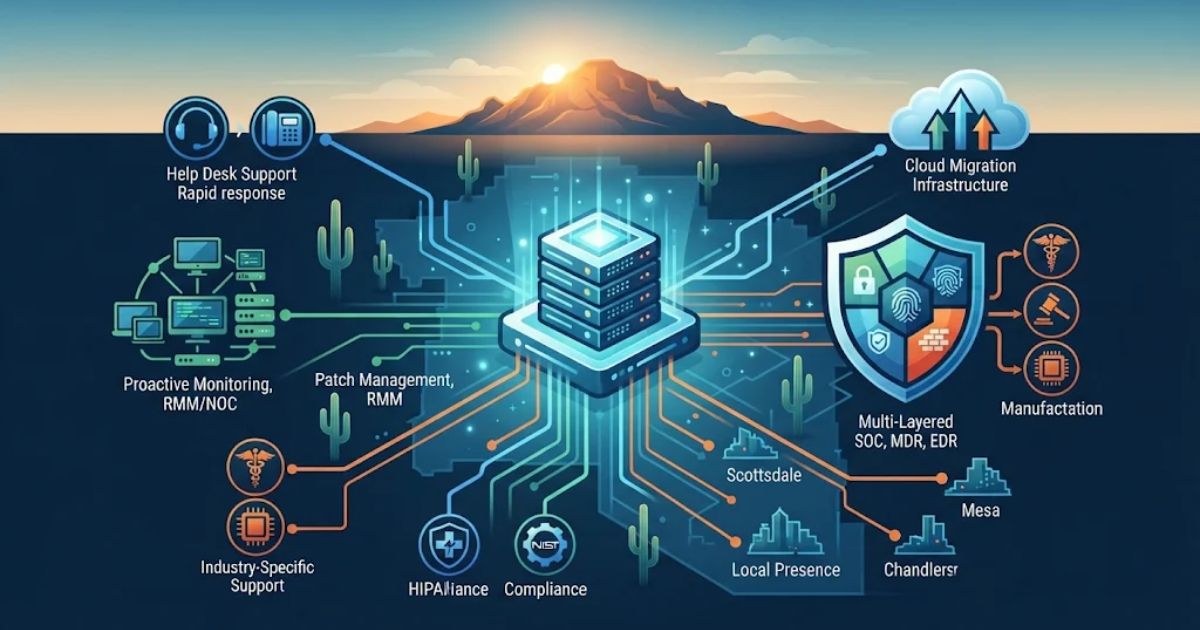
Advanced security tools work as layers, each covering a gap the others leave. A managed firewall filters traffic, security information and event management (SIEM) collects logs, and threat hunting searches for attackers that slipped past alerts. Together they form layered security, which engineers also call defense-in-depth.
Access controls matter as much as monitoring, so ask about zero trust network access, identity and access management, privileged access management, and single sign-on. A vCISO or cyber risk assessment shows where gaps sit, and data breach prevention plans turn those findings into tasks. Cyber insurance applications often ask which of these controls you run, so keep the answers handy.
How do cloud and backup services protect an office?
Cloud migration moves files and applications off aging servers, and cloud infrastructure management keeps them patched afterward. Providers offer hybrid cloud, private cloud hosting, Microsoft Azure, and Amazon Web Services (AWS) options. Virtual desktop infrastructure (VDI) lets staff open the same desktop from any location.
Backup and disaster recovery deserves the closest read of any contract. Ask about immutable backups, restore testing, and disaster recovery as a service (DRaaS), plus continuous data replication and point-in-time snapshots for fast rollbacks. A business continuity plan then sets the order you restore systems, and a battery backup (UPS) keeps equipment running through short outages.
Phoenix weather tests this setup every summer. Extreme heat, monsoon storms, and dust storms strain cooling and clog equipment, and power surges and outages follow. ERGOS notes that Phoenix stayed at or above 110 degrees for 31 straight days in 2023, so plan for it.
Which compliance rules affect Phoenix businesses?
Your industry sets the rules, and the rules differ by business type. Healthcare follows HIPAA compliance, defense suppliers follow CMMC readiness and NIST 800-171, and card payments fall under PCI DSS. Providers turn these rules into regulatory compliance tasks that you can assign, track, and review.
Vendors selling to larger companies often pursue SOC 2 or ISO 27001, and financial firms face SOX compliance, FINRA, and the FTC Safeguards Rule. The NIST Cybersecurity Framework works as a default when no outside rule applies. Healthcare groups sometimes add HITRUST, and vendors for Arizona public agencies may meet GovRAMP or FedRAMP requirements.
Arizona gives businesses 45 days to notify residents after a confirmed breach, so the Arizona data breach notification law belongs in every incident plan. A compliance gap analysis, audit-ready documentation, and compliance controls and evidence show auditors what you run. Governance, risk, and compliance (GRC) work keeps those records current instead of forcing a scramble before each review.
Which industries and areas do Phoenix providers cover?
Providers in the Valley of the Sun serve healthcare and medical practices, dental practices, law firms, and accounting and CPA firms. Financial services, registered investment advisors (RIAs), and manufacturing clients also appear on provider pages. Each brand lists its own industries, so check that yours appears.
Semiconductor suppliers, aerospace and defense contractors, construction firms, and real estate teams each face different security and access demands. Nonprofits, K-12 and education groups, government vendors, automotive dealerships, and oil and gas operators round out the list. Verify each industry on the brand’s own site before you assume coverage.
Coverage also depends on where an office sits in the Greater Phoenix area. BlueKey IT lists Scottsdale, Tempe, Mesa, Chandler, Gilbert, Glendale, and Peoria as nearby service cities, and ERGOS groups clients by areas such as the Camelback Corridor and Downtown Phoenix and Midtown. CompassMSP calls the region’s chip-making cluster the Silicon Desert, so manufacturers there should read its page.
Which Phoenix providers publish managed IT services?
Netirio, Nuvodia, Intelligent Technical Solutions (ITS), ERGOS, CompassMSP, TrueNorth ITG, and BlueKey IT each publish a Phoenix page. Each brand offers the services listed on its own website, so confirm details there before you call. Cloudtango and Jumpfactor, two comparison sites, help you cross-check them.
Their Phoenix offices sit in different parts of the Valley: Netirio on South 16th Street, Nuvodia on North 25th Avenue, ITS on North 16th Street, ERGOS on East Missouri Avenue, CompassMSP on North 28th Drive, and BlueKey IT in Mesa. TrueNorth ITG lists Texas and Washington addresses and no Phoenix office. Cloudtango’s Phoenix page lists providers with company size and partner details, and Jumpfactor’s guide compares eleven providers.
What does each brand confirm on its website?
Each brand’s page confirms a specific set of services, and the lists differ from site to site. Netirio lists helpdesk support, patch management, backup and disaster recovery, and cloud infrastructure management. Nuvodia lists remote IT support, on-site IT support, managed detection and response, and disaster recovery.
ITS confirms a 24/7 help desk, ransomware protection, and compliance support for HIPAA, CMMC, and SOC 2. ERGOS confirms low voltage cabling, cloud migration, and managed cybersecurity with incident response. CompassMSP confirms a 24/7 security operations center, guidance from a virtual CIO (vCIO), and unified communications.
TrueNorth ITG confirms hybrid cloud, private cloud hosting, HIPAA compliance support, and EMR hosting for healthcare groups. BlueKey IT confirms workstation support, 24/7 security operations center monitoring, and smart hands support from its Mesa office. Direct any service outside these lists to the brand as a question, not an assumption.
How do I compare response times and service agreements?
Compare the service level agreement (SLA) line by line: first response time, time to resolution, first-call resolution, and uptime. Ask each provider for last year’s customer satisfaction (CSAT) score and its client retention rate. Vague promises count for little without numbers.
While reading these pages, I found that BlueKey IT publishes a one-hour first response for critical issues and eight hours for low priority, both measured in business hours, and Nuvodia states a 60-minute SLA for priority 1 issues. CompassMSP reports an average ticket response under 15 minutes, and ITS offers 24/7 emergency support. Quarterly business reviews should repeat those numbers every three months.
Ask whether the provider keeps a local presence with local engineers who can reach your office. ERGOS describes local technicians for on-site work, BlueKey IT sends technicians from its Mesa office, and CompassMSP describes U.S.-based support on its 24/7 service desk. Test that promise with an after-hours call.
How much do managed IT services cost, and is the fee worth it?
Providers price managed IT through a per-user pricing model, per device, tiered packages, or a flat monthly fee. Final numbers depend on users, devices, security tools, and compliance scope, so expect a quote after a no-cost IT assessment. I list no dollar figures here because each provider sets its own.
The fee pays off when it replaces repeated outages. The cost of downtime climbs quickly, and a vCIO builds an IT strategy and roadmap that lifts your IT maturity instead of repeating the same repairs. Companies that read the contract for onboarding plan details, provider handover steps, and exit terms handle switching MSPs without losing access to their own accounts.
CompassMSP describes a 30 to 60-day onboarding that starts with discovery and documentation. During any handoff, move admin credentials to accounts you own and revoke the old provider’s access the day it ends. I treat a provider’s refusal to document that process as a red flag.
What do people ask most about managed IT in Phoenix?
Is managed IT only for large companies?
No. Netirio states that it works with companies from 5 employees to more than 250, and Nuvodia’s menu lists small business, mid-sized business, and enterprise solutions. Small teams often gain the most because they rarely employ in-house technicians for nights and weekends.
Can a provider work alongside my own IT staff?
Yes, and many companies choose this route. Co-managed IT keeps your staff in place and adds help desk coverage, tools, or specialists where they need them. Netirio, Nuvodia, ITS, CompassMSP, TrueNorth ITG, and BlueKey IT each list a co-managed option on their sites.
How do I shortlist providers quickly?
Pick three providers whose pages name your industry, your compliance rules, and your part of the Valley. Compare their published response targets, then request a no-cost IT assessment from each. Write down every answer so you can compare them side by side.
Where can I find the right managed IT provider in Phoenix?
Start with the checklist in this article: services that each brand confirms on its website, response targets, security layers, compliance fit, and a local presence. Then use this website to compare Top Managed IT Services Phoenix, AZ, so your calls go to providers that match your needs. Visit the site, shortlist three providers, and ask each for an assessment.