


Licensed solar installers protect your roof, your wallet, and your safety, so the installer you pick matters more than the panel brand. This licensed solar installers in Durham directory guide shows homeowners how to check each solar company Durham NC offers before signing a contract. You will also learn what solar panel installation Durham projects involve, from permits to payback.
What makes a solar installer legally licensed in North Carolina?
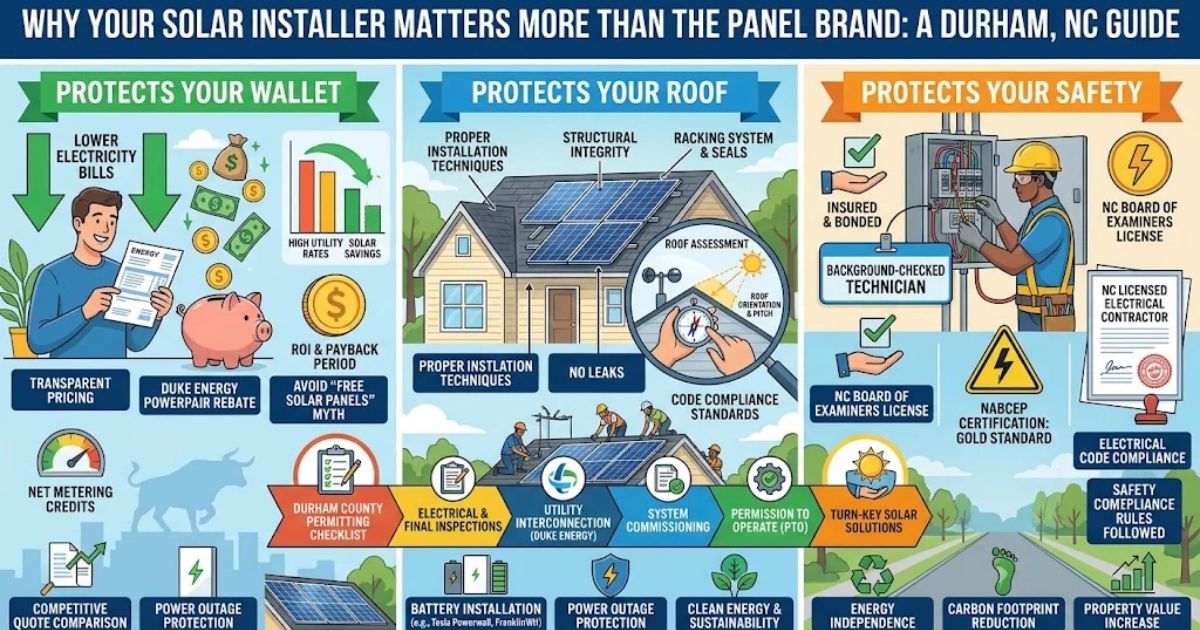
North Carolina requires an NC licensed electrical contractor for solar work, no matter the project’s price. The State Board of Examiners of Electrical Contractors issues that license after testing experience and knowledge. A certified solar contractor holds it, plus extra solar training that proves hands-on skill.
A general contractor license also applies when structural or other non-electrical work reaches $30,000. Ask for proof of being insured and bonded, too. Good crews send background-checked technicians who follow safety compliance rules and meet code compliance standards on every roof, steep or flat.
Do certifications matter if the installer already has a license?
Yes, because a license proves legal permission while NABCEP certification proves real solar skill. EnergySage calls the PV Installation Professional (PVIP) board credential the gold standard for installers. Check for both before you sign, and ask to see current copies of each credential.
Brand training counts too, since a manufacturer-certified installer knows each product’s rules, like a certified Tesla Powerwall installer or a FranklinWH certified installer. Southern Energy Management also displays Certified B Corporation status, an Energy Star partner logo, and a BBB accredited seal. Those marks help an established solar company back up its years of experience.
How do I find a trustworthy installer in a directory?
A Durham solar directory puts many installers on one page, so you skip hours of random searching. Each solar directory listing should show license details, services, service areas, and contact information. Use it to compare solar companies side by side before you request any visits.
Then start solar contractor vetting: read customer reviews, favor verified reviews, and weigh company ratings from Google, Yelp, and SolarReviews. Search solar installer near me and choose a local solar installer who answers calls fast and explains pricing plainly. A local solar company usually knows Durham’s permit office and Duke Energy’s process.
Who does the work, the company or a subcontractor?
Ask directly, because some firms hire subcontractors for part or all of the job. An in-house installation team keeps one company accountable from start to finish. Southern Energy Management, for example, says its own crews design and install every system.
Whoever climbs the roof, one solar energy company must stand behind the job with a workmanship warranty and a labor warranty. Request an equipment warranty for panels and inverters as well. Some firms add a performance guarantee that promises minimum output.
How does the process work from first call to finished design?
The solar installation process begins with a solar consultation, usually a short phone or video call. Southern Energy’s steps for going solar run discover, design, save, which keeps decisions simple. A solar educator explains the basics before anyone pitches you a contract.
Next, request a free solar assessment; many firms run a virtual solar assessment from satellite images, then send a free solar quote. A solar designer completes the site evaluation and builds a custom solar design with full system design drawings. Pick a company offering turn-key solar solutions, so one team handles everything.
How do permits, inspections, and utility approval work?
Your installer handles permit processing, but you should still know the sequence. Durham County and the City publish a permitting checklist for solar systems, and the county works to streamline approvals. Expect a building permit before work starts and an electrical inspection once the wiring finishes.
Next comes the final inspection, then a signed interconnection agreement that covers utility interconnection with Duke Energy. After system commissioning, you wait for permission to operate (PTO) before flipping the switch. A typical project timeline often runs two to four months, though installation day itself usually takes one to three days.
How do installers decide whether my roof works?
Installers run a shading analysis and study your roof orientation, roof pitch, and roof space before quoting anything. South-facing roofs with few trees usually perform best in North Carolina. Measured solar irradiance tells them how much energy each roof section captures across the year.
Most homes choose rooftop solar, but a sunny yard can host ground-mount solar instead. Roof mounting uses a racking system that bolts to rafters and seals against leaks. An older service panel may need an electrical panel upgrade first, so ask about that cost early.
What equipment and system size will I get?
A photovoltaic (PV) system uses solar panels, also called solar modules, plus an inverter and wiring. Most new homes choose monocrystalline panels because they deliver higher panel efficiency in limited space. Ask installers to name brands and models in writing.
Pick a solar inverter type: a string inverter costs less, while a microinverter or power optimizer handles shade better. Installers choose your system size in kilowatt (kW) by matching expected energy production, measured in kilowatt-hour (kWh), to your energy consumption. Ask for a written yearly estimate, then check it against last year’s bills.
Is adding a battery worth it?
Add solar battery storage if outages worry you or you want backup power after dark. A home battery backup keeps the fridge, lights, and Wi-Fi running while the grid sits down. That power outage protection matters most during extreme weather, like summer storms.
Popular picks include the Tesla Powerwall and the FranklinWH aPower, and a SPAN smart panel adds smart load management. Southern Energy says its battery installation crews have placed over 1,000 batteries across North Carolina. Most Durham homes keep a grid-tied system; a hybrid solar system adds batteries for energy resilience, while an off-grid system costs much more.
How much does solar cost in Durham?
The cost of solar panel installation varies with your roof, usage, and batteries. SunPower’s Durham page lists 5 kW systems at $12,000 to $20,850, a cost per watt of $2.40 to $4.17. Southern Energy reports an average solar cost of $39,000 for its typical 10.3 kW system with one battery.
Budget for the upfront cost first, then demand transparent pricing with every line item listed. Competitive pricing does not mean the lowest bid, so run a solar quote comparison across three written offers and ask each bidder to explain its assumptions. Ignore the free solar panels myth, because Durham installers do not give systems away.
How can I pay for solar?
You can pick solar financing options such as a solar loan, a solar lease, or a power purchase agreement (PPA). A cash purchase usually gives the best long-term savings, yet it demands the most money upfront. Ask each installer to show all four side by side, with monthly payments listed.
Zero-down solar financing lets you start with no upfront payment, but interest raises the total price. Leases and PPAs let the installer own the system and claim federal credits, which may lower your monthly rate. Compare total cost over 25 years, not just the first bill.
Is going solar worth it in Durham?
Often yes, because electricity bill savings grow when rising energy costs push utility rates higher each year. Your return on investment (ROI) depends on your bill, roof, and financing. A realistic payback period settles the question, so ask installers to calculate it for you.
Southern Energy cites a home value increase of $16,300 for an 8 kW system, which lifts your property value. Panels offer a 25-year panel lifespan and lose output through system degradation, typically under 1% per year. Run your own numbers on lifetime savings, because the ended homeowner credit stretches payback.
Is the federal tax credit still available?
Not for homeowners who buy a system outright today. The federal solar tax credit for residential buyers ended December 31, 2025, when Congress passed the One Big Beautiful Bill Act. The Inflation Reduction Act had set that credit at 30% back in 2022.
Businesses can still claim the 30% investment tax credit under Section 48E, and projects that start construction after July 4, 2026 must reach service by December 31, 2027. Owners also use MACRS depreciation and other business tax incentives. Churches and charities should ask about nonprofit solar incentives, since leases and PPAs can pass savings along.
Which utility and state incentives apply?
Start with Duke Energy PowerPair, which Southern Energy’s Durham page lists as open to eligible Duke Energy Carolinas customers who add a battery to solar. Rules shift often, so confirm before you sign. Your bill shows which NC utility serves your address.
Ask Duke Energy about the Duke Energy solar rebate and how net metering credits exported power. Beyond NC solar incentives, rural businesses can pursue a REAP grant through USDA rural energy funding. A licensed installer should explain each program in writing, including deadlines, because funding windows can close without warning.
What local laws and programs help Durham homeowners?
North Carolina’s solar access law, Senate Bill 670 from 2007, bars most bans on rooftop solar. A June 2022 NC Supreme Court ruling protects HOA solar rights, too, and stops associations from dictating placement that cuts output. Your HOA cannot block panels outright.
Durham County joined the City and nine other Triangle governments in Solarize the Triangle, a group-buy solar program that lowered prices. A low-income solar program with Yes Solar Solutions helps families too. These efforts support Durham County sustainability, City of Durham clean energy plans, and broader renewable energy goals.
Does Durham get enough sun?
Yes, Durham NC averages about 220 sunny days per year, above the US average of 205, according to Best Places data on Southern Energy’s page. June brings roughly 267 sunshine hours. That solar intensity supports strong output from a properly angled roof.
The same sun reaches the Triangle area, from Raleigh and Chapel Hill to Cary, the Research Triangle, and the wider Piedmont region. Durham County counted over 1,500 systems by August 2022, so neighborhood solar looks familiar in the Bull City. The North Carolina solar market ranks fourth among top solar states, per SEIA data Southern Energy cites.
FAQs
Can businesses, churches, and farms go solar too?
Yes, installers handle residential solar installation and commercial solar installation under the same licenses. Southern Energy lists solar for businesses, solar for nonprofits, solar for churches, solar for farms, and multifamily solar. Ask each installer which project types it completed, and request local examples.
Builders can plan solar for new construction from day one. Southern Energy also rates high-performance homes, tests building performance, and teaches green building methods that lead toward a net-zero home or zero energy home. Early planning also avoids costly wiring changes after the walls close.
What happens after the system goes live?
A good installer stays involved after the last bolt tightens. Most provide a system monitoring app and technical support for questions, so you can watch production daily. If output drops, solar repair crews diagnose the problem quickly, so you do not wait weeks without power savings.
Plan routine solar maintenance, including panel cleaning, and consider system upgrades or EV charger installation later. Southern Energy promises long-term support, offers a referral program, and throws ice cream parties to celebrate each solar milestone. Strong customer experience and community partnerships create real community impact, so read each solar FAQ before you call.
Why do people choose solar beyond savings?
Many homeowners want clean energy and renewable energy that shrinks their carbon footprint. Solar also builds energy independence and cuts fossil fuel dependence, since sunshine sends no fuel bill. It supports sustainability goals without forcing lifestyle sacrifices or daily effort.
Solar brings pollution reduction and helps fight climate change, while better energy efficiency multiplies those gains. A smaller environmental impact and future-proof energy appeal to families planning ahead. Sustainable living starts with one roof, so pick a licensed installer, verify the paperwork, and begin.