

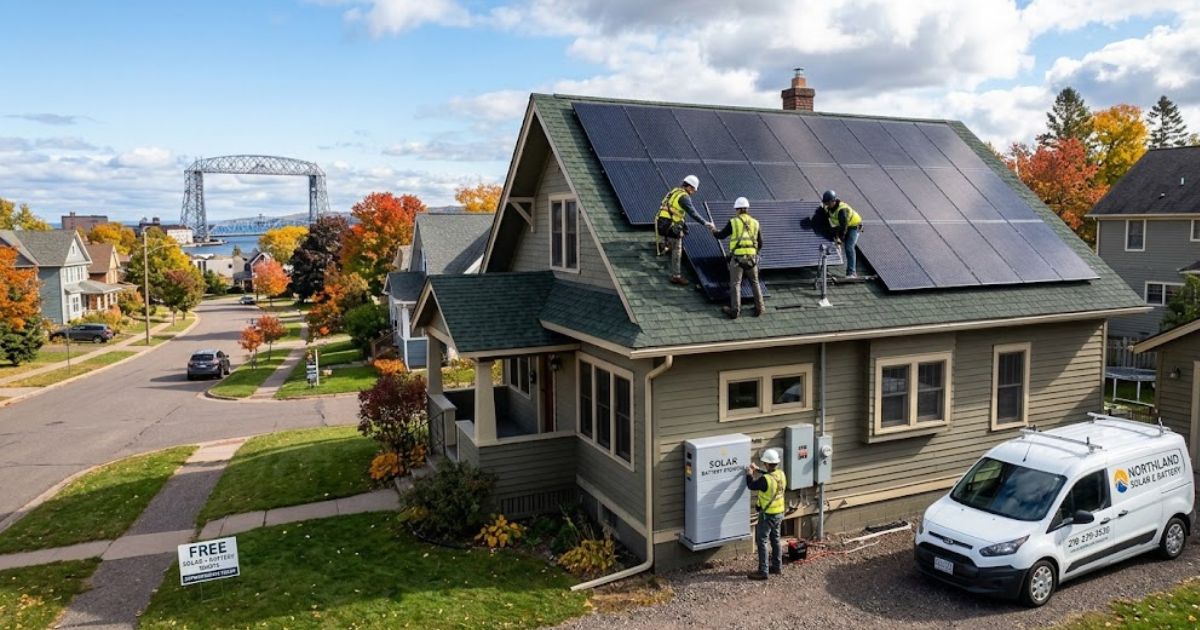
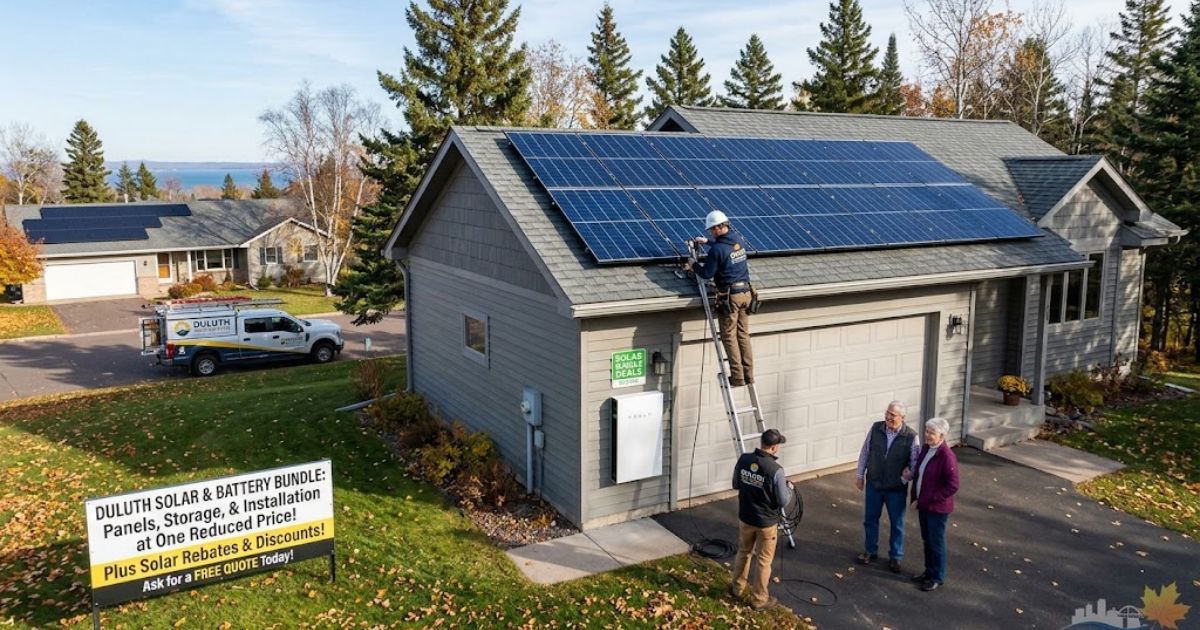
Solar battery storage deals Duluth today bundle solar panels, home battery storage and solar installation at one reduced price. Good offers add solar battery discounts, solar rebates and flexible financing options. Ask for a free quote so you can compare real numbers.
Here is the trick I share with every reader: hunt for solar deals that spell out incentive and rebate management, transparent pricing and no hidden fees. A no-obligation quote or free estimate from a solar company should list solar battery installation, storage installation and permitting line by line. Cheap bids often bury those costs, so read the fine print twice.
Where Can You Find Local Solar Deals Near Duluth?
Start with Duluth solar offers in Duluth, Minnesota, then widen your search to Duluth/Superior and Superior, Wisconsin. Installers across the Northland and Great Lakes area serve the same customers, so quote at least three of them. Check ZIP code 55801 pricing first, because it shows what your neighbors pay.
Do not mix this market up with Duluth, GA, where Atlanta solar and Georgia solar shops follow different rules and chase sunnier weather. Minnesota utilities, rebates and Minnesota solar rules apply only to northern buyers. Always confirm the state before you trust any online price.
Why Do Duluth Homeowners Want a Battery?
A battery supplies battery backup power during a power outage backup event and covers your nighttime energy use. It also builds energy independence and grid independence, because you lean less on the utility grid. Duluth’s winter storms make that emergency power worth real money.
A battery lets you store excess energy at noon, which lifts self-consumption and cuts waste. Some owners choose off-grid systems with generators for full self-reliance, but most pick hybrid systems or grid-tied systems. I usually recommend the hybrid route because it costs less and still keeps the furnace running.
How Does a Solar and Battery System Work?
Solar + battery storage integration sends direct current (DC) from the solar array to a solar inverter, which turns it into alternating current (AC). Surplus power flows into the energy storage system. Your main electrical panel then pulls from the battery after sunset.
A SPAN smart panel decides which circuits get battery capacity first. Microinverters and DC optimizers work as module-level power electronics that squeeze more output from each panel. Low voltage systems keep wiring safer, and every one of your battery cycles uses up a little lifespan.
How Much Does Solar Battery Storage Cost?
A battery alone usually costs $9,000 to $15,000 installed, while a full solar battery storage package often lands between $25,000 and $40,000. That average installation cost swings with brand and size. Your upfront cost also depends on the estimated hardware cost of each component.
Smart battery sizing matters most, since oversized units waste money and small ones fail in an outage. Custom battery configurations and expanding battery capacity later keep your options open. Run the battery ROI math with a payback calculator and a clear payback period before you sign.
Does the Federal Solar Tax Credit Still Apply?
Not for homeowners who buy in 2026. The federal tax credit known as the 30% federal clean energy tax credit, or Section 25D, ended for expenses paid after December 31, 2025. The residential clean energy credit no longer lowers your purchase price.
The investment tax credit (ITC) may still help some commercial or leased systems, so ask a tax professional. State incentives, local incentives and a property tax exemption can still trim your cost. I always verify each rule with the IRS and Minnesota’s Department of Commerce before I promise savings.
What Financing Options Can Lower the Cost?
Solar financing usually comes as solar loans, home energy loans or cash payment. Low-interest financing rewards strong credit scores. Both secured loans and unsecured loans exist, and secured ones normally carry lower rates.
Affordable solar often means a longer loan with a smaller monthly payment, not a smaller total price. Look for cost-effective solar terms that cut interest and match your monthly bill offset. Solar incentives change often, so ask your lender which ones the quote already counts.
How Much Can You Save, and Is It Worth It?
Usually yes, when your roof sees steady sun and your bills run high. Strong utility bill savings and a healthy return on investment make the numbers work, and a good deal delivers net benefit over 25 years. Duluth residents pay around 15 cents per kWh, so every offset kilowatt-hour counts.
A savings calculator or cost and savings calculator shows energy cost savings and lower energy bills. Reduced electricity bills build long-term savings, while financial gains include increased property value and higher resale value. Your electricity rate drives everything, and export credits add a bonus.
How Do Net Metering and Utility Rates Change the Deal?
Net metering pays you for power you send back to the grid. Minnesota law requires investor-owned utilities like Minnesota Power to offer 1:1 net metering for systems up to 40 kilowatts, which delivers full retail rate credits on each grid export. Larger systems often earn avoided-cost tariffs instead.
Time-of-use rates, dynamic rates and peak time-of-use hours make a battery smarter, because you practice load shifting and off-peak load shifting. Demand charges hit businesses harder, while demand response programs and a virtual power plant can pay homeowners. Smart meters, your local power grid, utility rates, any network charge, the grid electricity rate and fluctuating retail tariffs all shape the final bill.
Can Renters or Shaded Homes Use Community Solar?
Yes, often. Community solar lets renters and shaded homeowners subscribe to a shared solar project and receive bill credits without a rooftop. Minnesota runs one of the country’s larger programs, and it still supports renewable energy growth.
Compare subscription terms, because contracts differ on credit rates and cancellation. A small home battery fits better if outages worry you. I suggest comparing the offer against your own roof’s output before choosing.
Does Solar Work in Duluth’s Cold, Snowy Weather?
Yes, cold-climate solar works well because panels run more efficiently in cold air. Snow-covered panels produce nothing until they clear, but tilted arrays shed snow quickly. Duluth averages about four peak sun hours a day across a year.
Heating degree days top 9,000 per year in Duluth, so winter electricity demand runs high. Free tools show your solar potential, including a solar potential map built from satellite imagery, solar irradiance, solar insolation, solar irradiation data and NREL data. Look up a Duluth solar potential map for your street before you book a visit.
How Do Roof and Panel Choices Change Output?
A south-facing roof with little shade gives the best output, yet an east-west roof spreads production across the day. Roof pitch, roof orientation, flat roof setups and overall roof geometry also shape your system size. Partial shading and general shading impact can cut yield sharply, so ask installers to model them.
Photovoltaic (PV) panels come as monofacial panels or bifacial panels, and high-efficiency panels with strong panel efficiency cost more. Slow panel degradation matters, and roof-mounted systems cost less than ground-mounted systems. Installers rate system capacity in kilowatt-peak (kWp) and output in kilowatt-hour (kWh), and a Duluth specific solar yield near 1,200 kWh per kWp sets your annual yield.
Who Should Install Your Solar Battery System?
Hire a trusted installer with NABCEP-certified staff and certified solar professionals on every crew. A licensed electrical contractor often handles the wiring, while a solar contractor with local experience knows Duluth codes. Compare at least three solar installers before you pick.
A system designer drafts a custom design and tailored solar solutions, then files the plan set. All-in-one installation covers permit acquisition, a virtual estimate, an in-person property survey and a site assessment. A short solar consultation and a clear installation process signal good customer service.
Should You Wire a New Home for Solar?
Yes, wire it now. New construction costs less to wire today than to open walls later, so ask your builder for pre-wire conduit. That step gives you a solar-ready home and trims future labor.
Run a conduit from the roof to the service panel and leave space for a battery. Add a note to the plans so the electrician does not skip it. Resale buyers notice that extra.
What Warranty and Maintenance Should You Expect?
Ask for a complete system warranty that covers equipment and labor. Most panels carry a 25-year warranty, while a workmanship warranty often runs 10 years. A battery product warranty also commonly lasts 10 years.
Strong panel durability supports a system lifespan matching the 25 to 30 year panel life most makers promise. Preventative maintenance, panel cleaning and performance monitoring through remote monitoring keep output high. Reliable crews handle maintenance and repairs, troubleshooting, system upgrades and even panel removal and reinstallation during roof work.
Can You Add EV Charging or a Heat Pump?
Yes, EV charger integration lets your battery and panels feed EV charging at home. Plan the electrical load first so your service panel can carry it. Ask your installer to size the battery for both uses.
A heat pump heats Duluth homes efficiently, and solar covers part of its power. Together, these upgrades shrink your carbon footprint. They also support clean energy sustainability goals for your family.
FAQ: Quick Questions About Solar Battery Deals
How Long Does Installation Take?
Most Duluth homes need one to three days of work on the roof and in the basement. Design, approvals and utility sign-off add several weeks before and after. Plan for a total timeline of two to four months.
Winter slows roof work, so many owners book in late spring or early fall. Ask your installer to share a written schedule with each milestone. A clear schedule prevents surprises and helps you plan time off.
Can You Add a Battery to Existing Panels?
Yes, in most cases you can add a battery to an existing system. An AC-coupled battery works with almost any older inverter. Your installer checks the inverter age and electrical load before quoting.
Retrofits usually cost less than a full bundle because the panels already work. Ask whether the old warranty stays valid after the new equipment joins. I also suggest checking whether your utility needs a fresh interconnection form.
What Is the Smartest Next Step?
Collect three written quotes, check the tax rules and compare the price per usable kilowatt-hour of storage. Choose the offer that balances cost, warranty and installer reputation. Take your time, because a battery lasts a decade or more.
Book a site visit before snow covers your roof, since the installer needs a clear look at it. Bring a recent power bill so the installer can size the system correctly. You will walk away with real numbers and a firm plan.