

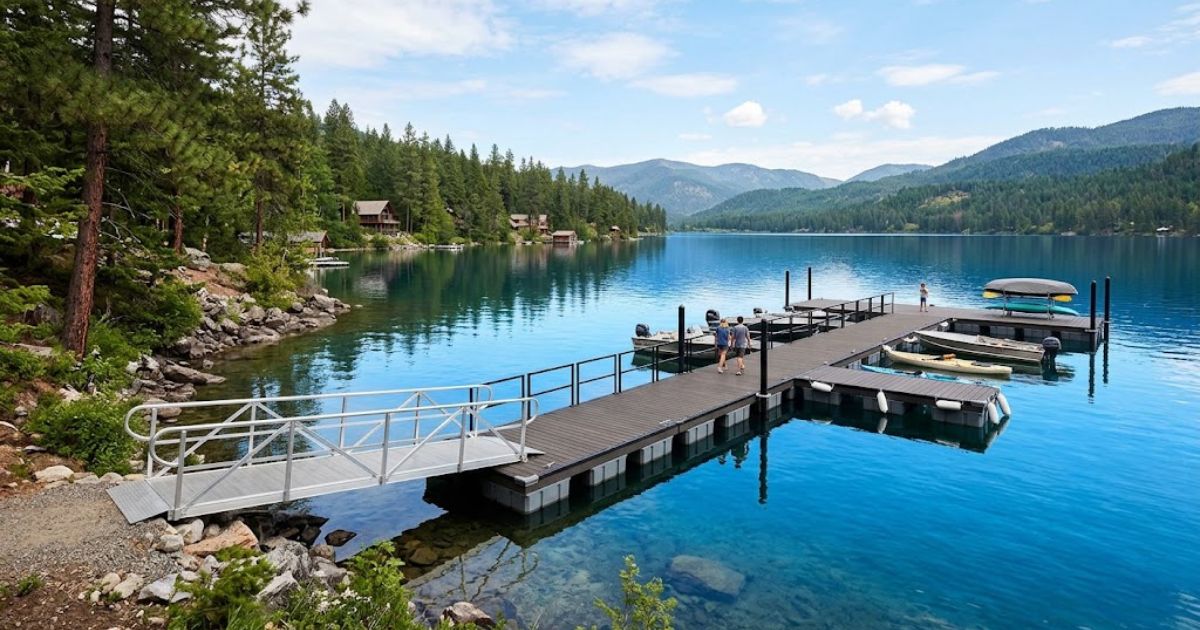
A floating dock is a platform that rests on buoyancy instead of fixed legs, so the deck rises and falls with water level. Sealed float chambers hold the structure up, and an anchoring system keeps it from drifting. Each floating dock system works as a set of joined modules.
A modular floating dock links sectional dock units with hinges, and that articulation lets each piece follow small waves independently. Self-leveling behavior keeps the surface near the waterline during fluctuating water levels. I always tell readers that this movement gives a floating dock its main advantage over a rigid frame, and it adds stability on uneven days.
What Types of Docks Can You Choose From?
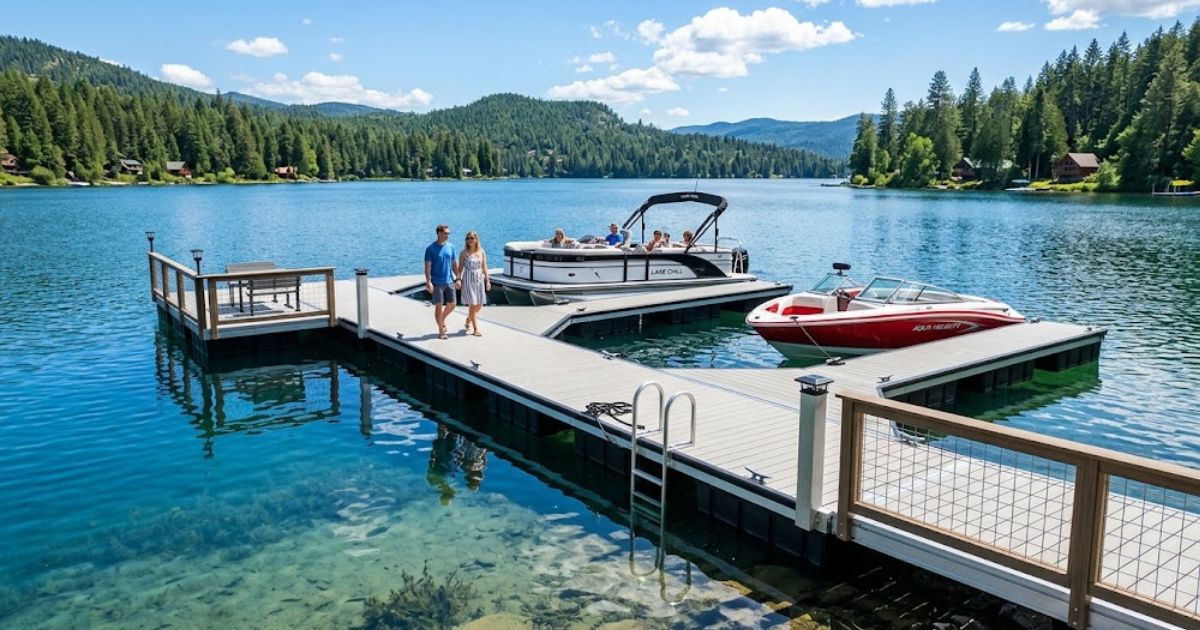
A stationary dock stands on legs set into the lakebed, while a roll-in dock rolls out of the water on wheels. A hybrid fixed-and-floating layout joins a legged section to a floating section.
Inside the floating category, a low-profile floating dock sits close to the water and a premium floating dock sits at the top of a range. A canal floating dock suits narrow channels, while a T-shaped dock or P-shaped dock adds mooring room. A patio dock, swim raft, or floating walkway extends the platform for lounging, swimming, and reaching deeper water.
Which Materials Go Into a Floating Dock?
A floating dock combines floats, a frame, and decking that you step on every day. A rotomolded float uses rotationally molded polyethylene, and many designs fill it with expanded polystyrene (EPS) fill or a solid foam core. A foam-filled float drum or HDPE float tank gives buyers other float styles.
Frames often use a welded aluminum frame made of marine-grade aluminum with TIG-welded aluminum joints and an anodized aluminum finish. Product pages describe a 9-inch welded truss frame, and some systems advertise universal floats, so ask which frames those floats fit. UV-stabilized polyethylene and recyclable polyethylene help floats last, while corrosion-resistant hardware and stainless steel hardware protect the fasteners.
What Are the Best Dock Floats for Resisting Corrosion in Wisconsin?
Freshwater lakes and rivers in Wisconsin face severe seasonal temperature shifts, ice expansion, and chemical exposure from runoff and algae, making float corrosion and breakdown a key concern. Heavy-duty rotational-molded polyethylene (HDPE) float drums filled with expanded polystyrene (EPS) foam core offer the best defense against environmental degradation.
Because high-density polyethylene is naturally non-reactive and rust-proof, it effectively resists moisture absorption, road-salt runoff near shorelines, and surface algae buildup. Choosing floats designed with UV-stabilized resins ensures that freezing winter cycles and harsh summer sun won’t cause cracking, puncturing, or structural brittleness over time.
Which Hardware Parts Deserve a Close Look?
Check the pipe guides, guide poles, hinges, and dock connectors first, because those parts carry daily loads. A center-connection design spreads stress through each joint, while perimeter strengthening bars stiffen the edges. A quarter-turn locking pin and a tool-free accessory track make later changes quick.
Slip-resistant decking improves footing, and flow-through decking drains water. Freeboard, the height of the deck above the surface, affects how dry the surface stays and how easy boarding feels. A gangway or ramp links the dock to shore, so ask about its length and how the dock meets the shoreline before you order.
How Does an Anchoring System Hold a Floating Dock in Place?
An anchoring system ties the dock to the shore or lakebed while still letting it move up and down. Common choices include pilings, deadweight anchors, pipe brackets, stiff arms, and a winch-and-cable assembly. ShoreMaster says a local dealer recommends the option that fits your shoreline and water conditions.
Galvanized pipe often serves as a vertical guide, and cables and chains plus mooring hardware complete many setups. Patriot Docks lets buyers choose their own anchoring system, shape, decking, and length. Connect-A-Dock recommends consulting an installer from its dealer search so the anchoring style suits your river’s conditions.
What Extra Features Can You Install on a Floating Dock?
Accessories turn a plain platform into a working waterfront for daily use. A dock ladder, cleats, dock bumpers, corner bumpers, and fenders handle boarding and boat contact. Safety handrails, dock storage boxes, solar cleat lights, piling caps, and dock carts cover protection and storage.
A flip-up dock ladder or retractable dock ladder tucks away when you want clear space. A drive-on PWC port serves small craft, and a kayak launch or swim platform serves paddlers and swimmers. Ask each provider which accessories fit its tracks, because fit can vary between brands and between product lines.
Who Uses Floating Docks, and for What?
Homeowners, businesses, clubs, and public agencies all use floating docks. A residential dock supports swimming and boating, while a commercial dock, marina docks, resort docks, and government waterfront facilities handle heavier traffic. Fisheries and aquaculture operations also rely on floating platforms for daily work.
Marine construction crews use a work barge, and rowing club docks and sailing club docks help clubs launch boats. Anglers like a fishing dock for steady footing, and a special event dock gives a venue temporary shoreline space. A boat slip, a drive-on boat lift, jet ski docking, personal watercraft docking, and kayak and paddleboard access keep small craft at water level.
What Are the Best Add-Ons for Floating Dock Systems?
The biggest benefit is that the deck follows the water, so access stays consistent through the season and across changing conditions. That feature supports deep-water docking and adds stability on calm days. You can also grow an expandable layout and reshape a customizable shape as your needs change.
Owners value low maintenance, easy seasonal removal, and no-drill installation in many designs. Good designs show stability in waves and boat traffic, though wake size still matters. Long-lasting durability depends on float quality, frame metal, the hardware you choose, and the care you give the dock each season.
What Problems Can Floating Docks Develop?
Most problems start with the floats, because they carry the whole load of the deck and everyone standing on it. Waterlogging and punctured floats reduce buoyancy, and cracking and brittleness show up in low-grade plastic. UV degradation speeds that aging when a manufacturer skips protective additives.
Water conditions add risk through corrosion in saltwater and brackish water, ice push damage, shoreline erosion, and strong currents. Boat wake and wave limits matter on busy lakes, and algae and marine growth plus barnacle buildup need regular attention. Owners of a fixed dock spend weekends on re-leveling fixed-dock legs, while a light floating dock can show trampoline-like bounce.
How Do You Maintain a Floating Dock, and How Long Does It Last?
Maintenance stays simple: a seasonal rinse, power washing when needed, and a routine to inspect anchoring and fittings. DockGear says polyethylene floats and aluminum surfaces clean up with a hose or gentle power washing. Tommy Docks gives similar advice of a seasonal rinse and a check of the anchoring and fittings.
Owners in icy regions pull sections out for seasonal dock removal, and plastic and aluminum surfaces need no sealing or staining. ShoreMaster’s page states a 20+ year lifespan with proper maintenance in its facts list and a longer figure in its FAQ, so ask any provider to put the number in writing. Keep replacement parts on hand and track maintenance costs each year.
How Do You Plan a Site Before You Buy?
Start with a shoreline assessment: measure water depth, note the bottom condition, and read the local permitting rules. DockGear advises checking those rules with your lake authority or county office. Online tools then help you sketch layouts and test them against those measurements.
The dock builder tool, product finder quiz, design-a-dock tool, and configurator tool let you test shapes before you spend money. ShoreMaster promotes a dock builder tool and a product finder quiz, and Connect-A-Dock lists a Design a Dock tool. Note whether you have a soft lakebed, rocky lakebed, or mucky lakebed, because each grips anchors differently.
Which Safety and Accessibility Features Matter?
Safety features protect people first and equipment second. An ADA-compliant dock gives wheelchair users a usable route, and ADA accessibility depends on ramp slope and clearances. Pet and child safety call for handrails, slip-resistant decking, and life rings within reach.
Regulatory buoys mark restricted water where rules require them, so ask your local authority which markers apply to your stretch of water. Solar dock lighting helps boaters spot the dock after dark. Plan these features early, since retrofits take more effort than a first install.
What Should You Look for in a Floating Dock Service Provider?
Look for clear installation options, written warranty terms, and support after the sale. A professional installer network, an authorized dealer network, or a DIY installation kit each suits a different owner. A limited lifetime warranty and financing options also deserve a direct question.
Ask how quickly the provider quotes, who inspects your site, and what happens when a part fails. Confirm repair coverage directly, since provider websites vary in what they state about it. I favor providers that explain anchoring choices for your water instead of selling one layout everywhere.
What Do the Brand Websites Say About Their Services?
Each brand offers the services listed on its own website, so read those pages before you call. ShoreMaster lists a dock builder tool, product finder quiz, dealer locator, brochure requests, installation instructions, and a product warranty. Patriot Docks lists dock parts, instructions, warranty and returns, technical data, a dealer search, and a Schedule a Visit option.
Dock Blocks lists a professional installer network, nationwide installation, global shipping, quotes in as little as 48 hours, a parts store, financing, and a limited lifetime warranty. Tommy Docks ships each floating dock as a kit with connectors, hardware, and instructions, and an authorized dealer can install it instead. Connect-A-Dock points to its dealer search, a Design a Dock tool, brochures, installation resources, and warranty information.
Which Brand Names and Product Lines Will You Meet While Comparing?
Product names differ by manufacturer, so compare features instead of labels. PolyDock, RhinoDock, Infinity FTS9, InfinityTrack, and FLEXX appear on the reviewed pages, along with Connect-A-Port and YAKport. Myers Industries also appears as a company name on those pages, so keep it separate from the product lines.
Read each specification sheet before you compare prices, since names alone say little about float material or frame metal. Patriot Docks offers a technical data page for that purpose, and you can ask any provider for one. DockGear sells a barnacle removal tool kit and replacement parts such as pier cushion straps for upkeep jobs.
How Does Our Website Help You Find a Floating Dock Provider?
Our website gathers these questions in one place and points you to each brand’s own pages. You can compare what ShoreMaster, Patriot Docks, Dock Blocks, Tommy Docks, Connect-A-Dock, and DockGear state, then shortlist providers that match your water. That keeps your research in one place and saves repeated searching.
Treat our site as a first step, then confirm details directly with each provider. Bring your water depth, bottom condition, and intended use to every conversation. A short, specific brief makes quotes from different providers easier to compare side by side.
What Questions Do People Ask Most About Floating Docks?
How Much Does Floating Docks Cost?
Prices vary with size, materials, and accessories, and the reviewed pages publish no single figure. Dock Blocks says it processes quotes in as little as 48 hours, and its site lists financing. Request quotes for the same layout so you compare like with like across providers.
Is a Floating Dock Worth It?
Often yes where water levels change a lot, because the deck follows the surface. Owners trade a little bounce for easier seasonal removal and fewer leg adjustments. Weigh that trade against wave exposure at your site and the boat traffic nearby.
Can You Install a Floating Dock Yourself?
DockGear says many installs need only basic tools, and Tommy Docks ships kits with instructions. Dock Blocks also lists a professional installer network for owners who prefer help. Check local rules first, then pick the route that fits your skills and your comfort with heavy lifting.
Where Should You Start When You Need a Floating Dock?
Start with your water: measure depth, check the bottom, and read your local rules. Then use our website to compare what each brand states about installation, dealers, tools, and warranties. Visit our site first, because it is the easiest way to find a floating dock provider and turn this checklist into real quotes.