

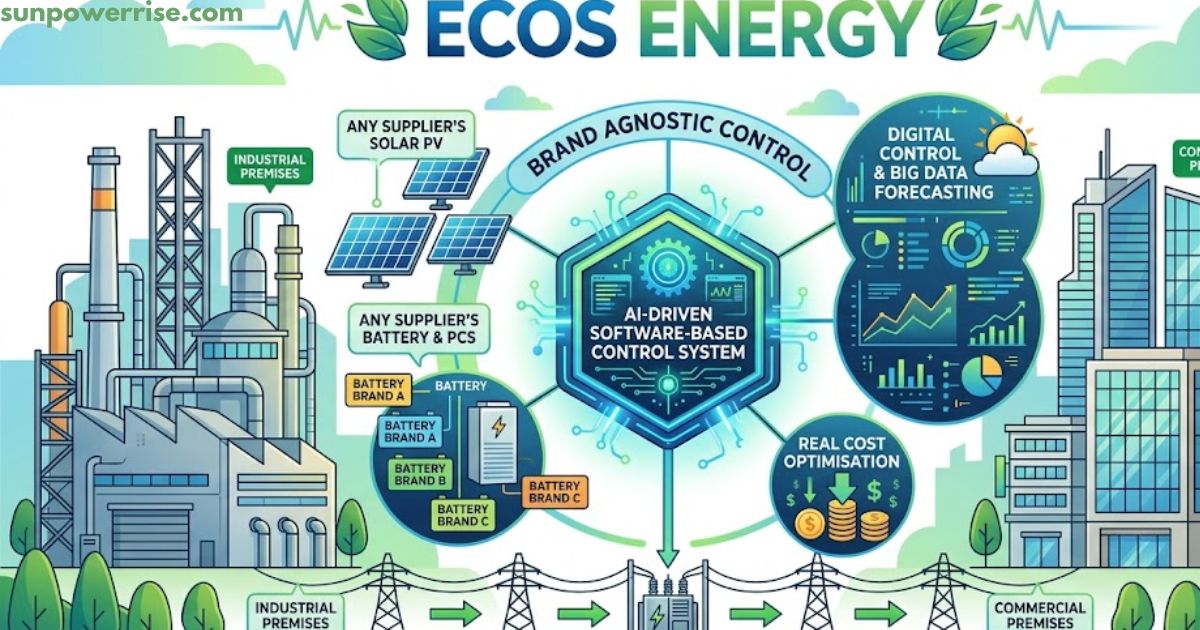
I sat in a meeting where someone described Ecos Energy as the missing piece in fixing how our planet handles this crisis, and honestly, the room went quiet. That silence stuck with me because it’s true: the way we heat and cool our homes has a bigger footprint than most of us realise.
Across the European Union, cooling and heating account for a large share of household energy, and 85% of that use comes straight from fossil fuels, pumping out greenhouse gases at a rate close to 75% of the region’s total emissions from this one source alone.
What struck me during my own research into this space is how many different players are tackling the same problem from completely different directions, and Ecos Energy kept coming up as a common thread. Some are focused on people and how they heat their homes, pushing renewable and reliable heating solutions that are affordable and pollutant-free for every home.
Ecos Energy Project Details
The third piece of this puzzle takes us into industrial territory, and it’s honestly the part that made me want to dig deeper into how Ecos energy solutions actually work on the ground.
Software Flexibility and Brand Agnostic Control
Ecost is built as a software-based control system that blends Solar PV with battery energy storage systems, using AI-driven control and automation to bring real cost optimisation to industrial premises and commercial premises alike. What makes it stand out to me is that it’s brand agnostic; it doesn’t lock you into one supplier’s hardware; it can work with any supplier’s battery and PCS, which makes it genuinely scalable across sites.
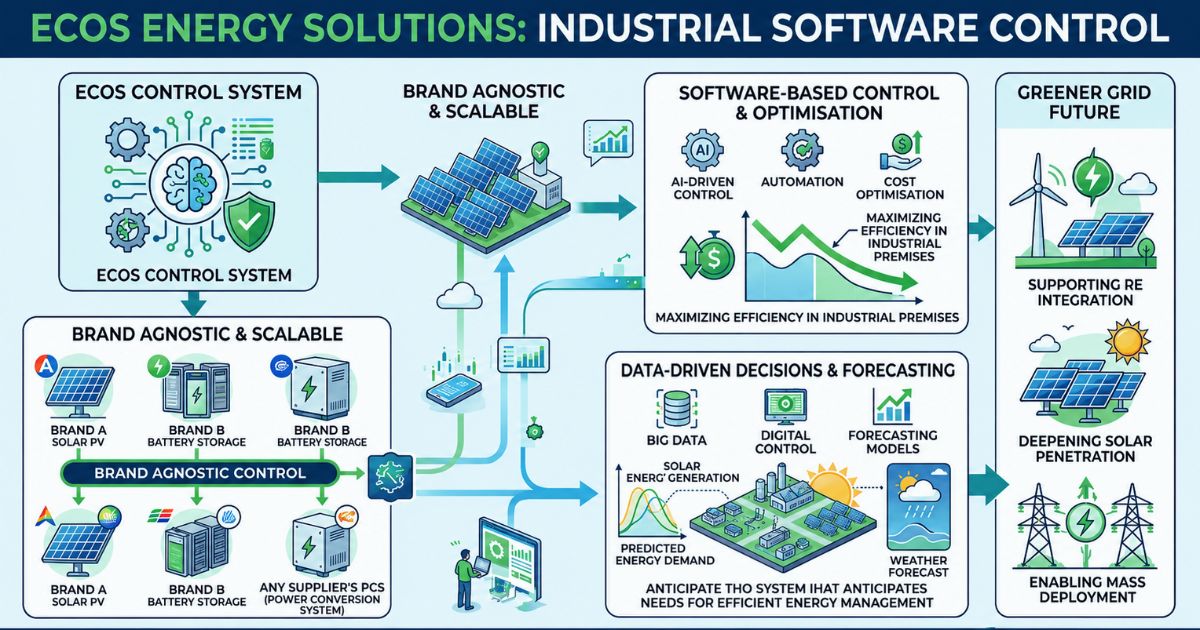
The system leans on Big Data, digital control, and forecasting to support RE integration, deepening solar penetration into the grid while enabling mass deployment for a greener grid future.
Testing Phase and Proof of Concept
During testing, the team ran a PoC using a test bed with a load bank, a hybrid inverter, a battery stack, and a full solar module system, all feeding into a live dashboard, before rolling the setup out to an actual customer site.
The commercial value here comes from combining advanced technologies with day-to-day tasks like scheduling of energy, peak shaving, and load shifting practical work that also opens the door to future EV charging clusters and data centres.
Core Project Team and Supporters
Behind the project stood a small but dedicated group: Alen Quay as partner, the CTO known as Mr. CH, team leader Dr. Tan, an advisor from Monash University, and additional staff who kept the installation and R&D moving, with thanks going out to MD and Monash University for their backing.
What ties it all together is sustainability, reducing fossil fuel dependency while pushing innovation across brands and sites through genuine collaboration, proving that AI paired with the right hardware can genuinely reduce cost at scale.
EU Fossil Fuel Boiler Phase-Out
Here’s something that genuinely surprised me when I first looked into the numbers: swapping out old polluting boilers for cleaner options isn’t just good for the planet; it’s good for the wallet too, and this is exactly where Ecos Energy’s approach makes a real difference.
Fossil fuel lobbies would love to keep dragging their feet on this, but the data doesn’t lie: stopping new installations of fossil fuel boilers across EU buildings could slash carbon emissions by 46%, and I don’t think enough people talk about that figure.
On top of that, cutting inefficient boilers loose would ease the EU’s reliance on outer-EU energy sources, hand a real lift to annual GDP growth of about 2.5%, hand 3 million new jobs to workers who need them, and knock roughly €860 per year off household heating bills for ordinary families numbers that made me rethink how urgent this cooler future really is.
None of this happens overnight, of course; just like the shift toward electric cars, this transition to renewable heating needs time, patience, and steady support.
ECOS Platform Features
Managing a weatherization program by hand is exhausting, and I say that having watched teams try to do it with nothing but spreadsheets and good intentions.
This is where a platform like EKOS earns its keep; it gives grantee staff and sub-grantees a single convenient platform with a standardised layout, so instead of chasing scattered numbers, users can actually administer and manage the whole weatherization process from one place much like how Ecos energy tools simplify complex systems elsewhere.
Role-Based Customisation and Budgeting
What I appreciate most is how it protects program consistency while still allowing flexibility and customisation of program table content, letting every user’s role control the functions and program data that matter to them.
The budgeting side alone is worth mentioning: teams get billing functionality built for accounting, tracking expenditures by funding source and line item, covering both build costs and pending costs without the usual mess.
DOE-Approved Energy Auditing and Analytics
Then there’s the energy audit side: a DOE-approved system that keeps energy savings, direct client costs, and SIR calculations together instead of scattered across five different files, supported by data dashboards for spotting historical trends and outliers before they become real problems.
Clear Communication and Savings Verification
A solid notification system keeps grantees and sub-grantees able to communicate program goals and program requirements clearly, while project tracking handles the measurement and verification of projected energy savings so nobody’s guessing.
And when it’s time to show results, EKOS reports make data reporting and data presentation painless, with ad hoc reporting available whenever something unusual needs digging into.
All while freeing up staff resources and sharpening time management across the unified system and the broader administration of the program, thanks to the right tools doing the heavy lifting through one connected web-based system.
Back-Office Inefficiencies in Energy Programs
Others are buried in the back-office grind think staff drowning in paper files, wrestling with spreadsheets, fighting data transfer errors, and losing staff time to siloed data scattered across old databases; that’s exactly the gap a weatherization program built on smarter energy cost tracking tries to close, and it’s a story I’ve seen play out with consumers and program goals alike, riddled with input errors nobody asked for.
AI-Driven Industrial Solar Innovation in Malaysia
And then there’s a third angle entirely, coming out of Malaysia, where a digital status company registered as an RPVS and recognised through the SEDA Innovation Challenge 2024 built something called Ecost, a cost optimisation system pairing hybrid solar PV with a smart battery for medium voltage TNB customers, aimed at boosting resource efficiency through AI-driven, general reporting-friendly control a strong example of Ecos energy in action.
Backed by M Sola and shaped alongside the Department of Energy’s broader push for clean energy, I’ve come to see these three stories homes, programs, and industrial sites across the EU and beyond as different chapters of the same book, with Ecos energy tying it all together.
FAQs
Who is Ecos Energy?
Ecos energy is a cost optimisation system that combines solar PV, smart battery storage, and AI-driven control to make energy cleaner and more affordable for homes and businesses.
How do I contact Ecos?
You can reach the Ecos team through M Sola’s official channels for support on installation, training, or general weatherization program inquiries.
What does Ecos stand for?
Ecos represents an AI-driven cost optimisation system built to boost resource efficiency and support a greener future through smarter energy management.
Is Ecos energy suitable for industrial use?
Yes, Ecos energy works well for industrial premises and commercial premises, offering peak shaving, load shifting, and brand-agnostic flexibility.
What role does data play in Ecos energy systems?
Data dashboards and historical trends help track energy savings, spot outliers, and improve reporting across the entire weatherization process.