

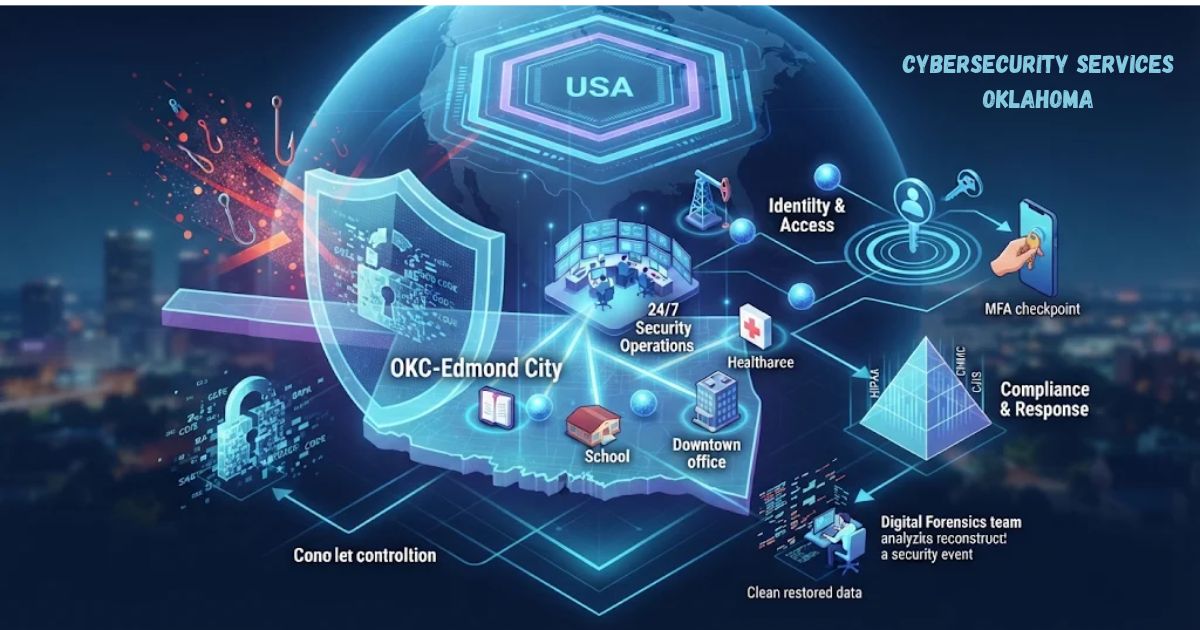
Finding cybersecurity services Oklahoma and Edmond takes more than searching for the nearest office. This guide explains what providers sell, which questions separate solid providers from vague ones, and how seven brands describe their work. Use it as a checklist before you request a quote.
What Are Cybersecurity Services Oklahoma City and Edmond?
Cybersecurity services oklahoma are outsourced security tasks that protect a company’s computers, accounts, and data from attackers. A managed security service provider (MSSP) runs those tasks daily, while cybersecurity as a service (CSaaS) packages them as a subscription. Most plans combine 24/7 security monitoring, testing, training, and recovery support.
A security operations center (SOC) staffs the monitoring, and analysts review every alert first. Managed cybersecurity services differ from a one-time project because the provider keeps tuning controls as your systems change. Many firms also bundle managed IT services and co-managed IT, so in-house technicians and outside teams share tools.
Why Do Oklahoma Organizations Need Cybersecurity Support?
Attackers scan the internet for open doors, then look up who owns them afterward. Size rarely protects anyone, and small and medium-sized businesses (SMBs) often lack a dedicated security employee. Outside help fills that gap with trained analysts and tested tools.
The INTEGRIS Health breach reached about 2.4 million patients, and attackers emailed those patients directly. In 2021, Conti ransomware forced the City of Tulsa to take systems offline for weeks. Security teams often trace incidents like these back to ordinary gaps that patch management and least privilege controls address.
What Threats Do Local Businesses Face Most Often?
The most common threats are the phishing attack, the ransomware attack, and stolen passwords from earlier breaches. Each starts with a small human slip, like a rushed click. Defending against them means stacking several controls instead of buying one product.
Attackers use email spoofing to imitate suppliers, credential theft to harvest logins, and password reuse to open a second account. Unpatched systems let malware run, and account takeover follows. Lateral movement then carries the intruder toward servers and backups, which turns one data breach into business downtime.
Which Newer Threats Should You Plan For?
Plan for deepfakes, wire fraud, and weak IoT device security. Attackers now imitate voices and faces to push payments, and smart cameras or printers can open network paths. Ask whether your provider’s filters use AI phishing detection to catch these messages.
Nation-state threats matter most to energy firms and defense suppliers, while third-party vendor risk and supply-chain risk touch anyone who shares data with a partner. A vendor login can give unauthorized access to your files. Ask each provider how it tracks human error, vendor accounts, and your security posture.
What Should You Look For in a Cybersecurity Provider?
Look for clear scope, named tools, a staffed response process, and written reports you can read. A good provider explains each service in plain language and says what it excludes. Vague promises about total protection deserve a direct follow-up question.
Begin with penetration testing, a vulnerability assessment, and a cyber risk assessment, because each shows a different exposure. An external penetration test probes your internet-facing systems, and a strong security assessment ends with a remediation roadmap that ranks fixes by risk. Ask for continuous monitoring, threat intelligence, and proactive threat mitigation too.
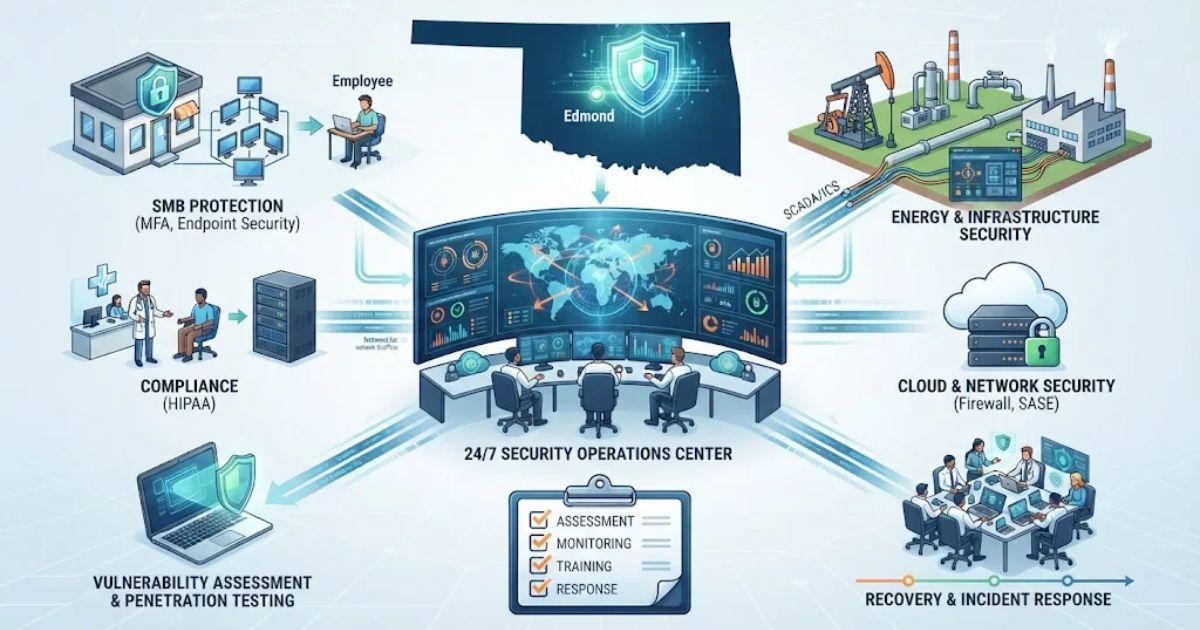
Vulnerability scanning checks software for known weaknesses, and vulnerability management tracks each finding until someone fixes it. Several providers offer a free vulnerability scan or a free cybersecurity assessment first. Request one and compare the reports.
Plan layered defense around identity, email, devices, and backups. A virtual CISO (vCISO) or cybersecurity consulting engagement helps leaders set priorities without a security manager. Security awareness training and phishing simulations then teach staff to spot messages that slip through.
Which Monitoring and Response Services Matter Most?
Prioritize managed detection and response (MDR), incident response, and emergency response support. MDR watches for attacks, and the response team contains them before they spread. Confirm who answers the phone at night and how quickly they start work on a confirmed threat.
After an attack, containment and recovery and digital forensics decide how quickly you resume work. Ransomware protection works best alongside immutable backups, tested restores, and backup and disaster recovery planning. These steps protect business continuity and build cyber resilience.
Which Security Tools Should a Provider Use?
Ask for endpoint detection and response (EDR), multifactor authentication (MFA), and email security at minimum. Those three cover the places where attackers start most often: devices, logins, and inboxes. Everything else adds depth around that core, and you can phase it in.
Newer options include extended detection and response (XDR), next-gen antivirus, and endpoint protection. Endpoint policy management keeps those settings consistent. A SIEM (security information and event management) platform adds log management and single-pane visibility, and some, such as Microsoft Sentinel, serve Microsoft environments.
How Do Identity Controls Protect Accounts?
Identity and access management (IAM) decides who can sign in and what each person can reach. Conditional access blocks risky sign-ins, and MFA adds a second check at login. Together they limit what a stolen password can do inside your accounts.
Privileged access management (PAM) adds application allowlisting and elevation control, and identity threat detection and response (ITDR) flags odd admin activity. Password management tools cut password reuse. Microsoft shops should review Microsoft Entra ID settings, the Microsoft 365 secure score, and Microsoft Defender for Business.
How Do Network and Cloud Protections Fit Together?
Network defenses keep intruders from moving once they get inside. A managed firewall, an intrusion detection system, and an intrusion prevention system watch traffic, while network segmentation separates sensitive systems. Together they limit the damage when any single control fails.
SASE (secure access service edge) and zero-trust architecture replace older VPNs with checks on every connection, and secure remote access supports remote staff. DNS filtering blocks bad sites, DMARC enforcement limits spoofed mail, and cloud app security watches Microsoft 365 activity. Dark web exposure reports show leaked credentials, and mobile device management secures phones and tablets.
Which Compliance Rules Affect Oklahoma Businesses?
Your industry decides which rules apply, and your provider should map each one to specific controls. HIPAA compliance covers medical data, PCI DSS covers card payments, and CJIS compliance covers criminal justice records. Ask your attorney to confirm the final list.
The HIPAA Security Rule governs electronic patient records, and the Oklahoma Security Breach Notification Act gained SB 626 on January 1, 2026, which describes reasonable safeguards. Education and finance add FERPA, the FTC Safeguards Rule, and GLBA. Oklahoma Cyber Command and OK-ISAC are state-level resources your provider should know by name.
What Do Defense and Federal Suppliers Need?
Suppliers that handle federal contract data need CMMC compliance, NIST SP 800-171, and DFARS 252.204-7012. These rules protect controlled unclassified information (CUI) and federal contract information (FCI). Your provider should write a system security plan and track every open item.
Tinker Air Force Base anchors a supplier network around Oklahoma City, and many local firms sit inside it. Aerospace and defense contractors may also need ITAR compliance, NIST 800-53, or the NIST Cybersecurity Framework (CSF) 2.0. Timelines for CMMC Level 2 have shifted, so confirm current dates, and expect SOC 2 and ISO 27001 requests from enterprise customers.
Do Industry and Location Change Your Needs?
Yes, because each sector and neighborhood carries different systems and different rules. A dental office near Nichols Hills needs different safeguards than a pipeline operator. Ask any provider to describe clients in your sector, and request one example of similar work.
Healthcare providers, law firms, accounting firms, community banks, and title companies handle private client data and wire instructions. Municipalities and government offices and tribal government operations add public-service concerns. Schools and districts and manufacturing plants need protection for student records and production lines.
How Do Energy and Industrial Needs Differ?
The Oklahoma energy sector relies on control systems that office security tools do not cover. Oil and gas security and pipeline infrastructure protection need SCADA security, industrial control systems (ICS) monitoring, and operational technology (OT) security. Segmenting networks keeps office breaches away from field equipment.
Critical infrastructure operators may also face NERC CIP rules, and pipeline operators may follow TSA Pipeline Security Directives. Ask whether a provider has handled either. LayerLogix and ABT Solutions both describe energy-focused security on their pages.
Which Local Areas Do Providers Cover?
Most providers cover Greater Oklahoma City, OKC, and Edmond, and several extend to Tulsa and Norman. Coverage details differ, so confirm whether support runs remote or on-site before you sign. Check neighborhoods such as Bricktown and Midtown if your office sits downtown.
Some providers send a local Oklahoma team to your office, while others work remotely and ship pre-configured equipment. NetSys and LayerLogix describe remote delivery on their pages. Either model works if the contract spells out response times.
How Much Do Cybersecurity Services Cost?
Cost depends on user count, device count, compliance scope, coverage hours, and the cleanup your current setup needs. Some providers quote flat-rate cybersecurity plans, while others price per user monthly or per project. Request itemized quotes to compare equal scope.
Cyber insurance readiness work helps you answer carrier questionnaires about controls such as MFA and backups. Your cyber liability coverage may require written proof of those controls. Ask whether the provider’s compliance management reports cover that documentation.
Which Brands Offer Cybersecurity Services in OKC & Edmond?
Seven brands publish cybersecurity pages for this region: Diverse CTI, The NetSys Group, Accel Technology Group, ABT Solutions, LayerLogix, Empower IT Services, and AND Group. Each brand offers the services listed on its own website. Read those pages directly before you decide.
Diverse CTI lists 24/7 monitoring, penetration testing, incident response with forensics, and compliance support for HIPAA, NIST, and CJIS. Empower IT Services lists threat monitoring, firewall and endpoint management, vulnerability assessments, and a free assessment from its Edmond office. ABT Solutions lists penetration testing, risk assessment, managed cybersecurity, awareness training, and compliance work.
Accel Technology Group lists MDR, SIEM, SASE, identity management, and a 24/7 SOC. NetSys lists MDR, conditional access, email protection, and a free external penetration test, and it works remotely. LayerLogix lists endpoint protection, access management, and PAM, and its Texas headquarters means remote or partner-based support.
AND Group lists managed cybersecurity, consulting, a security assessment, and ongoing monitoring and maintenance. Its FAQ also describes firewall management and cloud security. Compare each list against this guide.
Why Is Our Website the Easiest Way to Find a Provider?
Our website gathers the questions, standards, and provider details for OKC and Edmond in one place, so you compare options in one visit. Each listing points to the provider’s own pages for exact service lists. You then contact only the providers that fit.
Use this page’s checklists while you browse, and shortlist two or three providers that match your industry. Ask each for a sample report and a written response plan. Then request quotes with identical scope.
What Do People Ask About Cybersecurity Services in OKC & Edmond?
Do Small Businesses in Edmond Need Cybersecurity Services?
Yes, because attackers scan for reachable systems regardless of company size, and a small office still holds client data and email accounts. A basic plan with MFA, email filtering, backups, and monitoring covers the common entry points. Start with a free assessment.
What Should I Do First After a Ransomware Attack?
Isolate affected devices, avoid wiping systems, and call your provider or insurer before paying anyone. ABT Solutions advises calling for help before wiping systems or paying. Preserve logs, screenshots, and a note of when you first noticed the problem for investigators and your insurer.
Where Can You Find Cybersecurity Services in OKC & Edmond?
List your industry, your data, and the standards that apply, then compare providers against this checklist. Visit our website to review cybersecurity services in OKC and Edmond in one place, and open each brand’s own pages to confirm its service list. Request assessments from two or three providers and pick the one that explains its findings best.