

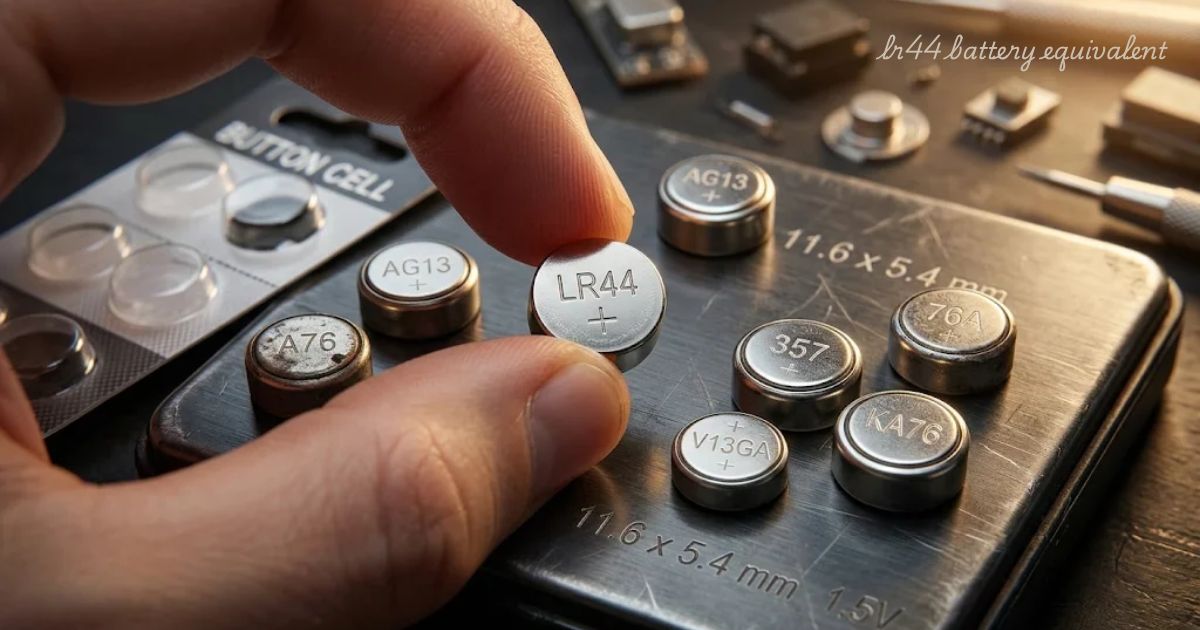
An LR44 battery equivalent is any cell that matches the LR44’s size and voltage closely enough to work in the same device. The AG13 battery, the A76 battery, the 357 battery, and the 76A battery all fit that description under different labels. Manufacturers invent their own codes, so one LR44 button battery can carry four names, and an LR44 equivalent battery from another brand can carry a fifth.
A direct replacement shares the LR44’s chemistry, while an exact equivalent differs only in the printed name. Some interchangeable batteries look identical but are same size, different chemistry, and that difference changes runtime. A cross-reference chart from the manufacturer settles the question faster than guesswork and points you to the best LR44 equivalent for your device.
Which codes and model names mean the same battery?
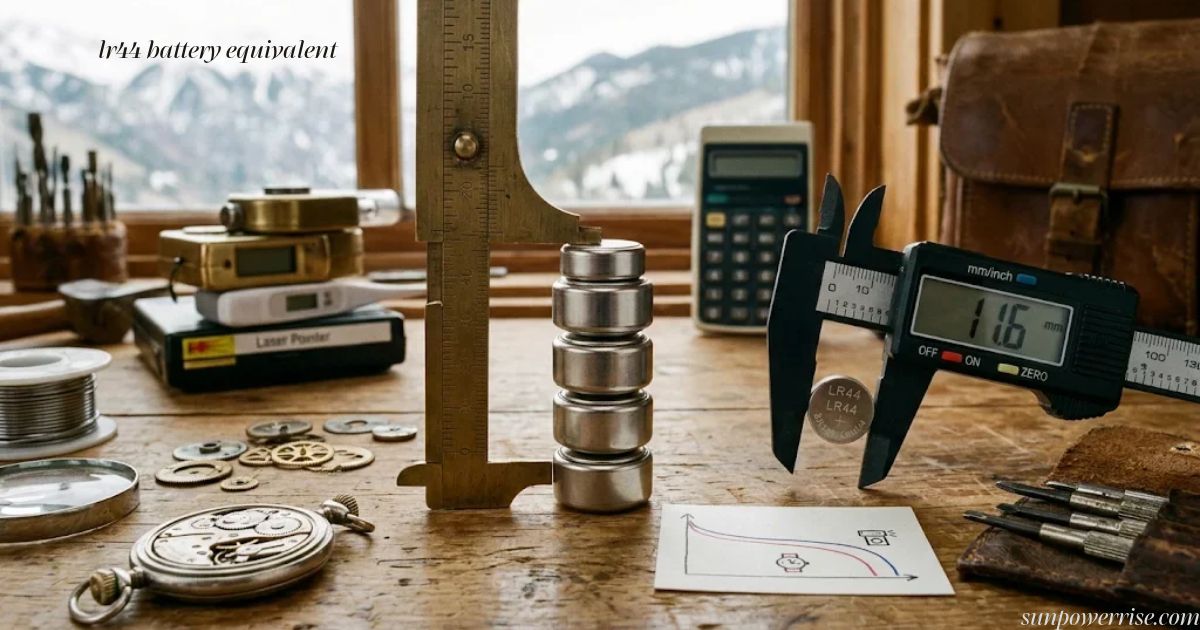
Most codes describe one physical size, 11.6 mm across and 5.4 mm tall. LR1154, L1154, and L1154F name the alkaline version, and Murata Electronics sells it as the LR44R series. Duracell labels the same alkaline cell PX76A, EPX76, or V136A.
Silver oxide cells use codes such as SR44, SR44W, SR44SW, SR1154, SG13, S76, and 303. Rayovac prints RW82, Varta prints V13GA, and Energizer prints KA76 on equivalent cells. Retail listings also show G13, 357A, and 157, so check each one against the datasheet before you buy.
What are the key differences between alkaline and silver oxide batteries?
An alkaline button cell supplies 1.5V and loses voltage gradually, while a silver oxide button cell holds about 1.55V until it nearly runs out. That steadiness makes alkaline vs silver oxide the main choice for watches. Your device manual usually names the battery chemistry it expects.
The types of button cell chemistry also include the zinc-air battery, common in hearing aids, and the retired mercury oxide battery. An alkaline manganese button cell, also called alkaline zinc manganese, pairs manganese dioxide (MnO2) with a zinc powder negative electrode and a potassium hydroxide electrolyte. Modern LR44 cells are mercury-free and cadmium-free, which makes disposal safer.
Which specifications should I compare first?
Start with nominal voltage, physical size, and capacity (mAh), because those three decide whether a button cell battery works. An LR44 supplies 1.5V, while silver oxide versions supply 1.55V. The 11.6 mm diameter and 5.4 mm height, or 11.6 × 5.4 mm, stay fixed across the whole family.
Alkaline cells store 110–130 mAh and silver oxide cells store 150–200 mAh. Spec tables label zinc-air figures as 1.4–1.45V (zinc-air) and 600–700 mAh (zinc-air). Datasheets also quote weight about 2 grams, an operating temperature range of 0°C to 60°C, and an optimal temperature 20°C.
How does discharge behavior change the choice?
Discharge characteristics decide how long a cell runs in a given device. Alkaline cells show voltage drops over time, while silver oxide cells keep better voltage stability, which suits low-drain applications such as watches. A device that fires bursts, like a camera flash, needs high-drain pulse discharge instead.
Each chemistry has a cutoff voltage, also called end-point voltage, near 1.0V for alkaline and 1.2V for silver oxide. A cell with low internal resistance and strong leakage resistance holds up better, and high energy density packs more runtime into the same case. The discharge rate on a datasheet, such as the 300 µA on the Murata Electronics LR44R, shows the load the maker tested.
Which devices need these batteries?
LR44 cells power watches, calculators, toys, and many medical devices. In health care they run glucose meters, blood pressure monitors, and digital thermometers. Some listings also name hearing aids, though those usually need zinc-air cells.
Around the house they sit in remote controls, electronic scales, light meters, and camera electronic flashes. Smaller gadgets include a laser pen, LED small lamps, a flashlight, voice recorders, and mini electronic games. Industrial uses include a security system panel, memory backup, and older motherboards.
What can I use instead of LR44?
Another alkaline cell with the same 11.6 mm width and 5.4 mm thickness works best, so an AG13 battery, an A76 battery, or a 76A battery usually fits. A silver oxide cell also fits and often lasts longer in watches. Anything with a different diameter, thickness, or voltage fails the test.
Will an A76 battery work for LR44? Yes, because both labels describe the same 1.5V alkaline cell. The question matters mainly when the chemistry or size differs, as the next four answers show.
Is LR44 the same as 357?
Not exactly, though the two share one size. An LR44 is normally alkaline, while a 357 is normally silver oxide, so the 357 holds steadier voltage and runs longer in watches. Most devices accept either one.
The 357 silver oxide equivalent follows the same logic as LR44 vs SR44, since both pairs trade a higher cost for steadier output. AG13 vs LR44 and L1154F vs LR44 differ mostly in labeling. When a device lists one code only, I follow that code.
Can I replace LR44 with AA?
No. An AA cell measures roughly 14.5 mm by 50.5 mm, so it cannot fit a compartment built for a small button. Even a forced fit would deliver the wrong current.
Both cells carry a 1.5V rating, yet the AA battery size difference and higher current output raise heat and leak risk. Forcing contacts also bends the compartment. Skip the shortcut and buy the right cell.
Can I use CR2032 instead of LR44?
Usually no. A CR2032 lithium coin battery provides 3V, twice the voltage of an LR44, and has different dimensions in both diameter and thickness. That mismatch can damage a device built for 1.5V.
Neighboring alkaline sizes cause the same trouble, because LR44 vs LR41 compares 5.4 mm against 3.6 mm and LR44 vs AG10 compares 5.4 mm against 3.1 mm. LR41 (AG3 / 392), LR43, and LR1130 (AG10 / 189) all share the 1.5V rating but not the LR44’s dimensions. A 377 silver oxide battery replaces an LR41, never an LR44.
Can a 675 battery replace LR44?
Not as a reliable swap. The 675 zinc-air battery runs below the 1.5V an LR44 device expects, so performance may drop. Treat it as a last resort when nothing else works.
Neware calls the 675 a workable alternative, and Blikai says it is no direct replacement, so I side with the cautious view. Zinc-air cells also start draining the moment you peel the tab. Check the owner’s manual before you try one.
How to replace an LR44 battery safely?
How to replace an LR44 battery comes down to battery polarity. Identify the positive and negative ends: on a typical alkaline cell, the flat marked side is positive and the small raised circle is negative. Then seat the cell in the battery compartment so it matches the device’s markings.
Leave the metal contact tabs in place, because bending them weakens the contact. Follow the manufacturer guidelines in the owner’s manual to prevent over-discharge risk and device damage. I note the old cell’s code before I discard it.
How should I store LR44 batteries in Telluride?
Keep spare cells indoors at room temperature. Proper storage and handling starts with one habit: store in a cool, dry place. Telluride sits near 8,750 feet, and winter nights regularly fall below the 0°C lower limit that makers publish.
Avoid extreme temperatures and avoid mixing old and new batteries, because the weaker cell drags down the stronger one. Remove dead cells promptly to prevent battery leakage, and take them to battery recycling instead of the trash. I label my storage box with the purchase month so the oldest cells go first.
Which brands make LR44 cells?
MicroBattery names Duracell 76A and Energizer A76 as direct LR44 replacements, and Maxell, Panasonic, and Toshiba also sell LR44-class cells. Murata Electronics acquired Sony’s micro battery division and now makes those cells. Rayovac, Varta, Seiko, and Philips appear in the Sinexcel-RE comparison table too.
Renata appears in MicroBattery’s brand listings, and MicroBattery cites Tianqiu as a smaller maker of LR44 cells. Labels differ by brand and region, so one cross-reference chart rarely covers every pack of LR44 battery equivalents. I check the brand’s own datasheet when two charts disagree.
What factors should you consider when choosing a service provider?
For any LR44 battery replacement, look for a provider that names the chemistry, prints the exact dimensions, and links to a manufacturer datasheet. Those three details show the seller understands the gap between alkaline and silver oxide cells. A clear contact route for questions matters just as much.
Check the return policy, the shipping terms, and whether the provider accepts special or wholesale orders. A provider that cites sources, such as Toshiba and Duracell data sheets, makes verification easier. Avoid any listing that shows a code but no voltage or size.
Which brand websites state testing and support services?
Each brand offers the services listed on its own website, so confirm current details there before you contact anyone. Neware and Sinexcel-RE build battery test equipment instead of selling a coin cell battery to consumers. Neither site describes repair work.
Neware lists a warranty request page, technical support, calibration help, custom testing solutions, and a request-a-quote option. Its CT-9000-5V5A battery tester handles button batteries and measures DCIR (direct current internal resistance) and cyclic voltammetry (CV), which help judge battery health and aging. Sinexcel-RE lists a quote form, a distributor application, and a guide to battery performance and capacity testing and discharge performance testing.
Which brand websites state ordering and customer services?
Blikai and MicroBattery sell batteries and components, and each brand offers the services listed on its own website. Blikai lists an RFQ page, shipping and delivery terms, a purchase guide, refund and return terms, an order notice, and certification details. None of those pages describes battery installation.
MicroBattery lists a FAQ, a return policy, a shipping policy, wholesale and OEM bulk accounts, and special orders for brands it does not stock. Its LR44 page links to Toshiba and Duracell data sheets, and its site carries a battery recycling article. Those pages describe products and policies rather than an installation service.
Why is this website the easiest place to start?
This site puts equivalence codes, specifications, and provider checks on one page, so you compare options before you contact anyone. Telluride is a small mountain town, so some readers order online, which makes checking a provider’s stated services worthwhile. You then know exactly which questions to ask.
The guide ties every claim to what a brand’s own website states and avoids guessing about services. Readers can match a code like A76 or 357 to a chemistry, then visit the brand pages with a precise question. Precise questions get precise answers.
What else do readers ask about LR44 equivalents?
Does cold weather shorten LR44 battery life?
Yes, cold reduces the runtime you get. Makers publish a range of 0°C to 60°C, so a cell kept below that range delivers less. I carry spare cells in an inside jacket pocket on cold days, which keeps them near body temperature.
Does an LR44 battery contain mercury?
No. Neware states that the cell contains no mercury or cadmium, and MicroBattery lists its Toshiba LR44 as mercury free. Only the discontinued mercury oxide types, which makers withdrew, used mercury.
Is LR44 the same as AG13?
In practice, yes for alkaline cells. Sinexcel-RE notes that AG13 also exists in silver oxide, so check the chemistry on the pack. A pack labeled AG13 with no chemistry deserves a second look before you put it in a watch.
Where can I find LR44 Battery Equivalents and Replacements: AG13, A76, 357, 76A Guide in Telluride?
This guide shows that an LR44 battery equivalent depends on size, voltage, and chemistry, not on the code alone. Compare those three details, confirm what each brand states on its own website, and avoid substitutes such as AA or CR2032 cells. Visit this website to find LR44 Battery Equivalents and Replacements: AG13, A76, 357, 76A Guide in Telluride, then use the provider checklist before you order.