

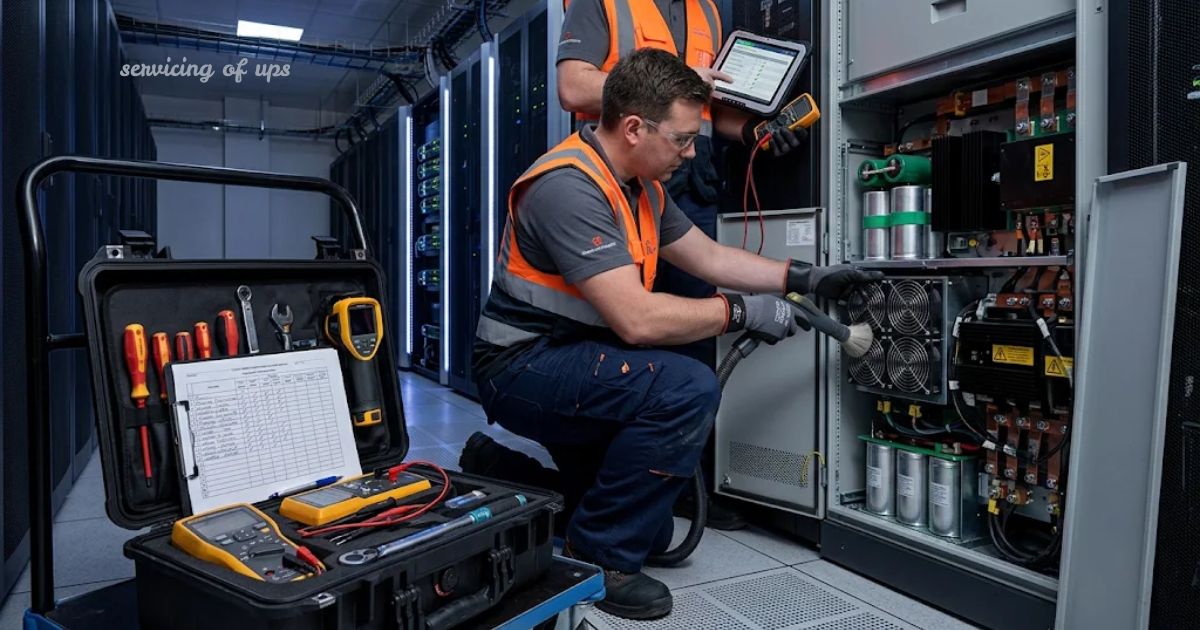
This guide explains how to maintain an uninterruptible power supply (UPS), what technicians check, and how to choose a provider. It covers schedules, battery care, testing, safety, and contracts in plain terms. This site then helps you find servicing of ups without guesswork.
What Is UPS Maintenance and Why Does It Matter?
UPS maintenance means scheduled inspection, testing, and repair so a UPS performs during a power outage. Regular UPS servicing protects uptime and prevents unplanned downtime across the year. It also keeps backup power ready for the one moment nobody can predict.
A neglected unit often fails the first time you need it, and I have watched owners learn that during a storm. Good UPS system maintenance supports power continuity, business continuity, and every critical power load. For critical infrastructure, preventive maintenance replaces weak parts before an outage forces the decision.
Which Facilities Depend Most on UPS Maintenance?
Data centers, hospitals and healthcare facilities, telecommunications sites, and banking and financial services depend on constant power. Manufacturing plants, government facilities, and schools and education campuses also protect sensitive equipment with a UPS. Small offices rely on the same protection for server racks and network infrastructure.
A hospital scanner cannot restart cleanly after sudden power loss, so imaging suites stay on a UPS. Branch offices share that weakness at a smaller scale. I ask every manager what stops working when the lights go out.
How Often Should You Service a UPS?
Most facilities follow a layered maintenance schedule that mixes daily checks, weekly checks, monthly inspections, quarterly service checks, semi-annual maintenance, and annual professional maintenance. Staff handle the quick checks, while a technician handles the deeper work. This mix catches small faults early and keeps the unit inside its rated limits.
Staff glance at alarms daily and check room conditions weekly. Technicians log battery readings monthly and run tests and cleaning quarterly. Whatever maintenance checklist you adopt, post it beside the unit and sign it every single time.
What Belongs on a UPS Maintenance Checklist?
A solid maintenance checklist covers the exterior, interior, batteries, connections, software, and records. Each item gets a pass, a fail, or a note so the next technician sees the history. I keep the list short enough that people actually finish it.
Software items include firmware updates, calibration, and load level verification, while management software shows load and alarm history. Corrective actions fix whatever the checks reveal. I schedule firmware updates for quiet hours, since a restart during business hours defeats the purpose.
What Should a Visual Inspection Cover?
A visual inspection starts with an external check of the UPS enclosure, vents and filters, and front panel display. An internal check follows once the technician isolates the unit safely. The technician looks for dust, heat marks, and anything out of place.
Cleaning dust and debris matters because blocked airflow drives heat, and vacuuming the interior removes what a cloth misses. Checking for corrosion and checking for swelling and leakage reveal trouble early. I photograph anything unusual, because last quarter’s picture settles arguments.
How Do Technicians Maintain Electrical Connections?
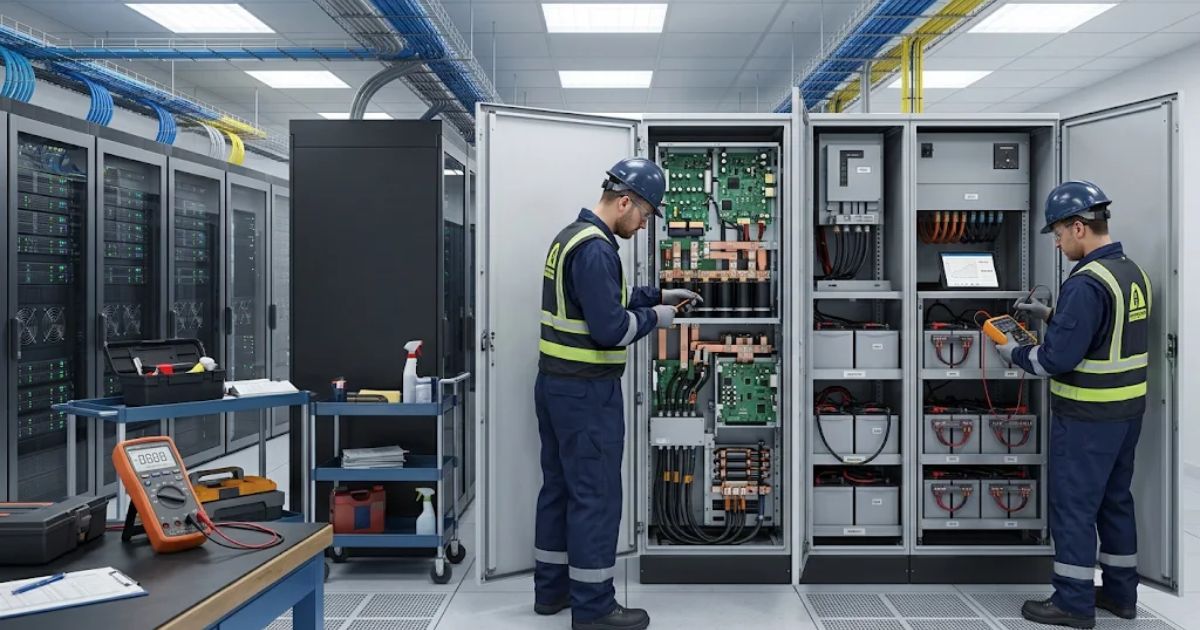
Technicians tighten and verify electrical connections because heat builds at loose joints. They run torque verification on terminals, check cables, wiring and conduit, and inspect MCBs and MCCBs. Tightening connections at battery terminals and battery connections follows the torque values in the manual.
Loose connections create hot spots long before an alarm sounds. A technician also looks for discolored lugs, which signal past heat. I ask providers whether they record torque values for each terminal, since that separates careful work from rushed visits.
How Do You Maintain the Battery Bank?
The battery bank wears out first in most systems, so it deserves the closest attention. Technicians test it, clean it, and track results over time. Battery replacement happens on evidence, and a battery monitoring system fills the gaps between visits.
I once saw a bank that looked spotless yet delivered only minutes of runtime in a test. Cleanliness does not prove capacity. Testing comes before every replacement decision, and a rundown test settles the question.
What Is the Lifespan of UPS Batteries and the Unit Itself?
Sealed lead-acid (SLA) batteries usually reach a 3–5 year battery lifespan, while the UPS itself often reaches a 10–15 year UPS lifespan. Flooded-cell batteries and lithium-ion batteries follow different timelines, so check each datasheet. Heat shortens every one of them.
Set a battery replacement timeline at installation and review it yearly. End-of-life replacement means swapping the whole string, because one weak battery drags down its neighbors. Technicians also schedule capacitor and fan replacement, since capacitors and cooling fans wear out sooner than the frame.
Which Battery Tests Should a Technician Run?
A good test plan combines battery testing, battery capacity testing, load testing, and voltage testing. Impedance testing and internal resistance readings reveal aging cells, while battery rundown testing confirms real runtime. Technicians compare every result against the readings from the last visit.
Float charging current and AC ripple current testing show whether the charger treats the bank properly. Battery equalization helps some flooded designs, and recharging after discharge restores full strength. No single reading tells the whole story.
Which Tools and Tests Catch Problems Early?
Thermal imaging, cable resistance checks, transfer switch testing, and alarm testing find faults that eyes miss. Event logs and fault codes show what the UPS already noticed. Remote monitoring and remote diagnostics let an engineer read the unit between visits.
NOC monitoring watches alarms around the clock at providers that offer it. Technicians also confirm that transfer switches and bypass switches work and that the unit moves between online mode and bypass mode. Lightning arrestors, the cooling system, and a backup generator deserve the same check.
What Causes UPS Failures?
Battery failure, exceeded capacity (overload), overheating, capacitor failure, and fan failure cause most breakdowns. Loose connections and corrosion add to the list. Voltage sags and swells, voltage spikes, harmonics, and electrical noise stress the unit and point to wider power quality issues.
Thermal runaway and gassing signal serious battery trouble, while reduced runtime signals a weak bank. Ignoring these signs leads to data loss and premature failure. Component degradation compounds over time.
How Does the Environment Affect a UPS?
Ambient temperature has the biggest effect on battery life, so a temperature-controlled environment pays off. Humidity control, ventilation, and airflow clearance protect the electronics. A dust-free space completes the setup, and I check each of them during every single visit.
Most battery makers rate SLA batteries near 25°C (77°F), and heat above that shortens their life. Leave clear space around the vents. I have seen units stacked behind storage boxes, and they ran hot.
Which Safety Rules and Standards Apply?
Qualified technicians follow NFPA 70E in the United States, which covers electrical safety in the workplace. IEC 62040 sets international requirements for UPS systems and their testing. Both push crews toward personal protective equipment (PPE), written lockout steps, and careful procedures.
Electrical hazards persist inside a UPS even when it is off, because batteries stay energized. Manufacturer safety guidelines spell out lockout steps for each model. Following manufacturer specifications matters for APC by Schneider Electric, Eaton (formerly Powerware), Vertiv (formerly Liebert), Mitsubishi Electric, Toshiba, Riello, GE Critical Power, and Fuji Electric, because each maker publishes its own procedures.
Why Do Maintenance Records Matter?
Detailed maintenance records show how a unit behaves across years, not just weeks, and they reward steady habits. A maintenance logbook captures readings, and a written service report summarizes each visit. Together they support identifying maintenance trends before those trends become failures.
Trends reveal slow problems, like a battery string that loses runtime every quarter. I ask providers for the report within days of the visit. A clear record also guides system modernization planning.
Which Service Models Can You Choose?
You can choose a maintenance contract, an annual maintenance contract (AMC), a service plan, one-time preventive maintenance, or emergency service. Contracts suit critical sites, while one-time visits suit smaller needs. 24/7 emergency response adds a safety net for outages at night.
A UPS health check or site survey gives you a baseline before you commit. Providers also offer installation and commissioning, UPS repair and replacement, battery life cycle management, battery disposal, and warranty services. A field service engineer usually performs the hands-on work.
What Should You Look for in a Service Provider?
Good servicing of ups starts with qualified technicians, clear response times, a written scope, and proof of testing capability. Ask whether the provider handles your brand and your size of unit. Confirm the service area before you sign, and request a sample report.
Ask what each visit includes, because a vague promise hides gaps. Compare the provider’s test list against this guide. For readers in Washington, DC, confirm coverage directly, because none of the eight provider websites I reviewed mention the District.
Which Providers Publish UPS Maintenance Services?
Eight providers appear in this guide: DC Group, Fuji Electric, Pearce Services, Facility Gateway Corporation (FGC), Nationwide Power, PRIDE Industries, BPC Energy, and Numeric UPS. Each brand offers the services its own website lists for servicing of ups. I describe only what those sites confirm.
DC Group describes inspections, load testing, calibration, checks for early component failure, and help with firmware and software updates. Its menu lists emergency services, battery services, and contracts. Pearce Services publishes four plans named Bronze, Silver, Gold, and Platinum, ranging from annual visits to quarterly maintenance.
Facility Gateway Corporation lists scheduled maintenance, 24/7 emergency service, NOC monitoring, thermal imaging, impedance testing, and nationwide coverage. Nationwide Power states emergency service, proactive maintenance programs, battery life cycle management, and system modernization. PRIDE Industries lists UPS maintenance, scheduled maintenance, and generator testing, and it follows NFPA 70E procedures.
BPC Energy in the UK lists maintenance agreements with 24-hour telephone support, UPS health checks, battery replacement, remote monitoring with SMS or email alerts, and a field service engineer. Numeric UPS in India lists preventive and corrective maintenance with 24×7 support, and its menu includes an annual maintenance contract. Fuji Electric’s page explains how servicing works and stresses qualified personnel with safety equipment, but it states no service offering of its own.
How Does This Website Help You Find Servicing of UPS?
This site gathers what providers publish, so you compare services side by side instead of opening eight tabs. You see maintenance options, testing methods, and emergency coverage in one place. That saves time, especially when a unit already shows alarms.
Use the checklist in this guide as your filter when you compare servicing of ups listings. Then contact two or three providers, confirm they cover Washington, DC, and request a sample report. The site gets you to a shortlist quickly, and the final choice stays yours.
FAQ: Is UPS Maintenance Worth It?
Yes, because a tested UPS gives you warning before an outage, while an untested one gives you none. Preventive visits catch aging batteries and loose connections early, before alarms start. Each fault you catch removes one outage from your future.
FAQ: How Long Does a UPS Battery Last?
Sealed lead-acid (SLA) batteries usually last 3–5 years when the room stays cool and the charger works properly. Heat, frequent discharges, and poor ventilation shorten that range. Yearly battery testing tells you exactly when your own bank reaches its limit.
FAQ: Who Should Service My UPS?
Qualified technicians who follow NFPA 70E and the manufacturer’s published guidelines should handle the work. Ask for proof of training and a sample report before you book a visit. Never open a UPS yourself, since batteries stay energized even when the unit is off.
What Should You Do Next?
Pick a maintenance schedule, write your own checklist from this guide, and choose the service model that matches your risk. Then use this website to compare providers, check which services each one lists, and shortlist two or three for a call. Visit the site today, and you will find servicing of ups faster than searching provider by provider.