

If you’ve been researching MVHR, you’ll know it stands for something that could genuinely change how your home breathes. At Mid-Tech Services, our experience and knowledge shape how we approach designing, creating, and installing ventilation for homes and commercial buildings across the UK and Ireland.
With the energy crisis pushing energy bills higher every year, more people ask us about a sustainable solution that keeps their indoors comfortable without wasting money, and that’s exactly where Mechanical Ventilation with Heat Recovery comes in.
This system, known simply as MVHR, works quietly in the background as a whole-building ventilation setup, pulling stale air out of wet rooms like kitchens and bathrooms and pushing filtered air back into habitable rooms through ducts.
What is an MVHR?
An MVHR is a mechanical ventilation system built around one simple idea: don’t let heat escape when you ventilate a home.
A well-designed MVHR system does this job continuously. Some people call these units an HRV, short for Heat Recovery Systems, but the job stays the same they extract stale moist air from kitchens, bathrooms, and utility rooms.
A typical MVHR system can recover close to 90% of the heat that would otherwise be lost, which means homes stay well ventilated and living spaces and bedrooms get a steady supply of fresh filtered air without losing heat through traditional ventilation methods.
How do these systems work?
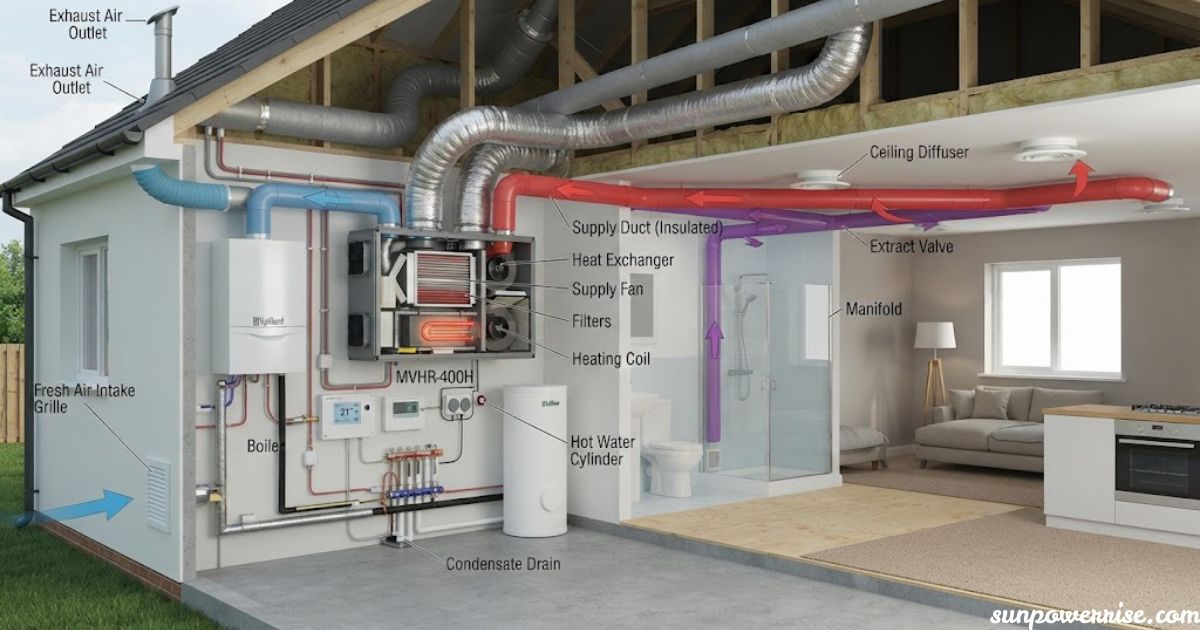
Its daily job starts with air extraction stale air gets pulled from wet rooms such as kitchens and bathrooms, moving through ducts toward the heat recovery cell. Inside, a heat exchanger captures the heat energy from that extracted air before it’s exhausted, then passes it into incoming air through a filtration system, so nothing gets wasted.
Fans pull in air and blow out air, while filters clean out dust and particles, protecting both longevity and system efficiency while boosting indoor air quality.
This whole step-by-step process fresh air intake, heat recovery, and air distribution keeps a continuous airflow and balanced airflow running through the ducted unit, whether it’s an individual unit or one serving the entire home.
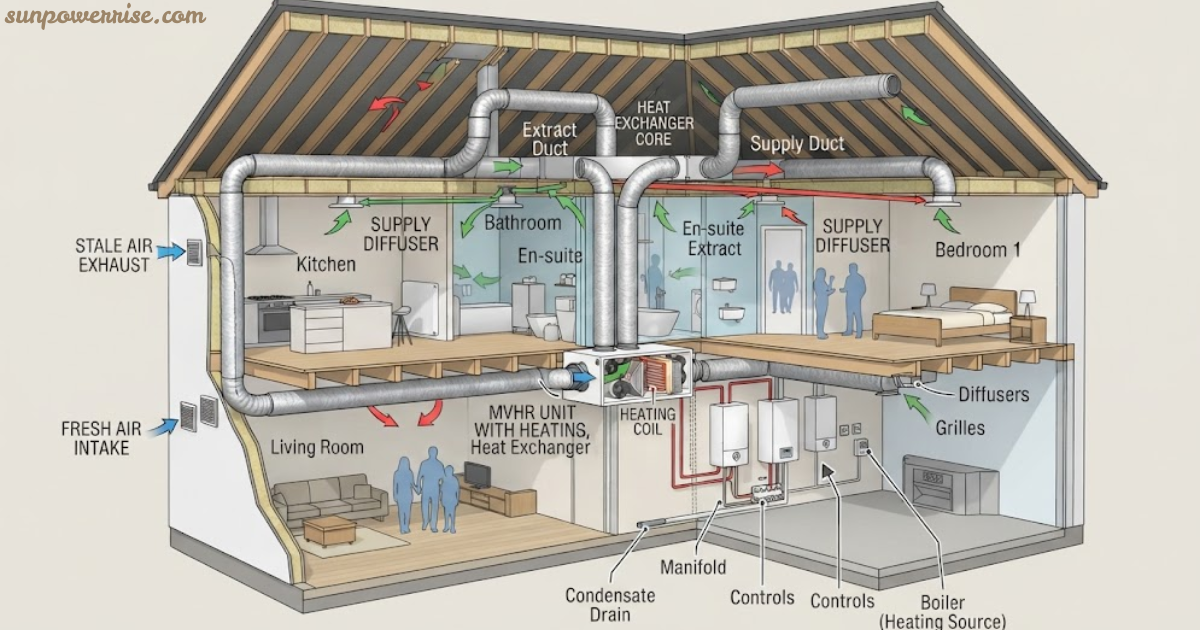
Most mvhr units include a summer bypass that stops overheating by letting the system skip heat recovery when it isn’t needed, and can be adjusted manually or through an electronic sensor. The result is integrated filtration, whole-home air distribution, and consistent air quality, with warm filtered air reaching living areas and bedrooms through the moisture-producing areas’ opposite dry, clean rooms.
Where can It be used?
Mechanical ventilation with heat recovery works well in both houses and flats or apartments, and it’s especially common in premium developments, mainly because the higher cost of purchase and installation is suitable for use where budgets allow for it.
How much does an system cost?
Every MVHR unit comes with its own price tag, shaped by features, functions, and the type of ducting chosen. A semi-rigid ducting system usually costs more upfront than a traditional branch ducting system, yet it’s often cheaper to install because it takes less time, and it also gives you lower audibility.
When budgeting, it helps to break the cost into the five types of costs: design and consulting costs, its unit itself, ducting, installation and commissioning, and ongoing costs like filters.
Property size, layout, ducting complexity, and whether it’s a new build or retrofit all affect the installation type and final system specification.
It’s worth thinking about life-cycle costs too: durability, whether parts can be fixed or switched, and the overall quality, functionality, and service you’re after, because understanding the full system matters more than chasing the cheapest number.
Key Components
Every good mvhr system depends on a handful of essential components working together: the heat exchanger, the ducting, and the filters, each playing its part in energy efficiency and steady indoor air quality.
Why It Is Ideal for the UK & Ireland Climate
UK and Ireland homes deal with high rainfall and humidity, long periods indoors during colder months, and airtight construction standards that make natural ventilation methods like trickle vents or opening windows unreliable and inconsistent whatever the weather.
It offers a controlled reliable solution that maintains airflow regardless of occupancy, and it supports compliance with building regulations, including Part F Ventilation England Wales Ireland and Part K Ventilation Northern Ireland.
MVHR vs Other Ventilation Systems
Compared to extractor fans, which only handle specific rooms, or trickle vents, which depend on passive airflow and external conditions, it delivers proper balanced whole-home ventilation.
PIV (Positive Input Ventilation) can introduce fresh air from a loft space and works in some existing properties, but it doesn’t match it’s ability at retaining heat or its controlled whole-home ventilation.
Air conditioning simply controls temperature without helping to improve ventilation, whereas MVHR units keep continuous whole-home ventilation running, giving you a genuinely complete solution in homes that would otherwise stay inconsistent airtight homes, all while helping to reduce condensation.
Pairing an Air Source Heat Pump for Optimal Performance
Pairing an Air Source Heat Pump with your mvhr system is one of the smartest combinations I’ve recommended, because the heat pump takes air from outside, heats it, and delivers space heating through radiators and underfloor heating, plus hot water.
It’s especially useful if you’re replacing an old coal-fuelled boiler system or one that runs on LPG (liquefied petroleum gas) or oil, since an ASHP can cut your bills by up to 75%. Once installed, the heat pump warms incoming air first, and then the MVHR unit takes over as usual, together making a genuinely energy-efficient solution.
Rather than allowing valuable heat to escape, an MVHR system can recover over 90% of the warmth from outgoing stale air and transfer it to incoming fresh air.
This process helps keep your home comfortable in every season, reduces heating losses in winter, and provides quiet ventilation for improved everyday living.
FAQs
What does an MVHR do?
It removes stale air from wet rooms like kitchens and bathrooms, then recovers the heat and pushes back fresh filtered air through ducts. It keeps your home’s indoor air quality healthy without wasting energy.
Are MVHR systems worth it?
Yes, a good system cuts heating bills, reduces condensation and mould, and gives you cleaner fresh air all year round. For airtight modern homes, it’s less a luxury and more a genuine necessity.
How much does it cost to install an MVHR system in the UK?
Costs vary based on property size, ducting complexity, and installation type, covering everything from its unit itself to design, ducting, and commissioning. Getting a tailored quote is the best way to know your real cost.
What are common MVHR problems?
The main issues include poorly installed ducts causing noise potential, tricky duct concealment, and reduced efficiency if the home isn’t airtight enough. Most of these come down to poor installation, not the system itself.
How long do MVHR systems last?
A well-maintained MVHR unit typically lasts 15 to 25 years, especially with regular filter changes and proper maintenance. Choosing quality components upfront really pays off over the system’s longevity.