

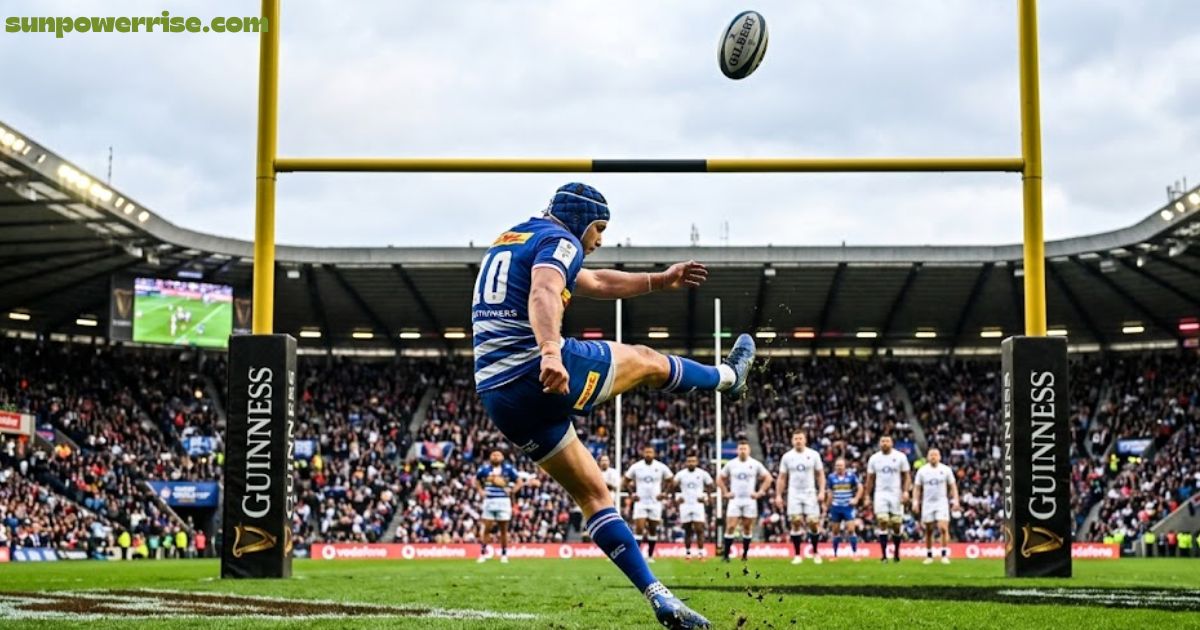
When the home nations crashed out of the Rugby World Cup, focusing on the maths behind every penalty and conversion kick kept my mind busy. Rugby’s odd scoring packets of 3, 5, and 7 quickly became an addictive rabbit hole.
But numbers aside, nothing in the game grabs me quite like the conversion kick. That single kick carries real strategic depth, because it can turn a good afternoon into a winning one, or just as easily tip it toward losing, and that blend of pressure and precision is what makes it feel like true skilful play rather than chance.
I have watched plenty of talented athletes assume this comes down to luck or some kind of natural talent, but that isn’t what I’ve seen up close good conversion kicking is a high-pressure skill built from fundamentals, a trustworthy routine, and repeatable habits rather than raw gift, and once a player accepts the rules of that process, the hesitation before a big kick fades and real confidence takes over, through every set of conversions the game throws at them.
Where the Conversion Kick Must Be Taken From
The Placement Rule
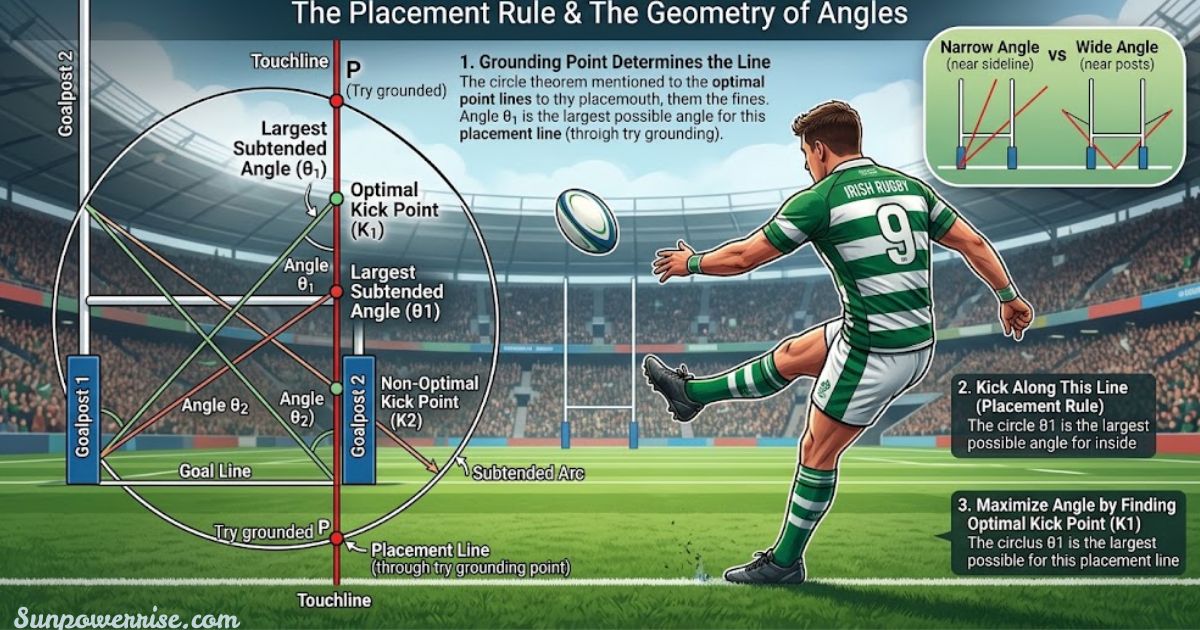
The primary rule for any conversion kick is simple to state but tricky to master: the ball must be kicked back from a line parallel to the touch line, running straight through the exact point where the try was grounded; rugby fans just call it the placement rule.
Impact of Pitch Position
Score right under the posts and the kicker gets a friendly, nearly straight-on kick location; score out near the sideline instead, and that same kicker faces a horribly thin angle, sometimes barely more than a sliver between the goalposts.
Tactical Try Placement
This is exactly why teams push so hard to touch down close to the goal line in the middle, because it turns a nightmare difficult angle into an easier conversion attempt for the scoring team, and every kicker feels that shift in angle the moment they step up to a fresh line.
Using Circle Theorems
Working out the single best place to stand along that vertical line is really a GCSE maths problem hiding inside a rugby pitch. Draw a diagram with a circle running through both posts, and the old circle theorem about angles subtended by the same arc at the circumference being equal does the heavy lifting for you.
A tighter circle gives a bigger, more forgiving maximum angle to aim through, while a larger circle flattens that same shot into a smaller angle, so the ideal position sits at the exact distance where the line just brushes the edge of the smallest possible circle.
Start With Your Alignment and Approach
Everything starts with your alignment, long before you ever strike the ball. I like to picture one straight line running from the ball straight through to my target, and I make sure my body and my approach follow that exact line, because even a small error in angle throws off the whole kick.
A good setup should never feel rushed; whether you take a couple of steps back or drift in from a slight side approach, the movement should feel natural and controlled every single time.
Consistency in how you set up builds familiarity in the body, and that familiarity is what turns a shaky habit into reliable results. The more often you repeat the same striking the ball motion, the more your accuracy improves, kick after kick, match after match.
Build a Consistent Routine You Can Trust
The very best goal kickers all share one habit: a routine they trust completely, no matter the situation. That process might be as simple as placing the ball down carefully, taking one step back, visualising the kick sailing between the posts, and drawing a slow breath before moving in, but whatever the steps are, they stay familiar and natural every time out. A repeatable sequence like this keeps a kicker calm and focused, blocking out distractions even when the whole stadium is watching.
Under real pressure, late in a tight game, this is exactly what saves a kicker from overthinking the routine takes over, sharpens their focus, and lets clean execution happen almost on autopilot.
Focus on a Clean Strike
The outcome of any kick really comes down to your technique, and nothing matters more than a clean strike on the ball. Plenty of beginners try swinging harder to chase extra power, but that usually ends in poor contact and the kind of inconsistency that ruins a good routine.
Force should never be the goal; instead, keep your plant foot stable right beside the ball and let a smooth motion carry your kicking leg through the strike.
Good contact sends the ball toward the target more consistently, holding both its direction and its distance far better than a rushed effort ever could. Let your follow through carry naturally toward the posts, and real power shows up on its own, without you ever forcing it.
Control Your Ball Placement and Angle
Where you rest the ball before a kick changes almost everything about the strike, and small shifts in ball placement and angle alter both the height and the direction the ball travels. Good placement and steady control over the position of the ball matter just as much in open-play conversions as they do off a tee, because tilting the ball slightly forward helps you strike up through it and get real lift.
Finding your ideal setup usually takes some honest experimentation, but once you land on something that works, stick with it, since consistency here is exactly what produces steady results kick after kick.
Keep Your Head Down and Stay Balanced
Balance decides more of a kick’s outcome than most players realise, and if your body is falling away to one side, or your head lifts before the strike, real control disappears fast. Keeping your eyes on the ball and your body centred all the way through gives you stability you can count on, plus a follow-through that drives cleanly forward rather than sliding off sideways.
This kind of steadiness is genuinely what separates accurate goal kicking from wobbly guesswork; it’s the difference between clean accurate kicks and ones that drift wide or fall short of the crossbar.
Practise From Game-Like Positions
It’s tempting to keep practising conversions from the same spot on the field every session, and that habit does sharpen raw technique, but it does very little to prepare you for real match situations. In actual games, tries land all over the pitch, often leaving kickers stuck with difficult angles, so your training needs to copy that mess on purpose.
Working from all kinds of positions builds genuine adaptability and lasting confidence, and over time it turns you into a genuinely reliable option your team can count on, wherever the try happens to land.
Manage Pressure Through Preparation
Pressure feels far less frightening once real preparation is behind you, and lasting confidence grows out of knowing you’ve already done the work through a trusted routine. The more you drill both technique and process in training, the less you need to think about mid-kick, and that quiet mind is what lets you stay composed and pour your energy into clean execution instead of the outcome.
Even small doses of pressure in practice, like setting sharp targets or running full game scenarios, build real mental strength for goal kicking, and they stop overthinking from creeping in when the whole match is riding on one kick.
Consistency Over Perfection
The single biggest mindset shift in goal kicking is realising that consistency beats chasing perfection every time. You don’t need a flawless strike on every attempt; you need technique that stays reliable, built on repeatable habits rather than one-off magic.
Lean into stable performance over flashy moments, and both your accuracy and your confidence will climb steadily as a result.
Strategic Significance of Conversion Placement
There’s a real strategic element hiding inside every try, because smart attacking play aims not just at crossing the line but at positioning the try for the easiest possible conversion opportunity what commentators often call dotting down under the sticks.
Turning a five-point try into a full seven-point score through one clean successful conversion can flip the whole scoreboard, and in tight matches that swing genuinely decides who wins.
Understanding conversion kick rules helps you see the tactical decisions players and teams are making before you even notice them, since scoring the try is only half the job, and the kicker completes the other half with intense focus.
Once you look at rugby this way, you stop watching a single play in isolation and start seeing the full strategy behind every points scored, worth precious extra points on the board, weighing the impact of the game and the true scoring potential locked inside every attack.
Kick Timing and Opposition Rules
Timing matters just as much as technique here, because the kicker must strike the conversion kick within 90 seconds of the try being awarded, or the chance disappears. While that clock runs, the opposing team has to stand behind their own try line, and those opponents cannot charge or advance until the kicker actually starts their run up or kicks the ball.
If the kicker stalls too long or fakes a kick, the opponents are free to move in, which keeps a fair chance for both sides and protects the natural flow of the game. A successful kick simply needs to clear the upright posts and pass above the crossbar nothing more, nothing less.
FAQs
What is a conversion kick in rugby?
A conversion kick is a bonus attempt at two points, taken after a try, aimed between the goalposts and over the crossbar.
Who has the longest recorded conversion kick in rugby history?
Most record-breaking long kicks, like Paul Thorburn’s legendary 64-metre effort, are actually penalty kicks, since exact conversion kick distances aren’t officially tracked the same way.
How long does a rugby player have to take a conversion kick?
A kicker has just 90 seconds from the try to strike the conversion kick, keeping the flow of the game moving.
Can you charge down a conversion kick in rugby league?
Yes, in rugby league, opponents are allowed to charge down a conversion kick once the kicker begins their run up.
Are you allowed to drop kick a conversion?
Yes, a conversion can legally be taken as either a place kick or a drop kick, giving the kicker flexibility in technique.