

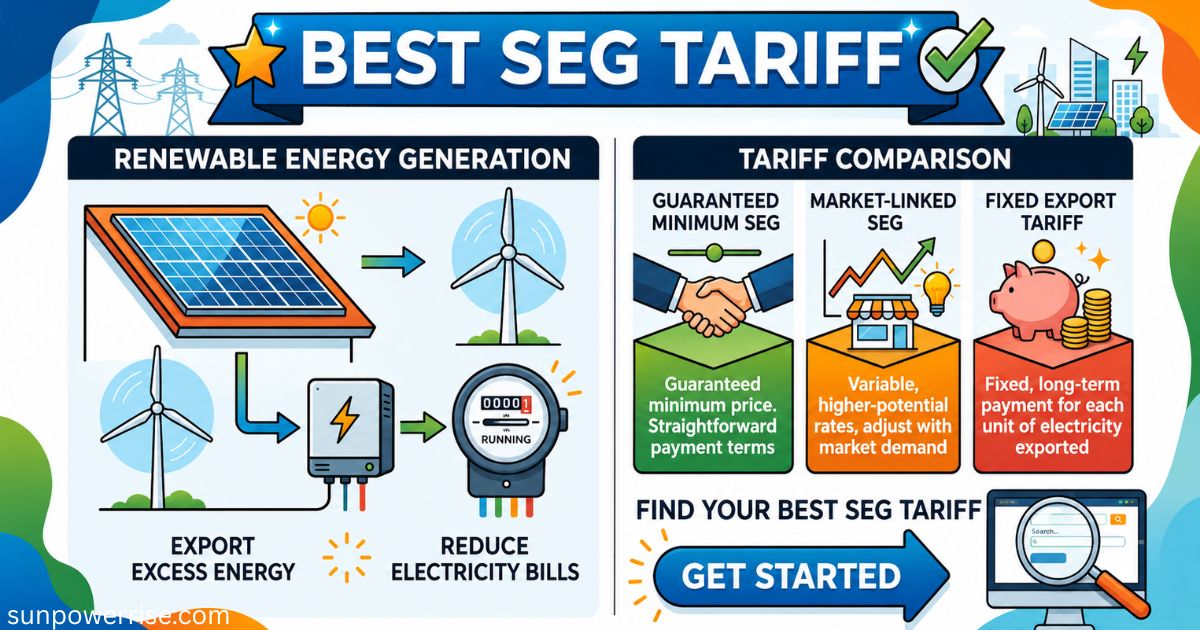
Homeowners searching for the best SEG tariff across the UK started asking about the Smart Export Guarantee the moment the government rolled it out on 1st January 2020 to replace the older Feed-in Tariff (FIT) system.
I’ve watched neighbours switch tariffs purely because their supplier fell into this bracket, since the rule forces a national rate style of fairness even though every provider runs its own per-supplier choice.
Before 2020, exporting renewable energy simply meant generating power and hoping for a fair deal, but FIT had already closed to new applicants, so SEG became the only door left open for new solar panel owners chasing income.
Best SEG Tariff
By 2026, the gap between the worst tariff and the best SEG tariff on the market genuinely surprised me; a typical 5kWp domestic setup with a battery can see a difference of £300–£400 a year, which is not pocket change.
For a non-battery household, Good Energy sits around 15p, while British Gas pays close to 15.1p and E.ON Next touches 16.5p, though both of those demand you take your import supplier from them too.
Octopus Outgoing Fixed dropped from 15p/kWh to 12p/kWh on 1 March 2026, which caught a lot of people off guard who assumed their flat rate was locked in for good.
Shopping around genuinely pays here, because variable rates on tariffs like Octopus Agile Outgoing average only 9.4p/kWh across the year on paper, yet a battery paired with Predbat software can push the effective yield toward 25–30p by targeting daily peaks.
Commercial exporters with half-hourly meters get a similar deal through Octopus Shape Shifters Outgoing, which mirrors the domestic Octopus Agile Outgoing structure but suits businesses rather than eligible homeowners.
SEG only requires a rate above zero, so nothing stops a provider from paying next to nothing, and this is exactly why chasing the best SEG rates 2026 rather than settling for the first flat export rate you see makes such a financial difference for earning money from your electricity.
Current SEG Rates: What Solar Exporters Can Earn
Every time I compare SEG tariffs, I notice how wildly the numbers spread across the same market. So Energy So Bright Export currently leads the pack at 20p, a rate few suppliers come close to, while Ecotricity Smart Export Tariff sits comfortably at 16p and E.ON Next premium export offers 16.5p for those willing to bundle their import with export.
British Gas Export Premium and Fixed options both land near 12p, and OVO Energy SEG Beyond Exclusive matches that figure too, showing that bundled deals often cluster around the same 12.0p mark regardless of brand. EDF Export 12m pays a solid 15p as a Fixed tariff, whereas its standalone sibling EDF SEG Export Variable and EDF Export Variable Value drop right down to 5.6p, a gap that genuinely shocked me the first time I checked it.
Standalone tariffs consistently pay less than bundled ones, and the data proves it: Octopus Energy Smart Export Guarantee Tariff offers 4.1p, E SEG Tariff and Utilita Smart Export Guarantee both sit at 3p, and UW Smart Export Guarantee Standard trails at just 2p.
Looking further down the list, NextExportExclusive and E.ON Next Export Exclusive v3 both offer 13p, NextExport and E.ON Next Flex Export v1 sit at 6p, and Good Energy Solar Savings comes in around 15.0p.
So Energy So Export Flex pays 4.5p, OVO SEG and OVO Energy SEG hover close to 4.0p and 3p depending on the exact plan, Utility Warehouse offers a UW Smart Export Guarantee Bundle at 8p, and older figures from Octopus show Flux near 29p, Intelligent Flux at 29.97p, and Agile reaching as high as 16.22p during peak time-of-day windows.
I checked these figures against data current as of 15 July 2026 and May 2026, and while the exact pence-per-kWh shifts constantly, the statutory minimum SEG rule means no rate can legally reach zero, only get close to it.
How To Choose
Choosing between tariffs comes down to your setup more than brand loyalty. If you skip a battery entirely, the strongest flat rate without touching your import supplier is Good Energy, though British Gas at 15.1p or E.ON Next’s premium export tariff at 16.5p edge slightly ahead if you’re happy to bundle.
I switched a friend’s account last year purely because Octopus Outgoing Fixed had dropped after March 2026, and it no longer made sense as the automatic pick for non-battery homes.
Running a battery with Predbat changes the maths completely, because Octopus Agile Outgoing wins here even though its raw half-hourly rates average only 9.4p/kWh; the variable structure lets Predbat hold exports back until peak windows hit 25–30p/kWh, lifting the effective yield well past any flat rate.
Without that kind of optimisation, a manual schedule risks missing those windows entirely, so a battery owner without Predbat is often safer sticking with a strongest flat rate deal instead.
For anyone running a commercial setup with an HH-settled commercial meter, Octopus Shape Shifters Outgoing mirrors the same logic as the domestic Octopus Agile Outgoing plan, giving the same upside without needing residential eligibility.
Why The Good Rates Are Around 15p And How They’re Funded
The best tariff rates exist because suppliers resell your exported power into wholesale and balancing markets, where average prices often run higher than what they pay you directly.
You collect roughly 15p, and the suppliers pocket the spread between that figure and the wholesale re-sale price it isn’t a subsidy, it’s a genuine market-making spread. This is exactly why the strongest export tariff deals from British Gas and E.ON Next always require bundling your import alongside your export.
Providers like EDF and OVO that don’t actively trade their exported electricity volumes tend to pay closer to the statutory minimum, and that difference explains the wide gap between the worst tariff and the best tariff on today’s market.
Export Tariff Vs The Upfront Incentives
It helps to separate ongoing money from one-time savings. Your export income counts as recurring revenue, while things like 0% VAT on a domestic install (running until 31 March 2027) and AIA tax relief for businesses are one-off effects felt only at the point of purchase.
Both shorten your payback period, and crucially they stack meaning you can still chase the best export tariff every 12 months on top of whatever upfront savings you already banked, rather than treating the two as alternatives.
Future-Proofing For Tariff Changes
Octopus has renamed and repriced its tariff names several times since 2019, yet the underlying structure behind them half-hourly settlement and variable wholesale-linked pricing looks set to stay because it’s now market-mandated.
If your setup already runs on time-of-use export through a battery and a Predbat-controlled inverter, you’ll be able to follow whatever new rates appear without re-configuring kit, which saved me a genuine headache when tariffs changed on a system I helped install.
Smart Export Guarantee vs Feed-in Tariff: Why the Change
FIT worked as a government subsidy with fixed amounts paid for both generation and export, but it closed to new applicants back in 2019, and SEG launched the following year, in 2020, purely as a market-led payment covering exported energy.
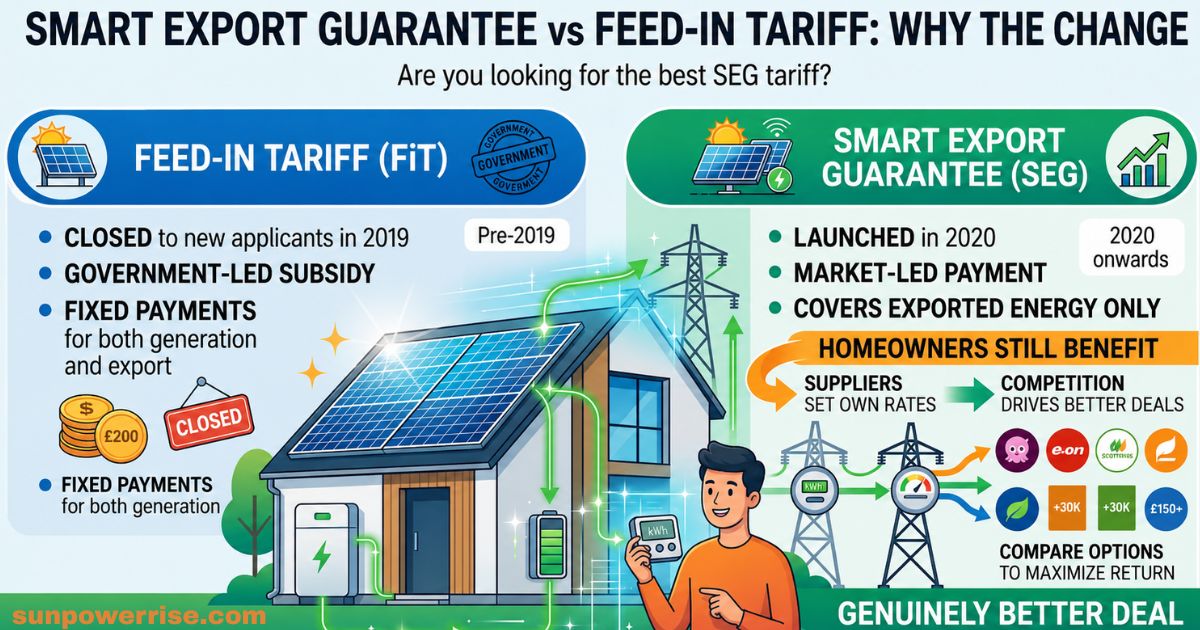
Homeowners still benefit under the newer system because suppliers set their own rates rather than a single fixed figure, which creates real competition between providers and, in my experience, a genuinely better deal for anyone willing to compare options rather than accept whatever their grid connection defaults to for rewarding renewable energy.
Eligibility for a Smart Export Guarantee tariff
Eligibility isn’t complicated, but it does have firm rules for securing the best SEG tariff. You need low-carbon technology that actually creates power solar panels, wind power, hydropower, or anaerobic digestion up to 5MW, plus micro combined heat and power systems under 50kW along with an MCS certificate confirming installation meets safety and performance standards.
A smart meter capable of half-hourly readings is also non-negotiable for finding the best SEG tariff, since suppliers rely on it to track your solar export payments accurately, and some run their own extra eligibility checks, including ownership documents, especially if you’re not already an Own Energy customer or solar panel customer with them.
What if you’re already on a Feed-in tariff?
Being on FIT already doesn’t shut the door on SEG. Your FIT payments split into generation and export, and under the right conditions you can keep your generation payments while switching your solar export payments over to SEG, since the market rate on SEG usually beats FIT export, roughly 15p versus 5.5p in most comparisons.
Before switching, remember that FIT contracts signed before 2020 often guarantee a rate for 20 years or 25 years, whereas SEG tariff rates can market rate decline at any time, you may face an additional cost if you lack a smart meter, and switching away from a deemed export rate where suppliers assume you’re sending 50% of energy to the grid without a meter is a one-way move.
There are also limits on how often you can switch, since you can only opt out once a year, so weighing SEG vs FIT properly before acting matters more than people expect.
What Types Of Best SEG Tariff Options Are Available?
Two structures dominate the market when hunting for the best SEG tariff. Fixed SEG tariffs lock in a set price per kWh for the contract term, usually 12 months, which suits anyone chasing budget certainty, while variable SEG tariffs move with market prices and can rise or fall unpredictably, meaning they carry more risk and stay far less predictable than their fixed counterparts.
FAQs
Who pays the best SEG tariff in the UK?
Currently, Good Energy leads with a flat export rate of around 15p/kWh for those not switching import supplier, while Octopus Energy’s time-of-use tariffs like Intelligent Flux offer even higher peak rates (up to 32p/kWh) for battery owners.
What are the current SEG rates?
UK SEG rates in 2026 range widely from a low of 3–4p/kWh to a high of 25p/kWh, depending on the supplier, whether you have a battery, and if you bundle your import electricity with the same company.
What is the best SEG rate in 2026?
The highest headline rate in 2026 belongs to Good Energy’s Solar Savings Exclusive at 25p/kWh (flat, no battery needed), while battery-owning households can chase Octopus Intelligent Flux’s peak rate of 32.17p/kWh.
Is SEG worth it?
Yes, the Smart Export Guarantee genuinely puts money back in your pocket for unused solar energy, and picking a top-paying tariff over a low one can add £200–£400+ a year to your household savings.
What is the SEG rate for Octopus Energy?
Octopus Energy’s Outgoing tariff currently pays a flat rate of 12p/kWh, down from 15p after a rate cut on 1 March 2026, their first change since 2022.