

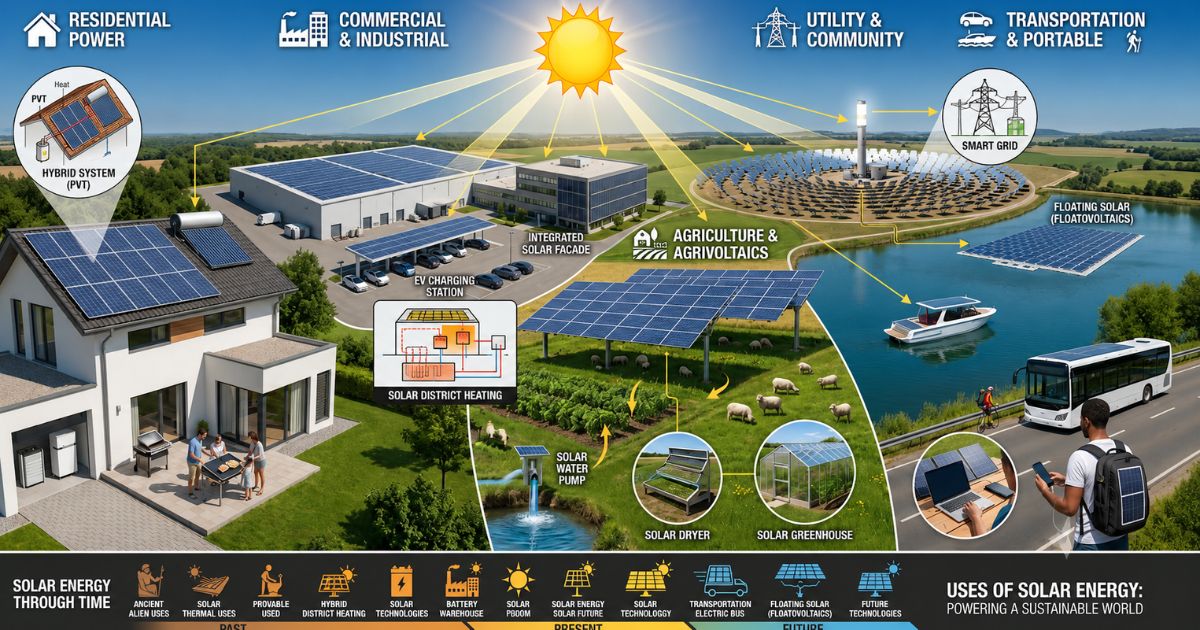
From powering everyday devices to whole homes, the uses of solar energy start with converting sunlight and heat into usable electricity or thermal energy, flexible enough to run everything from a fridge to a calculator to a car.
After spending years around solar installers, I’ve watched these applications transform a neighbourhood, and I still remember the first time I saw a single roof full of panels light up an entire street after sunset.
That moment shapes how I explain things today, so let’s walk through it heading by heading, the way I’d break it down for a neighbour over the backyard fence..
Uses of Solar Energy
Solar Electricity
Of all the practical uses of solar energy, solar electricity is the one I’ve watched gain the most momentum, and it’s the clean power source I trust most in my own home.
A rooftop solar PV system captures sunlight every day and turns it into usable power. Inside each photovoltaic panel, sunlight knocks electrons loose and pushes them across an internal electric field, generating clean, reliable electricity for homes and businesses.
Solar systems installed on homes and businesses send any surplus electricity back to the grid, which lets a property owner run grid-tied or fully off-grid, offset their usage, and bring down solar panel costs over time.
Large-scale solar farms do something similar at scale they sell their output to an energy off-taker, usually a supplier like EDF Energy or OVO Energy. Watching that mechanism work at both the rooftop and the farm level is what convinced me solar electricity earns its reputation.
Solar Water Heating
My own home runs on solar water heating, and honestly, it feels far more environmentally friendly than the old gas boiler it replaced.
A solar water heating system works through a rooftop collector sometimes called a solar geyser that absorbs the sun’s heat and passes it into a heat-transfer fluid. That fluid runs through a heat exchanger, warms the household water, and the hot water then flows into a cylinder for storage, whether that’s for a home or a hotel.
The same setup, with the help of a pump, can push hot water out to swimming pools and jacuzzis too. Collectors typically cost a household between £3,000 and £5,000, and while that’s not pocket change, the running costs are low enough that it stays one of the more cost-effective ways to use solar energy for water.
Solar Space Heating and Passive Design
Beyond water, solar can heat the building itself. Solar space heating systems warm a home through radiant floors or a forced hot air (FHA) system, giving you steady warmth through winter without burning gas.
Passive solar design takes this a step further and needs no equipment at all it’s about how a building is built. Smart window placement, orientation, and the choice of materials let a home trap and hold the sun’s warmth naturally. I’ve seen this work well in both homes and commercial buildings that want to lean on solar without adding hardware.
Solar Transportation and EV Charging
The scientific community expects solar-powered transport to become far more common buses, trains, aeroplanes, and even racing cars are all being tested on solar power today.
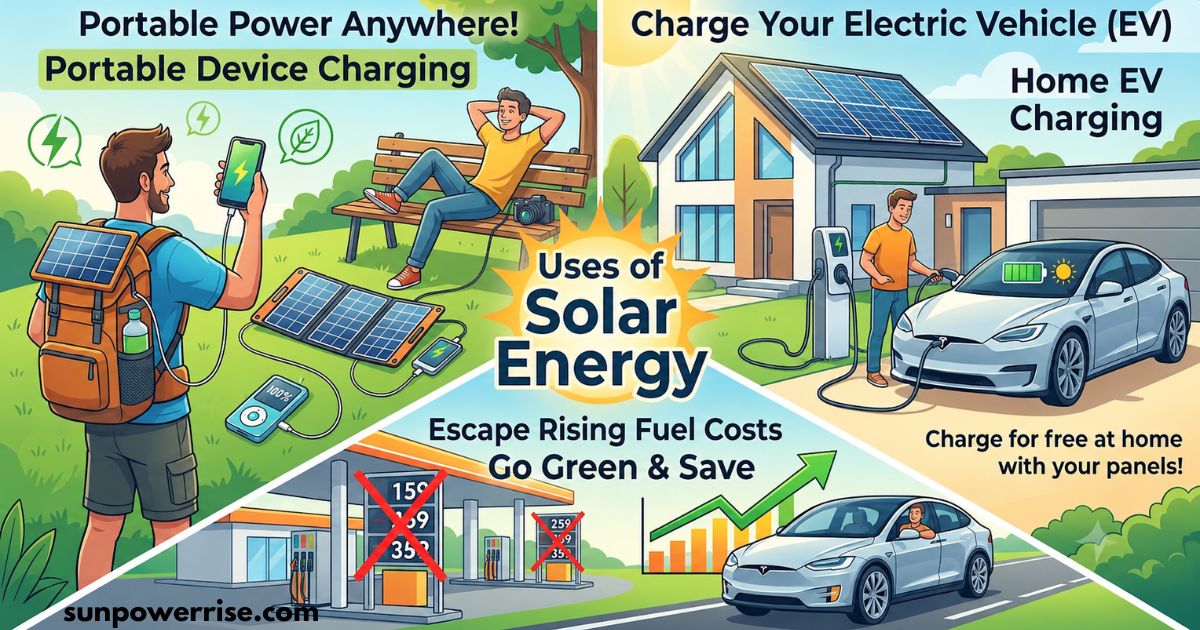
Fully solar-powered cars aren’t mainstream yet, but you can already charge an electric car using solar panels through a solar-connected battery, or set up a home PV system wired to a charging port for EV charging. That setup cuts a household’s reliance on grid power and keeps a hybrid or fully electric car running on sunlight rather than fuel solar and EVs really do belong together.
What Can Be Powered by Solar Energy?
In my solar-powered home, almost everything runs on electricity, from the TV and radio to the lights and every other appliance. I no longer worry about my electricity bill the way I used to, because solar covers most of what I use during the day and a good chunk of what I use after dark too.
Solar Power During the Day
My routine changed the moment the sun came up. I wake up to a solar-powered alarm clock, boil the kettle for morning tea, pull milk from a solar-powered fridge, and check a fully-charged phone all running on clean solar energy, with solar thermal supplying the hot water on top. Every device in the house runs on free daytime electricity right up until the sun sets.
Solar Power at Night
Once the sun goes down, a solar battery attached to the PV system takes over. It holds the surplus energy generated during the day and releases it as stored power overnight running lamps, garden lights, and security lights, and keeping the TV on for free.
Without a battery, any unused electricity just flows back to the grid and you fall back on your supplier after dark; with one, your bill stays low and the lights stay on.
Take Solar Energy With You
Solar doesn’t stop at the front door. Portable solar chargers keep phones, cameras, and other personal devices running wherever you go, and if you drive an electric car, home panels can charge it for free too which also means dodging the ever-rising cost of petrol and diesel.
This portability goes further than most people realise. It’s the same principle that’s kept solar watches ticking since the 1970s the Citizen Eco-Drive is a well-known example and researchers in Japan have been developing lightweight, water-resistant solar cells thin enough to eventually sit inside clothing, so your jacket could one day help charge your phone.
Solar Lighting
Solar lights are everywhere once you start looking for them home landscaping, security lights, road signs, and streetlights.
They’re inexpensive by solar standards, ranging from basic garden stake lights to higher-end fixtures, and you can pick them up at a hardware store or order them online.
Since they need no wiring and no mains connection, they’re one of the easiest ways to shave a little off a monthly electricity bill.
Solar Batteries
A solar battery storage system exists to solve one problem: the sun doesn’t shine on demand. It stores the excess energy your panels generate so you’re not left short on a cloudy day or after dark. This matters even more at the scale of a solar farm, where output can swing a lot depending on the weather storage is what turns an unpredictable supply into something you can actually rely on year-round.
The same idea works in miniature. I carry a portable solar power bank that charges through a USB cable using nothing but sunlight, and for camping or travel it beats a regular power bank simply because it never needs a wall socket to begin with.
Solar Watches
Solar wearables go back further than most people expect. In 1972, Roger Riehl released the Synchronar 2100 the first solar-powered watch, with an angular case and LED time display, running on a battery that effectively never died.
Since that first wave through the 1970s and ’80s, the technology has only gotten more refined and more stylish. Today, established watchmakers like Tissot, Cartier, and Seiko all produce solar-powered watches that look nothing like the Synchronar’s utilitarian design.
Solar Security Cameras
Solar-powered security cameras are often more reliable than wired alternatives, simply because there’s no wiring to fail.
They’re built waterproof and weather-resistant, and most models can be repositioned easily since they’re not tethered to an outlet. They run around the clock charging through the day and drawing on stored power to keep recording through the night.
Solar Calculators
Solar calculators feel like a recent idea, but they’ve been around since 1976, starting with the Sharp EL-8026 the first calculator to run on solar power instead of a battery you’d eventually have to replace. Solar-powered scientific calculators followed in 1982, and they’ve been a fixture in classrooms and exam halls ever since.
How Much Energy Do Solar Panels Generate?
Every solar PV system produces a different output depending on its size, the panel model, and the house it’s fitted to, so it’s worth checking panel sizing before committing to an installation.
Panel output is measured in watts, and most home systems sit somewhere between 200W and 400W per panel. A 300W system will cover most of an average home’s everyday electricity use, while a 200–275W setup suits a tighter budget without giving up much of the carbon savings.
To put that in perspective, here’s roughly what common household appliances draw:
|
Appliance |
Typical Power Draw |
|
Clothes dryer |
1,000–4,000W |
|
Dishwasher |
1,200–1,500W |
|
Washing machine |
500W |
|
Fridge freezer |
150–400W |
|
Desktop computer |
100–450W |
|
49″ LED TV |
85W |
|
LED light bulb |
7–10W |
|
Mobile phone charger |
4–7W |
With a 300W system, I can comfortably run the TV, keep my phone topped up, and keep the fridge freezer going entirely on solar it’s usually the dryer or the dishwasher that still needs a top-up from the grid. Once you weigh that against lower bills and a smaller footprint month after month, the upfront cost stops looking like an expense and starts looking like an investment.
Pros and Cons of Using Solar Energy
After years around installations, I’ll be the first to say solar isn’t a one-sided story, and anyone weighing the pros and cons of using solar energy deserves the honest version, not just the highlight reel.
The pros are the ones I’ve already walked through above: lower electricity bills, a smaller carbon footprint, low ongoing maintenance, and the ability to run everything from a fridge to a security camera on free daytime power. Add in grid export payments and government incentives, and the case for going solar gets stronger every year as panel prices keep falling.
So what are the disadvantages of using solar energy? The upfront cost is the big one: a full rooftop PV system still runs into the thousands before any payback begins, and add-ons like water heating collectors or a home battery stack on top of that.
Output also depends on the weather and the season, so a run of overcast days, like the ones I mentioned in the UK, will always pull generation down. Panels need decent roof space and the right orientation to perform well, which rules some homes out entirely, and without a battery, any power made after the sun sets has to come from the grid instead.
FAQs
What are the uses of solar energy?
From lighting a home to charging an electric vehicle, the uses of solar energy cover electricity, heat, water heating, ventilation, and even portable devices, making it one of the most versatile renewable energy sources around.
What are 5 examples of solar energy?
Five clear examples include solar panels generating electricity, solar water heaters warming your home, solar-powered calculators, solar security cameras, and solar EV charging for your car.
Is solar energy free to use once installed?
Yes, once your solar panels are fitted, the sunlight they capture converts into free electricity for daily use.
How long do solar panels typically last?
Most solar panels last around 25 to 30 years, making them a smart long-term investment for any home.
Can solar energy fully replace grid electricity?
With enough solar panels and a solar battery, many homes can cover most of their electricity needs, though some still rely on the grid for extra energy.