

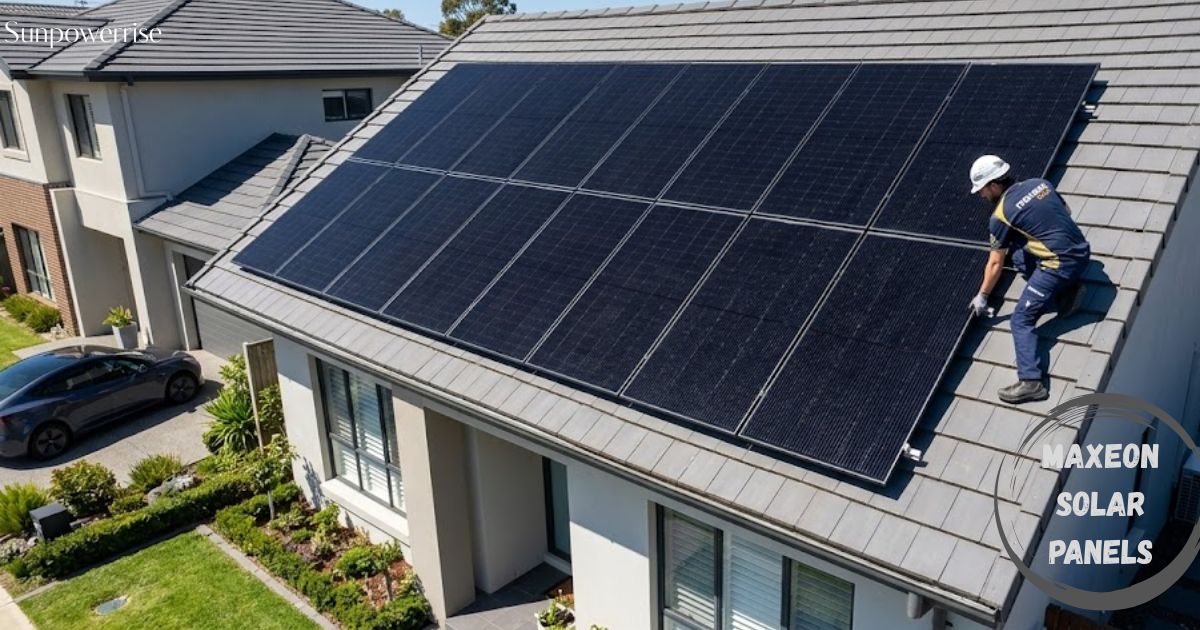
Maxeon solar panels stand out for their premium back-contact technology, approximately 22–24% efficiency, industry-leading 40-year warranties, and some of the slowest power degradation rates available.
They’re also, as of 2026, no longer SunPower’s current flagship, and the company that manufactures them is going through a corporate restructuring that every UK buyer should understand before signing a quote.
This guide covers what the panels actually are, what they cost installed in the UK, how the warranty really works right now, and where the premium is and isn’t worth paying.
How IBC Technology Makes Maxeon Solar Panels Different
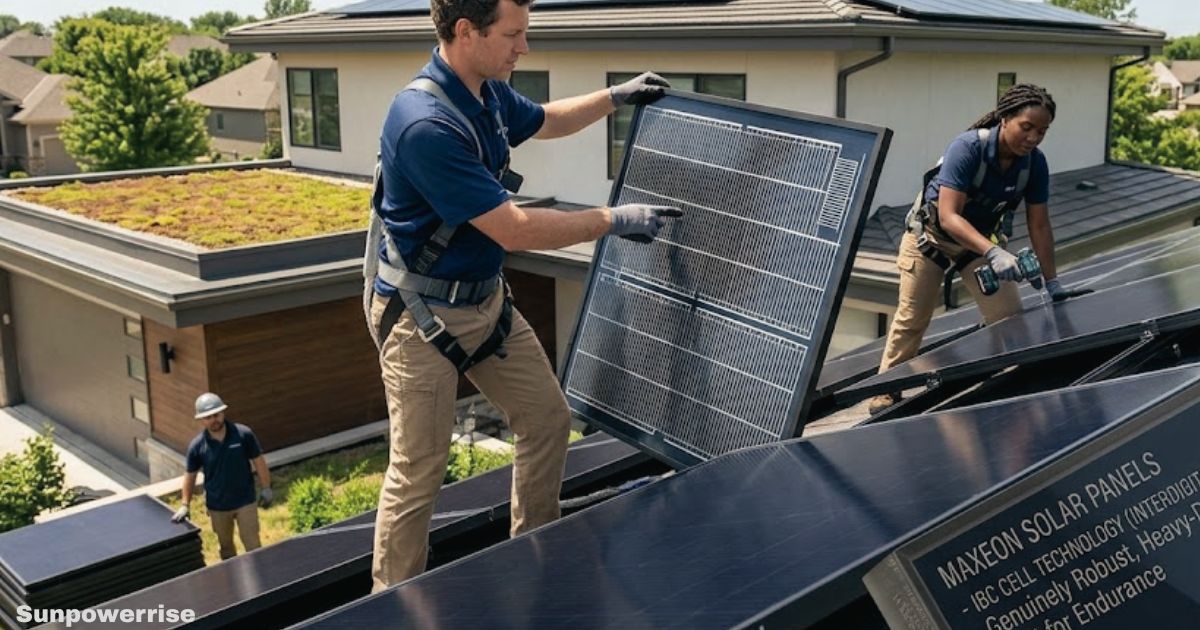
Maxeon builds what’s called an Interdigitated Back Contact (IBC) cell. On a conventional panel, thin metal fingers and busbars run across the front of every cell to carry current away and those lines both shade the silicon and give corrosion and thermal fatigue a place to start.
Maxeon moves all of that wiring to the back of the cell instead, so the entire front face is free to capture light. The upside is a genuine one: a few percentage points more usable surface, a cleaner all-black look with no visible grid lines, and one less common failure path.
Underneath that, each cell sits on a solid copper foundation rather than being connected by thin ribbon wire. That’s the real reason these panels resist the micro-cracking that shortens the life of cheaper panels on a roof that flexes in wind or takes a hail strike not because the cells are simply “bigger,” but because of how they’re electrically joined.
Maxeon has been refining this design since the 1980s, when the back-contact concept was first commercialised out of Stanford research. That decades-long field record into the tens of millions of panels installed is genuinely the reason the company is comfortable writing a 40-year warranty.
It’s also true that SunPower-developed back-contact cells have flown on record-setting solar aircraft and boats; that’s a real and useful credibility point, and it doesn’t need embellishing to land.
Maxeon also owns a separate, lower-cost shingled-cell line (originally built on patents acquired from Solaria in 2023), which cuts standard cells into overlapping strips to remove busbars entirely. This is a genuinely different product from the IBC range, sold at a lower price point with a shorter warranty worth knowing so you don’t compare a shingled quote against IBC pricing by mistake.
Maxeon 7 Is No Longer the Flagship
This is the part most Maxeon guides including earlier versions of this one get wrong by simply being out of date.
SunPower’s UK homeowner range has moved on from the Maxeon 7. The current back-contact flagship is the SunPower M Class, reaching up to 24.5% efficiency and up to 495W per panel, with the same 40-year cover.
The Maxeon 7 hasn’t been withdrawn it’s still being fitted from distributor stock through accredited partners but if a quote lands on your desk specifying “Maxeon 7,” it’s worth asking your installer why you’re not being offered the newer panel instead. Sometimes the honest answer is good stock pricing on the outgoing model. Sometimes it’s an installer working from an old spec sheet.
The manufacturer itself is in real financial difficulty. Maxeon Solar Technologies was placed under interim judicial management by the Singapore High Court on 9 April 2026.
Its shares were suspended from Nasdaq on 1 May 2026, and a further delisting notice followed on 26 May 2026, citing the absence of independent directors on its audit committee and an unfiled annual report.
Degradation and Long-Term Performance
This is where Maxeon’s real advantage sits, and it’s a genuinely strong one; no need to overstate it.
Maxeon warrants its IBC panels to retain at least 98% of their rated output in year one, with degradation capped at just 0.25% per year after that. Run that forward, and you land at roughly 88–89% of original output at year 40, which is the basis for the “40 years of real power” claim.
For comparison, a typical mainstream TOPCon panel is warranted at closer to 0.4–0.5% annual degradation, averaging out to a noticeably lower output over the same period. That gap compounds over decades; it’s the panel’s best argument, stronger than the headline efficiency number.
What is the Maxeon Solar Panels Cost in the UK?
In the UK, Maxeon sits firmly at the top end of residential solar panel prices. Expect to pay roughly £280–£420 per panel installed, depending on system size, roof complexity and which installer you use.
In the UK, a 3.5kW Maxeon system around 8 panels typically costs £6,500 to £8,500 installed. Step up to a 5kW system (about 12 panels) and you’re looking at £8,500 to £11,500. A 7kW system, roughly 16 panels, runs £11,500 to £15,000, while a larger 10kW system with around 24 panels lands between £16,000 and £21,000 installed, as of 2026.
That premium reflects the 40-year warranty, the higher manufacturing cost of copper-backed IBC cells, and lower UK sales volume compared with mass-market brands not, at this point, a clear lead on peak efficiency.
Maxeon vs the Competition
|
Panel |
Cell tech |
Efficiency |
Max wattage |
Warranty |
UK price/panel |
|
Maxeon 7 |
IBC |
up to 24.1% |
445W |
40 yrs |
£280–£420 |
|
SunPower M Class |
Shingled back-contact |
up to 24.5% |
495W |
40 yrs |
Similar tier |
|
Aiko Neostar |
ABC |
up to 24.8% |
500W |
25–30 yrs |
£200–£350 |
|
LONGi Hi-MO X10 |
HPBC 2.0 |
up to 24.0% |
470W |
25–30 yrs |
£160–£300 |
|
Jinko Tiger Neo |
TOPCon |
~22.5% |
450W |
25–30 yrs |
£130–£220 |
Aiko and LONGi are the two names worth actually cross-shopping. Both now match or edge Maxeon on peak efficiency, both offer higher wattage per panel, and both cost noticeably less trading roughly 15 years of paper warranty for it. Maxeon’s case rests on the warranty length and the long field record behind it, not on being the highest-efficiency panel anymore.
A Technical Detail Most Guides Skip
The 112-cell Maxeon 7 has an open-circuit voltage (Voc) of about 83V, roughly double a conventional 440W panel, which sits closer to 38–42V.
That matters because Voc rises further in cold weather, and at a UK winter design temperature it can climb to around 90V. Divide that into a common 600V maximum inverter input, and you typically get six panels per string, which means a ten-panel array needs two strings across two MPPT trackers, or a 1000V-rated inverter.
This isn’t a reason to avoid the panel; it’s a reason to make sure the inverter was chosen to match it. If you’re quoting Maxeon 7, ask your installer directly: which model variant, what’s the inverter’s maximum DC input voltage, and how many strings does the design use? A vague answer to that last question means the design hasn’t actually been done yet.
UK Incentives: 0% VAT and the Smart Export Guarantee
Maxeon panels qualify for 0% VAT on residential installations in the UK, in effect until at least March 2027, applying to panels, inverters, batteries and mounting equipment under the same contract.
They also qualify for the Smart Export Guarantee (SEG), which pays you for electricity you export to the grid, provided installation is by an MCS-certified installer using MCS-listed products. SEG rates vary by supplier, broadly 3–30p per kWh in 2026. Because Maxeon’s higher efficiency generates more surplus on a space-constrained roof, it can modestly increase SEG income though, as above, this rarely closes the price gap on its own.
Pros and Cons of Maxeon Solar Panels
Pros
With a 40-year product, power, and service warranty and a low degradation rate of just 0.25% per year, it offers some of the strongest long-term protection in the residential solar market.
Solid copper-backed IBC cells resist micro-cracking and corrosion better than ribbon-wired panels. Genuinely high efficiency (up to 24.1% on Maxeon 7, up to 24.5% on the current M Class flagship).
Clean, uniform all-black appearance with no visible busbars. Long, well-documented field record: decades of back-contact production data.
Cons
Maxeon panels are among the most expensive on the UK market, typically costing £280–£420 per panel. However, Aiko and LONGi have now caught up with or exceeded their efficiency.
Maxeon Solar Technologies is under judicial management in Singapore as of April 2026; UK warranties are held by a separate TCL entity, which is reassuring but adds a layer buyers should actually understand. The premium rarely pays back on generation savings alone.
Higher open-circuit voltage on some Maxeon 7 variants can constrain string design on common inverters. Sold only through accredited installers, so pricing can’t be shopped around as freely as mainstream brands.
FAQs
Are Maxeon solar panels any good?
Yes, Maxeon panels are known for high efficiency (up to 24.1%) and a rare 40-year warranty, ranking among the best-engineered solar technology available. Sadly, great hardware backed by a shaky company is a hard pill to swallow.
Is Maxeon 7 Still the Best Maxeon Panel on the Market??
No. SunPower’s current UK flagship is the M Class, which beats the Maxeon 7 on efficiency, wattage and year-40 output retention while carrying the same 40-year warranty. The Maxeon 7 is still available and still a strong panel, but it’s the outgoing model.
Why is Maxeon Solar falling?
The stock decline stems from financial distress, U.S. Customs shipment holds, mounting lawsuits, and the company entering court-ordered judicial management in Singapore in 2026.
Is Maxeon Solar a Chinese company?
Not originally, but China’s TCL Zhonghuan became its majority shareholder amid the financial collapse, giving it significant ownership control today.
What Is the Price of Maxeon Solar Panels in the UK?
Typically £280–£420 per panel installed. A 5kW system (around 12 panels) runs roughly £8,500–£11,500 installed, including 0% VAT, in 2026.
Is Maxeon Solar still in business?
Technically yes, panels are still produced and sold but the company is under court-supervised restructuring in Singapore and facing possible Nasdaq delisting, so its future remains uncertain.