


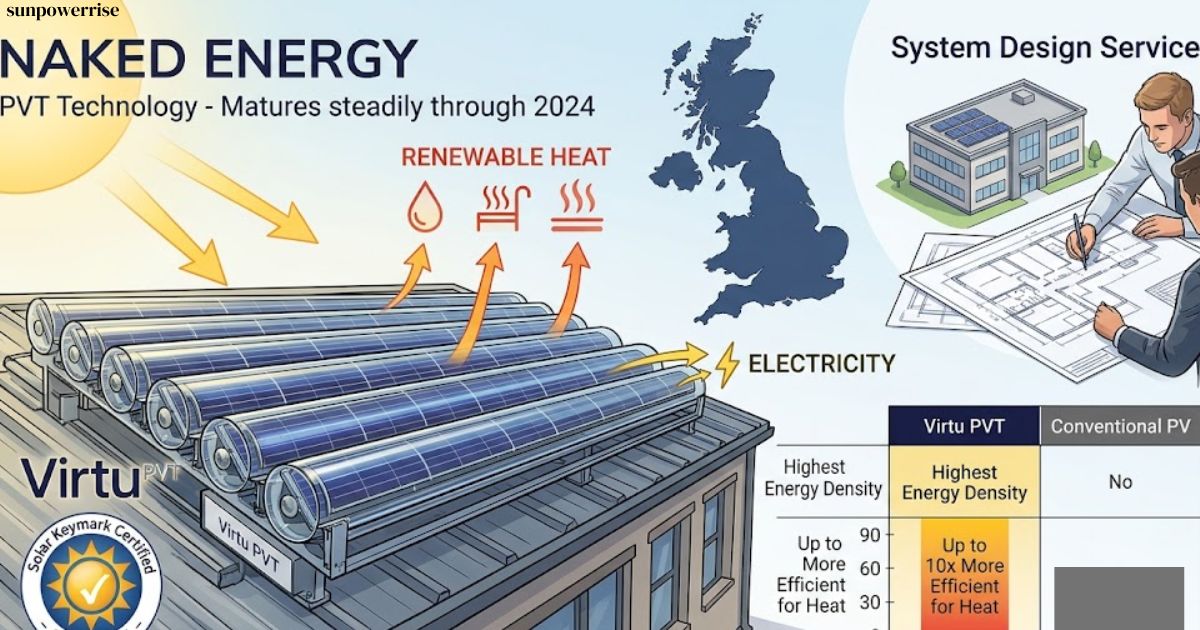
Virtu PVT is a hybrid solar collector made by British company Naked Energy that generates electricity and heat from the same set of evacuated tubes, instead of needing separate solar panels for power and separate ones for hot water.
Each tube houses PV cells alongside a thermal absorber, so a building can pull both outputs from one roof array a design that’s earned it the title of the first evacuated-tube PVT collector in the world to pass TÜV Rhineland testing, and the first anywhere to receive a Solar Keymark certificate, awarded in October 2024.
For commercial and industrial sites with limited roof space but constant demand for both heat and power, that combination is the whole appeal.
Virtu PVT and Virtu HOT: Two Products, One Platform
Naked Energy actually sells two versions built on the same tube architecture. Virtu HOT is the heat-only option, built for sites that need hot water or process heat and nothing else; it can reach up to 120°C.
Virtu PVT is the combined version, delivering both electricity and heat, though because it’s sharing the tube with PV cells, its thermal output tops out lower, around 75°C. Both share the same evacuated-tube engineering, so a site can often mix the two products depending on which roof section needs which output.
How the Tubes Actually Work
Materials and Manufacturing
Each collector is built from 19 cm-wide evacuated glass tubes, inside which an aluminium absorber laminated with PV cells sits alongside a U-shaped copper pipe that carries heat transfer fluid down to a manifold.
The trickiest part of manufacturing, by the company’s own account, is sealing the metal pipe where it exits the glass, a metal-to-glass junction that has to hold under years of thermal cycling. Naked Energy sources its glass tubes from Germany to keep transport distances down and only ships the glass caps from China, with final assembly done in the UK.
Vacuum Insulation and Efficiency Benefits
The vacuum inside each tube does double duty. It cuts thermal losses dramatically, which is what lets the collector produce usable heat even in cold or overcast UK weather, and it also shields the PV cells from humidity while keeping them at a steadier temperature than an exposed panel would run at.
That matters because PV cells lose efficiency as they heat up by drawing waste heat away into the water circuit; Virtu PVT keeps the electrical side running cooler and, as a result, more efficiently than a standalone PV panel sitting in direct sun. On the heat-only side, a single Virtu HOT tube is rated at a peak of 400W, which works out to roughly 615W per square metre of roof once you account for the full array.
Reflectors and Low-Profile Design
Reflectors positioned between the tubes are a big part of why the numbers look the way they do: they catch light that would otherwise miss the tubes entirely, adding up to a 40% lift in peak output and around 15% more energy across the year.
Spacing and tilt angle are also tuned to the site’s latitude, so the array avoids shading itself in winter while still capturing peak summer sun. The whole thing sits about 25 cm above the roofline, low enough to dodge a lot of the planning permission headaches and wind-loading issues that come with bulkier A-frame racking.
What This Actually Means for a Roof
Because the tubes mount low and pack tightly with the reflectors between them, Naked Energy says a Virtu array can occupy over 85% of available roof area, compared with roughly 50% for a conventional solar layout, where panels need gaps to avoid self-shading.
More roof used means more energy per square metre, which is the whole basis for Naked Energy’s claim that Virtu delivers 50 to 100% greater financial returns than a standard solar PV setup, alongside carbon savings running 2 to 10 times higher since it’s offsetting both a heat source (usually gas) and an electricity source at once, not just electricity.
Independent modelling cited by Solar Impulse puts payback at 4 to 8 years with an IRR that can reach 36%, and suggests sites can hit around 50% energy independence with Virtu, against 20% or less from rooftop PV alone.
Where It’s Actually Been Installed
British Library Flagship Project
The highest-profile UK reference is the British Library in London, where 240 Virtu PVT and 710 Virtu HOT collectors cover 712.5 m² of roof, supplying sanitary hot water, space heating, and feeding the dehumidification system that protects the rare books collection.
After its first full year of operation, presented at Eurosun in August 2024, the array’s thermal yield came in at 297 kWh/m² ahead of what was simulated, while the electrical yield of 72 kWh/m² came in about 2.5% under forecast.
Diverse UK and International Installations
Other UK sites show the range of where this gets used. An Oxfordshire Municipality installation is saving an estimated 22.55 tonnes of CO₂ and around £17,000 a year compared with running on gas.
At Swansea University’s Active Office building, 40 Virtu PVT tubes were mounted on the south-facing façade rather than the roof, delivering 2.4kWp of electrical output and 9.6kWp of thermal output, and specifically angled to boost solar gain during the shoulder and winter months when it matters most.
Beyond the UK, Naked Energy has pushed into the US market too, partnering with ELM Companies to install roughly 240 Virtu HOT HD collectors at Creighton University in Omaha, with a peak thermal capacity of 69.9kWp heating water for a 400-student residence hall.
Target Customer Profile
Typical customers across these projects tend to be organisations with steady, year-round heat demand: hospitals, hotels, leisure centres, multi-residential buildings, supermarkets, student accommodation, and food or beverage manufacturing sites, where hot water use doesn’t really let up.
The Business Behind the Tubes
Company History and Design Expertise
Naked Energy was founded in 2012, and Virtu has been commercially available since 2018, with the company now selling into around 20 countries, mostly across Europe.
In 2024, the company also stood up what it calls the UK’s first bespoke system design service from a solar thermal manufacturer, bringing on Sam Notter, a chartered engineer with a background in UK district heating at Vital Energi, plus prior experience at Veolia and Engie, to lead it.
The team uses established modelling platforms like Polysun and EnergyPro alongside an in-house simulation tool to forecast how a Virtu array will actually perform once it’s integrated with a site’s other heating and power systems, rather than leaving customers to guess.
Strategic Funding and Heat-as-a-Service Model
That expansion was backed by a Series B raise in summer 2024, pulling in £17 million from E.ON Energy Infrastructure Solutions and Barclays, both now shareholders in the company.
Part of that deal structures Virtu as a Heat-as-a-Service offering through E.ON EIS, meaning the infrastructure provider covers upfront installation costs so a site can switch to Virtu without the capital outlay showing up on its own balance sheet, a detail that matters a lot to commercial buyers weighing this against a straight PV install.
FAQs Related To Virtu PVT
What are PV-T solar panels?
PVT panels, like Naked Energy’s Virtu PVT collector, combine PV and solar thermal in one unit, producing both electricity and heat at once, so a single roof does double the work.
Are PV-T better than PV?
For most homes, PV-T isn’t simply “better,” but when both heat and electricity are needed, it beats standard PV panels on overall energy density and space efficiency, almost like getting two systems for the price of one.
Is solar PV panels worth buying in the UK?
Yes, with the right installation and steady UK sunshine, solar PV genuinely pays off over time, and honestly, watching your own bills drop each month brings a quiet sense of pride.
Which is better, TOPCon or Bifacial?
TOPCon cells generally deliver stronger peak performance in standard setups, while Bifacial panels capture extra solar energy from reflected light on both sides, so the right choice depends on the installation site.
How many PV panels for 5kW?
Most UK homes need around 12 to 14 panels for a 5kW system, though the exact number shifts slightly based on each panel’s wattage and the roof’s available space.