

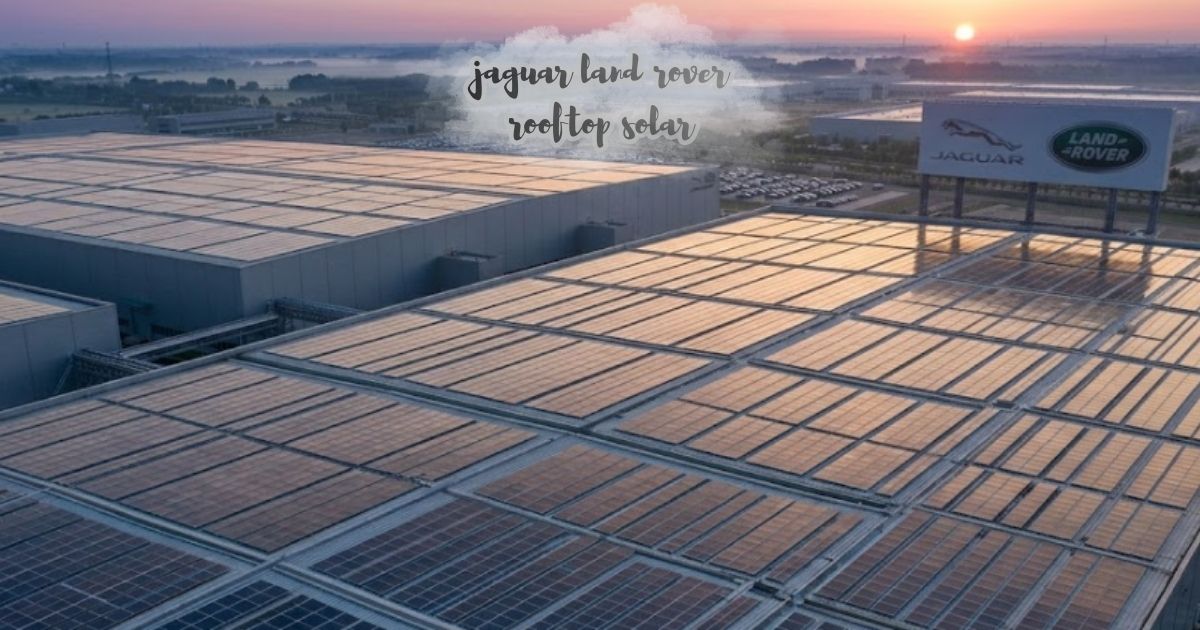
I’ve watched a fair few manufacturers talk about going green, but the Jaguar Land Rover rooftop solar rollout is one of the rare cases where the numbers actually back up the talk.
From a 26-hectare field of panels in the English countryside to a rooftop packed with 18,000 solar panels in the West Midlands, this isn’t a token gesture; it’s a real shift in how a luxury automotive manufacturer keeps its factories running.
Jaguar Land Rover Rooftop Solar
Jaguar Land Rover, known widely as JLR, stands as a luxury automotive manufacturer pushing hard toward lower carbon global operations through a bold renewable energy strategy built on renewables, and the Jaguar Land Rover rooftop solar push sits right at the centre of that story.
On 20 August 2025, the company opened new large-scale solar installations, including a 26-hectare solar farm at its Gaydon HQ that matches a solar farm size of roughly 36 football pitches, alongside the UK’s largest rooftop solar array in Wolverhampton.
This roll-out forms just the first of three UK solar projects meant to cut emissions, reduce reliance on grid energy, and build resilience against cost fluctuations, grid instability, and other disruptions.
JLR’s headquarters and UK headquarters together anchor decarbonisation efforts that fit into a global picture where, according to the IEA, solar PV generation jumped 320 TWh, up 25%, in 2023, reaching more than 1,600 TWh worldwide. These solar energy investments, spanning solar farms, rooftop arrays, and future car ports, show JLR chasing one-third of its global energy from clean power by 2030.
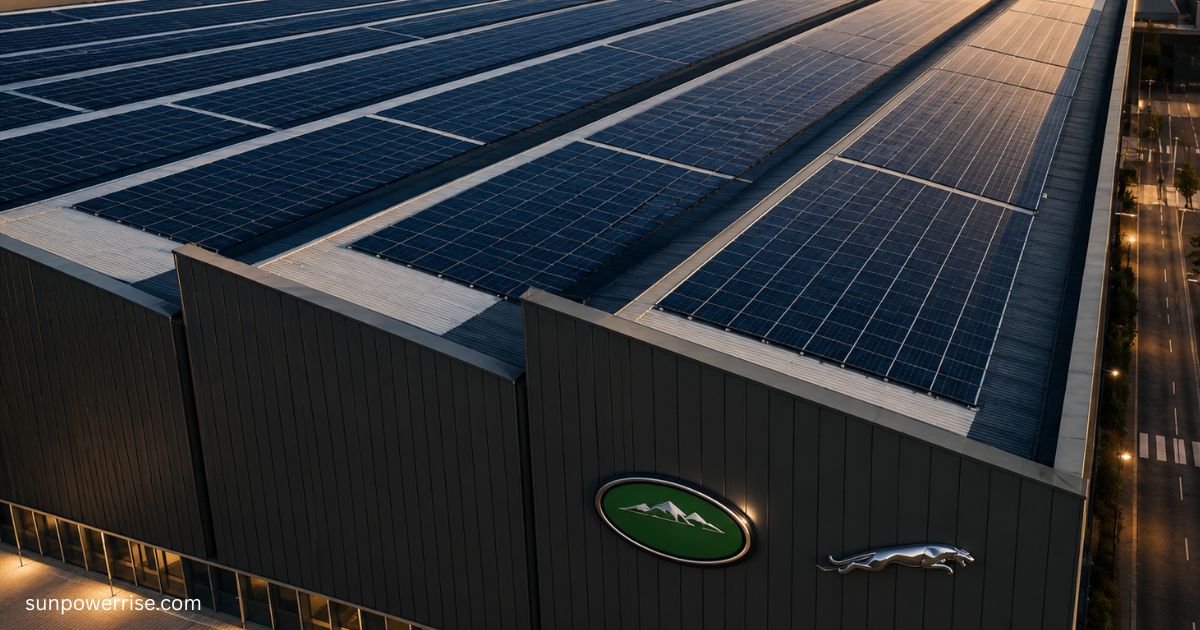
This milestone summer season brought together an 18MW solar PV power plant, a 20MW rooftop boost, and further solar PV plant capacity to strengthen JLR’s global operations against volatile power markets.
Gaydon Solar Farm
At the Gaydon site, home to JLR’s head offices, a new ground-mounted installation spreads across 26 hectares of land, forming a 26-hectare facility with an 18 MW generation capacity that lines up with the wider 18MW solar PV power plant figures used elsewhere.
This ground-mounted panels project can supply 31% of the site energy requirements and covers ground equal to 36 football pitches, marking the completion of the first among three UK solar projects, part of a broader group of three UK solar energy projects and other UK-based solar projects moving through decarbonisation efforts.
This Jaguar Land Rover rooftop solar and ground-mounted expansion shows how much ground JLR is willing to cover to hit its targets. Beyond generating electricity for the plant’s energy demand, JLR has focused on biodiversity at Gaydon, planting native wildflowers and pollinator-friendly species alongside bird-friendly species while restoring hedgerows around the panels.
These biodiversity efforts deliver a biodiversity net gain and a biodiversity uplift that sit well above mandated levels and the mandated level set by regulatory requirements, showing that a working facility can still support nature. Roughly 10% of extra habitat gain beyond the baseline reflects how seriously JLR treats these regulatory requirements at Gaydon.
Wolverhampton EPMC Rooftop Solar
In Wolverhampton, the Electric Propulsion Manufacturing Centre, known as EPMC, is finishing a major rooftop installation this autumn, building on an existing rooftop array and a pre-existing solar array already on site.
The expansion adds more than 18,000 solar panels, pushing the system toward 10.7 MW, also written as 10.7MW, and giving the plant a combined solar capacity, or combined capacity, strong enough to be called the largest automotive manufacturing rooftop solar array and the UK’s largest automotive rooftop array in the country.
Once finished, this rooftop solar PV installation will generate close to 9,512 MWh of electricity annually, delivering clean electricity capable of powering homes for around 3,500 homes across the UK. This rooftop solar capacity covers about 40% of site energy needs, supporting production of electric drive units and batteries used in next-generation vehicles, proving how one system can reshape an entire manufacturing site’s energy story.
Halewood Solar Car Ports
Next year, in 2026, JLR will start building solar car ports and solar carports across its Halewood manufacturing plant in Merseyside, creating what the company calls the largest solar car port in the UK or the largest of its kind anywhere in the country.
Canopy structures and solar walkways will stretch from the main car parks to the site entrances, giving employees and visitors sheltered parking, improved access, and protection from tough weather conditions, plus electric vehicle charging and EV charging points along the way.
This Halewood push follows a £500 million investment made last year in September, when the site expanded and got refitted for growing EV manufacturing, including a rooftop solar PV installation that already meets about 10% of site energy demands each year.
Together, these solar car port plans build on what Halewood already started, keeping JLR’s UK sites moving toward the same clean-energy finish line, with EV charging support growing at every stage.
China / CJLR Rooftop Solar
In China, JLR’s joint venture partner CJLR has pushed hard toward energy self-sufficiency by finishing a 20MW expansion of its rooftop solar array at the manufacturing facility.
Operational since May 2025, this rooftop solar installation now covers more than 50% of the plant electricity consumption and the monthly energy consumption at the site, marking real progress for JLR as a whole.
The system also brings additional shading into the workshop, supporting temperature regulation, enhancing comfort for workers, and reducing energy use through steady energy saving habits.
These gains translate into cost reductions for the site while keeping day-to-day operations comfortable for everyone on the floor.
2030 Target / Emissions Commitment
As a luxury car manufacturer, JLR stays committed to sourcing one-third of its global energy needs from onsite renewables and near-site renewables in place of natural gas by 2030, a plan built for cutting emissions, energy resilience, and self-reliance against market volatility.
Through energy switching and efficiency measures, JLR has already reached a 23.4% reduction in operational emissions compared with its FY19/20 location-based baseline, proving that clean power targets can move from paper into real, measurable progress. In many ways, the Jaguar Land Rover rooftop solar program is the clearest proof point of that whole 2030 strategy.
Beyond JLR: The Wider Solar Picture
Beyond its own projects, JLR keeps exploring tailored renewable energy solutions and low carbon energy solutions site by site, including solar, wind, and hydrogen options suited to each location.
Other manufacturers are moving too: Ford Motor Company installed a 5.2MWp solar PV array at its Dunton Campus, a research and development facility, expected to cover about 10% of its 55,000MWh electricity demand, while an earlier project sits at the Daventry site, and a solar PV array installed near the Halewood facility serves a nearby gearboxes factory.
Government policy backs this rooftop solar deployment nationally too. The Clean Power 2030 Action Plan, published in December 2024, sets the UK clean power target at 45-57 GW of solar by 2030, well above the 18.1 GW recorded in March 2025, with room for another 9-10 GW from rooftop projects alone.
Globally, the IEA reports that generation jumped 320 TWh, up 25%, in 2023, topping 1,600 TWh worldwide a trend that ties neatly back into JLR’s own 2030 ambitions.
FAQs
How much energy does JLR’s Gaydon solar farm produce?
The Gaydon solar farm is an 18MW, 26-hectare installation that can supply up to 31% of the site’s energy needs and it’s the first of three UK solar projects JLR is rolling out.
What makes the Wolverhampton rooftop array the UK’s largest?
With over 18,000 solar panels and a 10.7MW capacity, the EPMC rooftop installation generates about 9,512 MWh a year, enough to power roughly 3,500 homes, making it the UK’s largest automotive manufacturing rooftop solar array.
How much of CJLR’s energy in China comes from solar?
Since its 20MW rooftop expansion became operational in May 2025, JLR’s China joint venture CJLR now covers more than 50% of its monthly energy use from rooftop solar.
What is JLR’s overall renewable energy target for 2030?
JLR is aiming to source one-third of its global energy needs from onsite and near-site renewables by 2030, and has already cut operational emissions by 23.4% against its FY19/20 baseline.
Is JLR the only carmaker investing in solar power?
No, Ford Motor Company has also installed solar arrays at its Dunton and Daventry sites, part of a wider UK push under the government’s Clean Power 2030 Action Plan, which targets 45-57 GW of solar capacity nationally.