

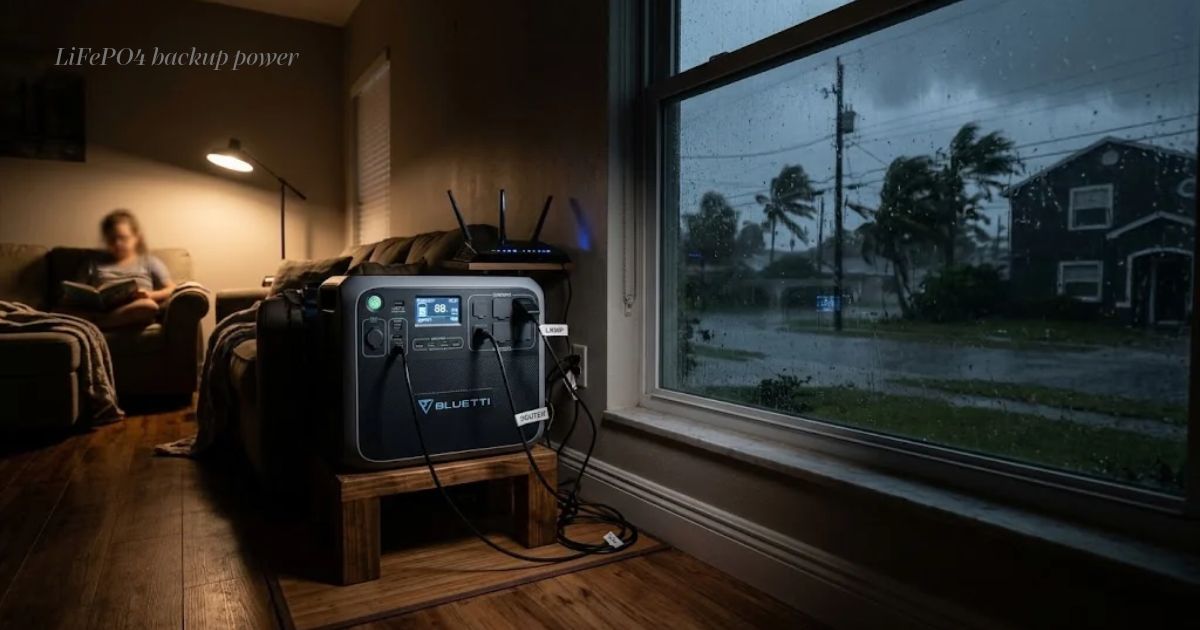
LiFePO4 backup power stores electricity in a battery and feeds your essential loads when the grid drops during a power outage. I have helped neighbors size lithium iron phosphate systems before hurricane season, and the LFP battery keeps earning their trust. This guide explains the basics in plain words for Tampa, Florida families.
How Does a LiFePO4 Battery Work?
During charging, lithium ions travel from the iron phosphate (FePO4) cathode into the graphite anode. During discharge, they travel back and push electrons through your connected devices. An inverter then turns that flow into household power the moment grid failure hits.
This lithium-ion chemistry avoids cobalt, so it stays cobalt-free and relies on non-toxic materials. Its charge/discharge efficiency stays high, so little energy escapes as heat. In my tests, the thermal stability and chemical stability show up as a battery that stays calm under heavy loads.
Is a LiFePO4 Battery Safe for My Home?
Yes, it ranks among the safest lithium battery options for home use today. Iron phosphate resists the thermal runaway that can damage weaker lithium cells. Reputable brands also earn independent safety certifications and build in a battery management system (BMS) for protection.
The BMS gives you overcharge protection, over-discharge protection, and over-current protection on one board. It also runs active balancing so every cell stays even. Cold-weather models add a low-temperature cutoff or a self-heating battery, and Bluetooth battery monitoring shows live data on your phone.
How Long Does a LiFePO4 Battery Last?
Most makers promise 5,000-8,000 cycles, which can mean a 10-year lifespan with normal use. Some brands publish tighter numbers, such as 3,000 cycles at 80% capacity. Always read the battery lifespan claim on the spec sheet before you spend any money.
Cycle life counts full charge-and-discharge rounds, while capacity retention shows how much power remains afterward. A true deep cycle battery handles a deep depth of discharge (DoD) without damage. I also look for Grade A cells in a prismatic cells layout, because cheap cells fade sooner.
How Does LiFePO4 Compare With Other Batteries?
LiFePO4 trades some size for better safety and life. In LiFePO4 vs lithium-ion, the standard cell wins on energy density, which is why phones use it. The lower energy density trade-off means a slightly larger pack for the same power.
In LiFePO4 vs lead-acid, lithium wins on lifespan, because lead-acid typically lasts only 500-1,000 cycles. LiFePO4 vs AGM shows that AGM batteries hate deep draining. LiFePO4 vs NMC, LiFePO4 vs LiCoO2, and LiFePO4 vs LiMn2O4 all favor LiFePO4 on safety, though NMC and cobalt cells beat it on size.
Is a LiFePO4 Battery Worth the Money?
For most backup buyers, yes, because the savings add up over the years. The lithium vs lead-acid cost gap shrinks once you count replacements, and a maintenance-free battery saves your weekends. Recyclable batteries with a decade of life also cut waste.
Judge total cost of ownership instead of sticker price. Long-term cost savings come from fewer swaps, low maintenance, and lower operational costs. Your return on investment improves, and a smaller battery replacement cost finishes the case.
How Do I Size a Battery Backup?
Start by separating critical loads from nice-to-have devices, not by shopping for the biggest box. Battery backup sizing begins with a device list and an energy budget in watt-hours (Wh). Big systems use kilowatt-hours (kWh), and amp-hours (Ah) times voltage gives you watt-hours.
A load calculation multiplies average load by hours of use. Your runtime estimate equals watt-hours times 0.9 divided by device watts, so a 1,190 Wh unit feeding 100 watts lasts about 10.7 hours. A runtime calculator automates that math, and reserve capacity keeps you from draining to zero.
What Do Running Watts, Surge Watts, and Inverters Mean?
Running watts show what a device uses steadily, while surge wattage shows the brief spike at startup. Motors and compressors create that startup demand for a second or two. Your inverter output and continuous output watts must cover both numbers.
Choose a pure sine wave inverter for laptops and medical gear. Recharge rate and solar input limit decide how fast you refill, and a MPPT solar charge controller squeezes more from each panel. Quick recharge matters most when usable capacity and conversion efficiency trim your real runtime.
What Is the Difference Between a Portable Power Station and a Home Battery?
A portable power station plugs devices in directly, while a fixed system ties into your panel. A portable LFP power station suits renters, and a solar generator adds panels for daily refills. An LFP home battery backup of either type delivers silent power with no exhaust.
Whole-home battery backup needs a home energy storage system (ESS) and often residential energy storage hardware. Commercial energy storage and industrial energy storage scale that idea to stores and factories. Voltage matters too, since 120V vs 240V and split-phase power decide which appliances run.
How Do I Choose the Right Voltage and Battery Size?
Match your system voltage to the job you want it to do. A 12V LiFePO4 battery fits RVs and small kits, a 24V LiFePO4 battery suits mid-size systems, and a 48V LiFePO4 battery drives most home setups. Higher voltage means lower current and thinner cables.
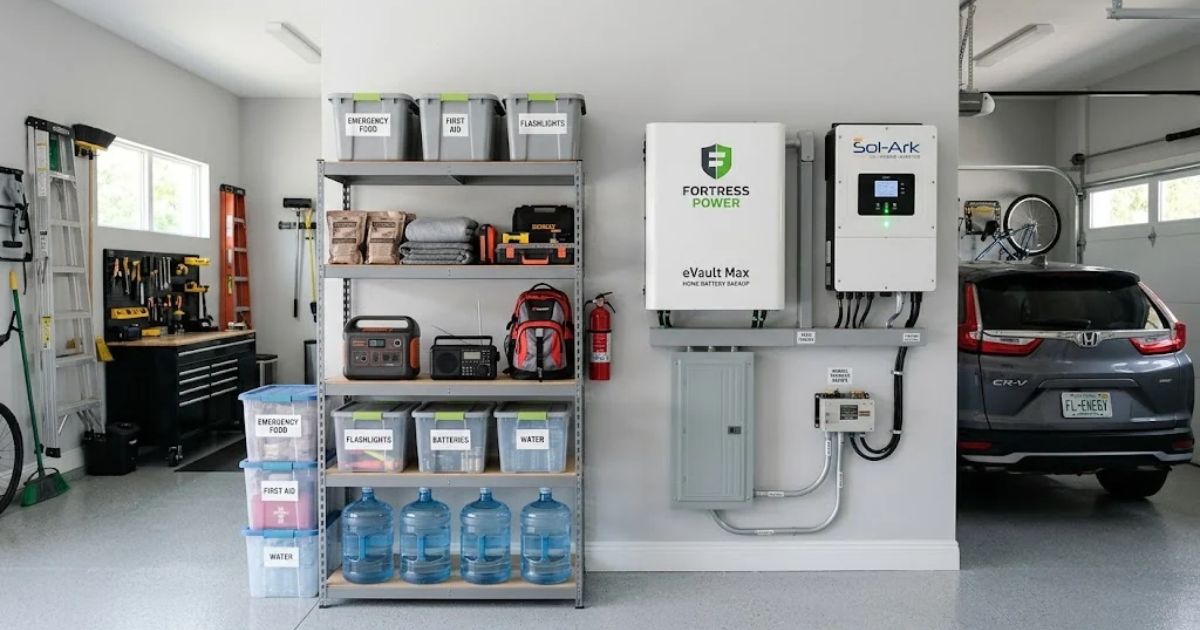
Many homeowners start with a 5kWh / 10kWh battery in a wall-mounted battery or floor-standing battery case. Modular battery storage lets you grow later through parallel battery connection or an expansion battery. A server rack battery inside a battery cabinet keeps big banks tidy.
Which Inverter and Gear Do I Need?
A hybrid inverter manages solar, battery, and grid in one box, and an all-in-one inverter adds the charger inside. An off-grid inverter works without the utility, while a grid-tied system shuts down during outages unless you add a battery. A complete off-grid power system combines all of these parts.
Protect wiring with a circuit breaker and a fuse holder. A battery monitor with a shunt tracks every amp, and a DC combiner box joins solar strings. Always use a LiFePO4 battery charger built for this chemistry.
How Does the Battery Take Over When the Grid Fails?
A transfer switch moves your home from the grid to the battery safely. An interlock kit offers a cheaper manual version at the panel, while automatic transfer switches within moments. I prefer automatic setups because nobody fumbles in the dark.
UPS mode works like an uninterruptible power supply for routers and computers, and a seamless transfer time under 10 milliseconds keeps them running. An inverter bypass passes grid power through when the battery rests. Never risk backfeeding by plugging a unit into a wall outlet.
Does Solar Make a LiFePO4 Backup Last Longer?
Yes, because panels refill the battery every sunny day while the grid stays down. Solar-plus-storage turns a one-night backup into a multi-day plan for your home. A 420W array produces at most 1,680 Wh from four full-sun hours before real-world losses.
Portable solar panels fold up for renters, while roof solar panels suit owners, and a bifacial solar panel also catches light from behind. Together they form a quiet generator alternative, an eco-friendly choice that cuts your carbon footprint. They also support sustainable energy, energy independence, and energy resilience at home.
What Can a LiFePO4 Backup Run During an Outage?
During a blackout, start with the low-draw items first. Wi-Fi router backup and modem and router power need only about 20 watts together. Laptop charging, LED lighting, and a box fan add little more, at roughly 60, 20, and 60 watts.
CPAP backup power needs about 40 watts, so a 1,190 Wh pack runs one for roughly 27 hours. Medical equipment backup needs advice from your doctor and the device maker first. For refrigerator backup and freezer backup, measure real energy use over several hours.
What Can’t a Portable Battery Run Well?
Heating, cooling, and big motors drain portable batteries fast. Space heater limitations show up quickly, because a 1,500-watt heater empties a 2,083 Wh pack in about 75 minutes. Central air conditioning limitations also bite, since it needs 240V and a large surge.
A 240V well pump needs a larger fixed system, and Level 2 EV charging pulls more than any portable unit offers. Plan food carefully, because food safety during outage guidance says an unopened fridge stays cold only about four hours. A full freezer holds roughly 48 hours if you keep the door closed.
Can I Use LiFePO4 for RVs, Boats, and Camping?
Yes, the same chemistry works well far from your house. RV power and camper van battery setups love the light weight, while a marine battery or trolling motor battery handles long, deep draws on the water. A golf cart battery gains range and drops the watering chore.
Camping power feels easy with a compact unit, and remote property power keeps gates and cameras alive. In my experience, a small pack handles weekend trips without fuss. Adding a folding panel tops it off between outings.
Why Does Tampa Need a Home Battery?
Tampa sits in hurricane-prone Florida, where storms regularly knock down power lines and flood streets. Gulf Coast storms can leave Tampa Bay area neighborhoods dark for several days at a time. Florida power outages also follow ordinary summer thunderstorms across the region.
Tampa utility outages strike fast, and crews in Hillsborough County restore streets in stages. Tampa home battery backup keeps your lights, fan, and internet alive meanwhile. Tampa hurricane preparedness should list a battery beside water and flashlights.
How Does Florida Heat Affect the Battery?
Heat shortens battery life, so shade and airflow matter. Florida heat and humidity push inverter fans harder, and the temperature limits on the label tell you how hot is too hot. Keep units off garage floors that bake in summer.
Good ventilation prevents overheating, and a dry shelf keeps moisture away. Follow the maker’s storage and maintenance rules, and park idle packs near mid-range state of charge (SOC). Unlike a gas generator, a battery makes no carbon monoxide, and clear space around it adds fire safety.
Which Safety Certifications Should I Look For?
Look for recognized UL marks first, because they show that independent labs tested the product. UL 1973 covers stationary batteries, UL 9540 covers complete storage systems, and UL 9540A tests fire spread. UL 2743 applies to portable power packs, such as plug-in units.
Inverters often carry UL 1741, and some products list CEC certified status. Vehicle-style batteries may cite ECE R10. A clear warranty backs those marks up.
FAQs
Who Should Install a Home Battery in Tampa?
Hire a licensed electrician for any panel connection or hardwired battery installation. Florida building codes and installation codes govern mounting and wiring, and permitting protects you if an inspector visits. Portable plug-in units skip that work entirely, so renters can relax.
Look for Florida solar installers with real battery experience and ask for references. Ask to see photos of past jobs, not just brochures. I also confirm who handles service when something fails.
Do Hospitals and Data Centers Use LiFePO4?
Yes, many critical infrastructure sites around the country rely on it. Healthcare facilities and hospitals need constant power for patient equipment, while data centers and server rooms protect files from sudden drops. Telecommunications towers need the same steady backup around the clock.
These sites demand uninterrupted communication, downtime prevention, and business continuity above all. LiFePO4 supports power system stability because it absorbs voltage fluctuations and power dips. That same strength helps a bakery or a home.
How Do I Prepare for a Long Outage?
Hurricane preparedness starts weeks before the storm arrives, not when the sirens sound. Keep a short, printed outage checklist with your emergency preparedness supplies, and add emergency power to the same kit. Charge the battery fully the week before June, then test it.
Run a two-hour outage test and write an outage log afterward. For storm backup power, plan for a multi-day outage with solar. A solid overnight backup and essential-load backup cover most homes, so start small and grow.