

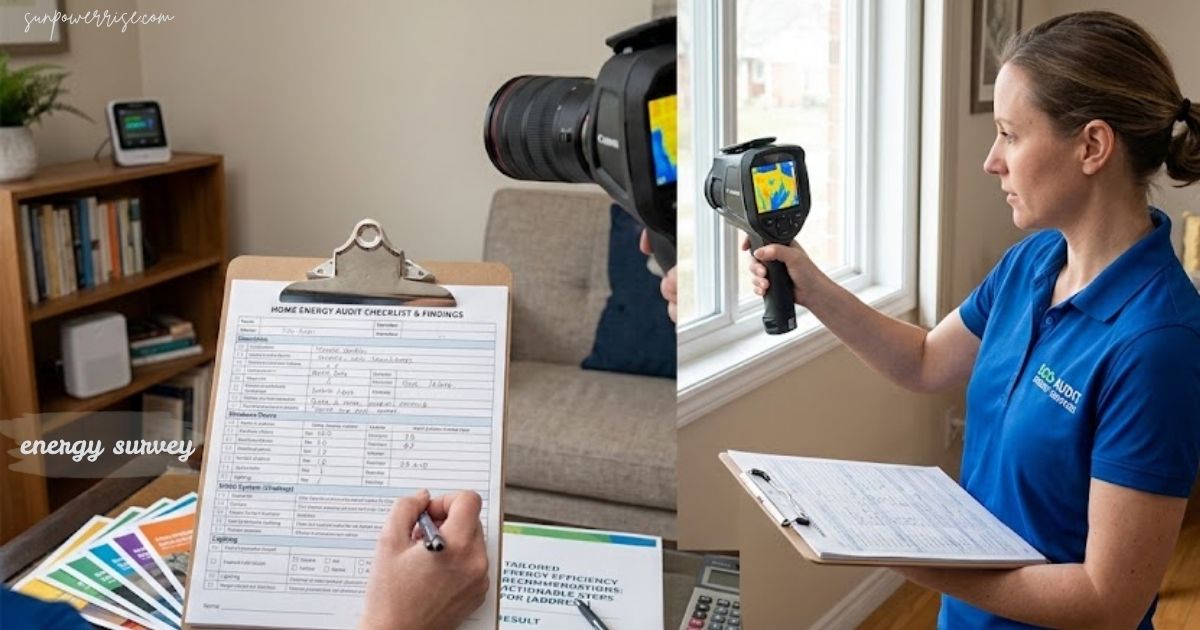
Every property starts telling you a story about how it uses power the moment you know where to look, and that story usually begins with an energy survey.
I remember visiting a semi-detached home last winter where rising bills were traced to inefficient heating systems and poor insulation, highlighting how a home energy survey assesses a property’s energy status, including thermal imaging and heat loss around doors and windows.
What Is An Energy Survey?
An energy survey is really just a detailed inspection and analysis of how a building or home uses power, and it usually results in tailored recommendations you can actually act on.
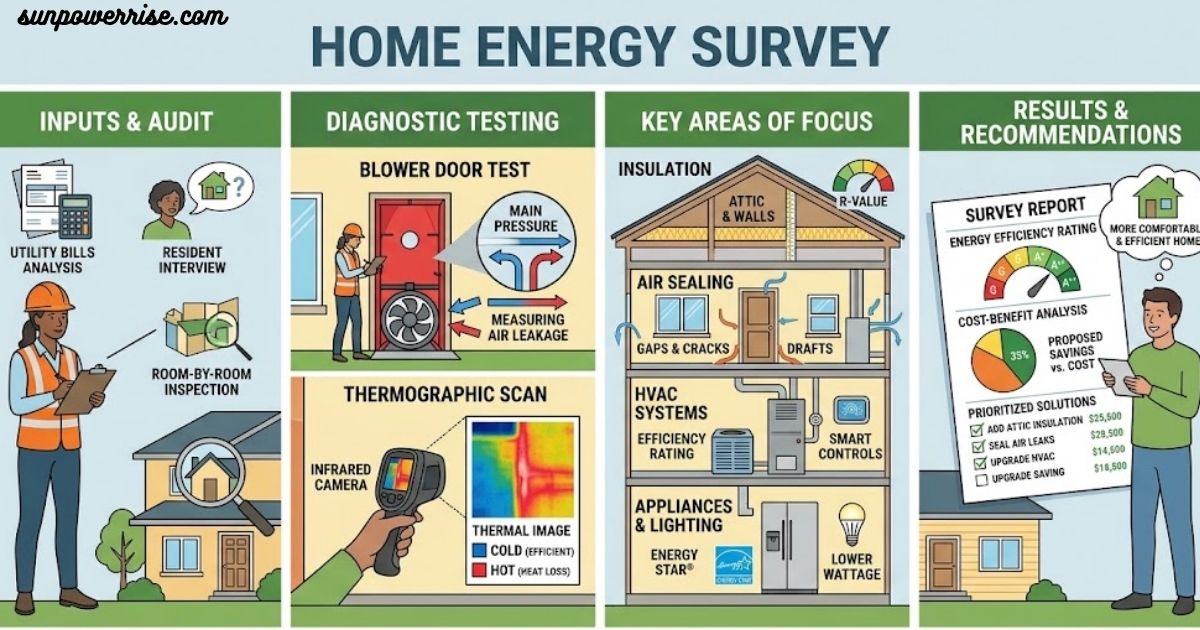
Trained energy survey engineers, working as your energy assessor, walk through the property checking insulation levels in walls, floors, roofs, and lofts, along with hot water systems, heating systems, lighting systems, and electrical equipment like appliances.
They also look at ventilation, airtightness, and any mechanical problems, then rate the energy performance through an EPC, or Energy Performance Certificate.
Across the UK, this kind of energy assessment has become common because of rising utility bills and growing wastage, and it’s often offered as a free, no-obligation assessment, which matters, since it’s tied to funding schemes such as ECO4, ECO Flex and the Warm Home Local Grant.
Government figures back this up: UK Government policies helped drive renewable energy adoption up by 15%, with solar installations in England rising 10% and roughly 75,000 new systems fitted in 2024 alone, covering everything from heat pump installation to battery storage systems.
In short, whether you call it a home energy survey, an energy survey, or simply an energy efficiency survey, the goal is better energy efficiency, lower carbon emissions, and home improvements that actually pay off.
Proven Benefits of Renewable Energy
Every funding criteria checklist relies on solid proof, and our unsolicited comments from past clients back up what we already know: homeowners who understand their heating season habits and switch to renewable energy end up far happier with the results, especially once they see the drop in carbon emissions on their next bill.
Supplier Reliability & Energy Surveying
That trust matters even more once you factor in how much supplier satisfaction can vary. Survey results showing that Scottish Power ranks UK’s worst energy supplier in survey results for customer service are a good reminder that choosing the right provider is just as important as fixing up the building itself, and it’s exactly why energy surveying as a practice has earned so much trust over the years.
What Will the Surveyor Check?
Visual & Structural Walkthrough
Picture the assessor arriving at your home for a typical visual survey: they start conducting walkthroughs of the property, taking photographs, photos, and notes on the structural condition of the building fabric, then move room by room, checking the floor, walls, windows, doors, loft, and roof for structural issues.
Thermal Imaging & Air tightness
Anywhere between November and April, during the heating season, they may also run a thermal imaging analysis using thermal cameras to spot heat loss, cold air infiltration, draught-proofing gaps, and general draughts, alongside an air tightness test to measure air leakage rates.
Insulation, Glazing & Moisture Control
The energy efficiency survey process covers insulation and insulation levels, age and condition of materials, plus measurements taken with proper measurement equipment.
They’ll be assessing and inspecting the glazing type, seals, and frames on every window, testing for condensation, damp, mildew, and other moisture issues, and running ventilation assessments to catch overheating issues and weigh up mechanical cooling options.
Heating & Hot Water Systems
The heating system gets equal attention: the boiler, boilers, radiators, radiator sizes, underfloor heating, electric heating, thermostat settings, controls, and timers are all checked for leakages, stability, and general efficiency, alongside the hot water and hot water systems, their storage and distribution.
Energy Usage & Occupancy Pattern
Appliances and lighting are logged too, noting daily usage and efficiency ratings, while the assessor asks about occupancy patterns, daily energy use, historic energy consumption, real-time energy consumption, current bills, and tariffs to understand the full picture.
Once finished, the assessor turns all this into a survey report with clear recommendations, usually delivered within 7-14 days, giving you real support and confidence in your home’s energy use and energy efficiency going forward.
What Is Included In An Energy Report?
Report Types, Scope & EPC Rating
After the on-site survey, the surveyor puts together an energy report sometimes a full report, sometimes a shorter personalised report that reflects the complexity and size of the property, whether it’s a domestic property, a commercial property, a leasehold building managed by a commercial landlord, or a property management firm dealing with larger properties and older properties alike.
Any incumbent factors get noted, along with the property’s EPC rating through the Energy Performance Certificate, and the energy performance summary that follows.
Key Survey Findings & Improvement Options
Inside, you’ll find findings and survey findings covering property insulation tests, with practical fixes like new plasterboard, alongside replacement recommendations for old appliances, notes on heat loss, dampness, and general health and safety issue concerns tied to condensation and ventilation.
There’s a full look at hot water systems and heating, options like air source heat pumps, batteries, and other renewable energy options or energy solutions, plus planning issues, grants/subsidies, incentives, and schemes, scheme details, and help with financing.
Energy Survey Different From A Home Buyer Survey
An energy survey is not the same as a home buyer survey or a measured building survey, and it helps to know the difference before you rely on either one.
A home buyer survey looks mainly at the physical condition of a building or property, flagging urgent repairs for prospective buyers, while an energy survey report goes deeper into energy performance and energy efficiency with real depth of assessment and tailored recommendations.
Rather than competing, the two complement each other nicely, giving new homeowners genuine in-depth guidance, which is exactly why smart buyers commission both energy surveys before signing anything.
When an energy survey is needed
There’s rarely a bad time for an energy survey, but a few moments make it especially worthwhile. If you’re buying a new home, the report gives useful insights into the property’s efficiency, helping you negotiate on price or plan for future upgrade costs before you commit.
A solar panel cost calculator can even suggest the ideal system size for your needs. Owners of commercial premises and businesses benefit just as much, since a survey can spot sources of waste that quietly drive up energy bills.
If you’re renovating or extending, it makes sense to review methods to enhance efficiency and energy-efficient upgrades before renovation plans begin, folding them into restorative work rather than fixing things twice.
Living in draughty or cold homes is simply uncomfortable, and a survey helps homeowners find the exact sources behind it and turn things cosier with better control over usage. Cutting your carbon footprint and environmental impact starts with improving comfort, and every estimate, set of recommendations, and solution offered helps lower your overall emissions, wherever your budget allows.
FAQs
How can I obtain an EPC certificate for my property?
You can get an EPC certificate by booking a qualified domestic energy assessor who will inspect your property and issue an official energy rating report.
How can I find my properties’ EPC rating?
You can check your EPC rating for free on the official government EPC register by simply entering your postcode or property address.
Can I do my own EPC assessment?
No, an EPC assessment must be carried out by an accredited energy assessor, as self-assessment isn’t legally recognised.
How much should an EPC certificate cost?
An EPC certificate typically costs between £60–£120, depending on your property size and location.