

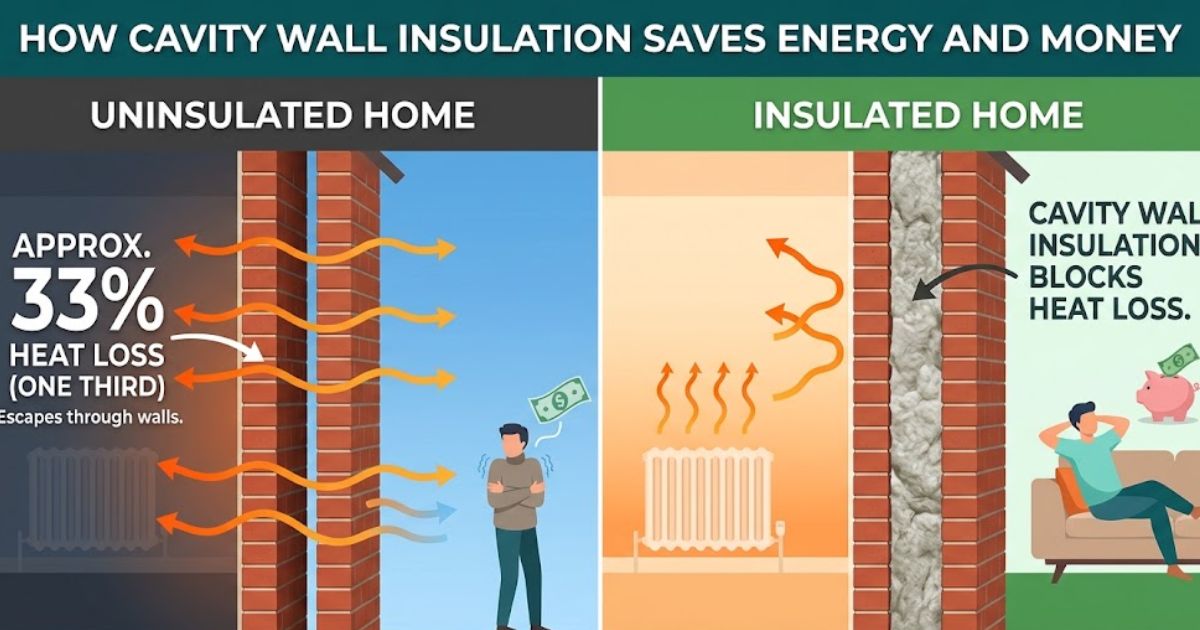
Cavity wall insulation matters more than most people think. In an uninsulated home, about 33% of the heat loss, roughly one third, escapes through the walls, so the warmth you pay for drifts outside. Cavity wall insulation stops that, and it is a cost-effective way to cut your heating bill and build a warmer home.
Builders have fitted wall insulation in most houses since the 1990s, but an older house rarely has any. Houses built after the 1920s usually have two skins with a 50mm gap between them, and unless your home is under 20 years old, those empty cavities probably still wait for insulating material.
The Energy Saving Trust says you could save £160 a year and see the job pay back in less than 5 years, so it pays for itself. Professional installers finish in two hours with no mess, and grants and offers help cover the energy upgrade.
What is cavity wall insulation?
A cavity wall is an external wall built from two layers. Builders make these thin walls from brick and call them skins or leaves. A gap, which people call the cavity, separates the two, and metal wall ties hold them together across that space. Cavity wall insulation adds an extra layer that keeps heat inside, and installers fill the space with injected material.
How to tell if your walls have cavities?
Start with the age of home. Most UK houses built after the 1920s have cavity walls, while pre-1920 houses usually have solid walls, and a house from around 1930 could be either. Check the exposed brickwork first: cavity walls show a brickwork pattern with every brick lengthways, but solid walls show an alternating pattern, a long-short-long-short look with bricks laid across the wall and end-on.
If render or timber cladding hides the bricks, or a previous owner rendered or cladded the house, measure the wall thickness from an open door, windows or doorways. A brick wall between 260mm and 350mm, or over 10 inches, is probably a cavity wall. Stone walls and other stone builds stay solid even at 500mm, and earth walls reach 300mm to over one metre yet stay solid too.
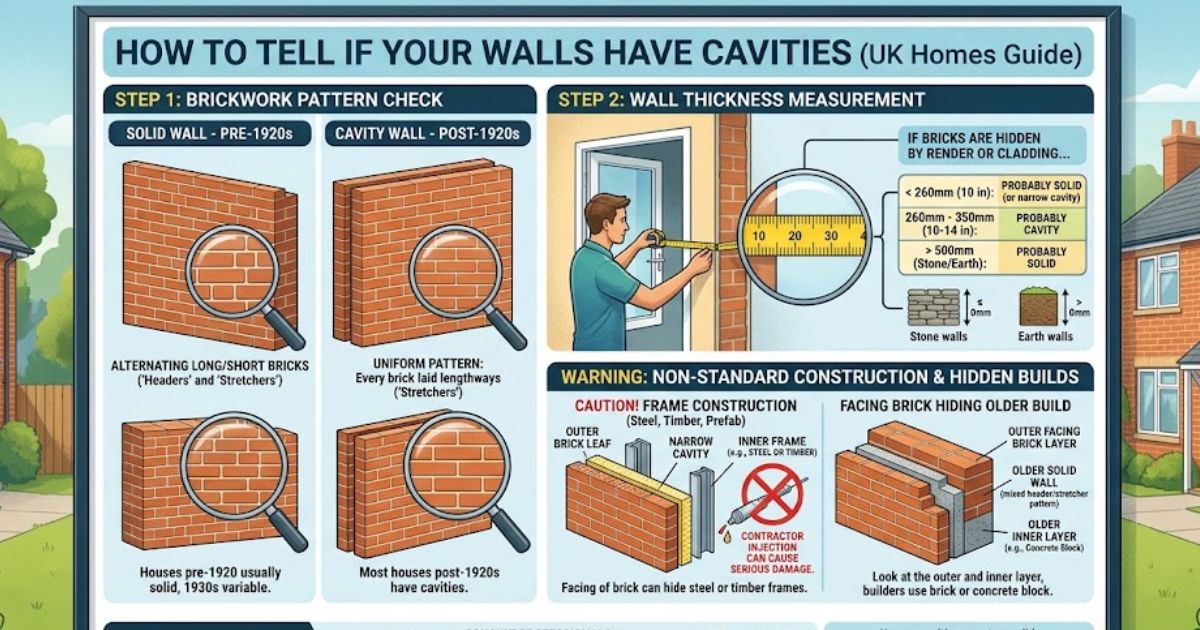
Some homes use a steel-frame, a timber frame, pre-fab concrete or prefabricated concrete, and a contractor who offers to inject between the outer brick leaf and the inner frame can cause serious damage. A facing of brick can also hide an older build, so look at the outer layer and the inner layer, which builders make from brick or concrete block and other masonry. Narrow cavities count as solid, so ask a specialist installer, an architect, a surveyor or another building professional. The National Insulation Association can point you the right way, and solid wall insulation suits those homes.
How to check if your house already has cavity wall insulation
A house under 20 years old usually has cavity wall insulation already, but older properties need a check. A registered installer drills a small hole in the external wall and runs a borescope inspection to see whether the wall is hollow or empty instead of filled, which tells you if you already have an insulated cavity.
You can also ask the building control department at your local authority for records, or read your EPC, the energy performance certificate. Look for faint marks from 1-inch holes at regular intervals, but don’t mix them up with an injected damp proof course. Climb into the attic too: if material is spilling out at the top of the wall, call a professional to seal off the wall.
Cost, savings and payback
The installation cost of cavity wall insulation depends on home size, and the Energy Saving Trust shares estimates for a gas-heated home using fuel prices from July 2025, with no subsidy, so they stay unsubsidised.
A typical home in Great Britain, or GB, pays around £2,200, while Northern Ireland, or NI, pays around £1,000. One set of figures puts a detached house at £4,300 with £420/year saved, a semi detached house at £2,700 with £240/year, a mid-terrace house at £1,500 with £140/year, a detached bungalow at £2,000 with £180/year, and a mid-floor flat at £1,100 with £120/year.
A second set for England, Scotland and Wales shows lower prices: a detached home costs £720, saves £275 and pays back in 32 months; a semi costs £475, saves £160, pays back in 36 months and brings 650 kg of CO2 savings; a mid terrace costs £370, saves £105, pays back in 43 months and cuts 430 kg; a bungalow costs £430, saves £110, pays back in 47 months and cuts 450 kg; and a flat costs £330, saves £90, pays back in 45 months and cuts 360 kg, while the detached home cuts 1,100 kg.
The payback period shifts between summer and winter, and a 1-bedroom flat or a large detached house should still recover the money in five years or less through lower energy bills. For a semi, that means £165 saved yearly and a return in less than 3 years, plus 680kg fewer carbon emissions, which equals 11 trees. You can trim the bill by pairing the job with other home improvements or by doing the insulation bit by bit.
Grants and funding for cavity wall insulation
Many homeowners can claim grants or funding for cavity wall insulation, and some even get free installation. Look for financial support and finance options in your area, because several schemes pay for energy efficiency improvements like insulation.
Does cavity wall insulation cause damp?
Some building professionals say cavity wall insulation always leads to damp bridging, but about 4 million UK homes have gone through retrofitted insulation and real problems stay rare. Water penetration usually comes from defects in the construction, like cracks or pre-existing damp, not from faulty installation.
A competent assessor spots those problems, the owner gets them remedied, and a proper assessment before the job makes all the difference. A good installer checks for flooding, extreme weather and a narrow cavity that could cause water ingress, and keeps your ventilation working.
Air flow brings fresh air into the house and stops moisture and damp from building up, so the crew never blocks airbricks, underfloor grilles that keep wooden beams and floors dry, wall vents or trickle vents, and they add additional wall vents where the house needs them.
How is cavity wall insulation installed?
Only a registered installer, or a trained and qualified installer, should do this job, so forget DIY. A suitability check comes first. Then the crew drills small holes of about 25mm, the size of a ten pence piece, into the mortar and uses special equipment for injecting the insulation material into the cavity. A telescopic lance system helps on tricky spots, while new-build properties often get rigid insulation boards instead.
On easy-to-access walls in an average-sized house, the work takes two hours with no mess, and the crew will make good afterwards. You then receive a guarantee from CIGA, the Cavity Insulation Guarantee Agency, that lasts 25 years, plus written confirmation of building regulations compliance, and your local authority may carry out a spot check. Choose an installer who belongs to the National Insulation Association, or NIA, or the British Board of Agrément, or BBA, and who follows a code of professional practice.
What kind of cavity insulation will they install?
Installers choose between polystyrene beads, polystyrene granules, mineral wool, mineral fibre, expanding foam and polyurethane foam, and every product must meet British standards.
Polystyrene beads, often with a carbon coating for extra performance, give strong heat retention, stay dry, reach awkward areas, and travel blown into cavity walls with less drilling, less patching up and no scaffolding, which trims the cost.
Mineral wool looks like the quilt insulation in lofts, broken into tufts, and it loses its thermal value if it gets wet, and it may settle and leave air pockets near the top of walls.
Beads and granules leave the wall gap-free, though they can gush out after cutting or drilling, and they sometimes escape through airbricks. Expanding foam gives the best thermal results but needs expert attention and may degrade over the long term, and polystyrene stays popular partly because it won’t absorb moisture, while new-builds often use boards.
FAQs
Is cavity wall insulation still recommended?
Yes, cavity wall insulation is still a cost-effective choice for unfilled cavity walls in good condition, because it cuts heat loss and brings lower energy bills. A registered installer should check your home first.
What are the downsides of cavity wall insulation?
The main downsides are damp, moisture and mould, which appear when installers fit it in unsuitable homes, such as those with narrow cavities, cracks or extreme weather exposure. A careless installer can also block airbricks and leave air pockets.
Is it hard to sell a house with cavity wall insulation?
Not usually, especially when you keep your guarantee certificate from CIGA and the written confirmation that the work met building regulations. These paperwork details give buyers peace of mind.
What is the best type of insulation for a cavity wall?
Polystyrene beads are the most popular choice because they stay dry, leave the wall gap-free and give strong heat retention. Expanding foam gives the best thermal results, but it needs expert attention.
Why are people removing cavity wall insulation?
People remove it when damp or mould appears after poor installation work, or when the home was unsuitable from the start, such as one with wet wall insulation. A specialist removal company handles the job safely.
Why is my house so cold even with cavity wall insulation?
Nothing feels worse than paying for insulation and still shivering. Uneven distribution, air pockets and settled mineral wool leave cold areas and draughts, and damp can make it worse. Call your installer to revisit the property.