


Anyone who needs electronics recycling in Columbus, Ohio wants two answers: where the equipment goes, and what happens to the data inside it. Providers across the Columbus metro answer those questions in very different ways. This guide on r2v3 columbus recycling shows you what to check before you hand over a single drive.
What does R2v3 certified mean for a Columbus recycler?
An R2v3 certified recycler has passed an audit against the R2v3 standard, which Sustainable Electronics Recycling International publishes. A certification body audits the facility itself, not the company’s marketing. The audit covers how the site handles equipment, data, and downstream partners.
The SERI R2v3 certification replaced the older version, so you may still see the R2:2013 to R2v3 transition online. Read the version on the certificate itself. An R2-certified facility earns that status one address at a time, so a parent company’s logo says nothing about the warehouse.
How can I verify a recycler’s certificate myself?
Open the R2 directory search on the SERI website, filter by city, and read the listing for each facility. The entry shows the street address and the certified standard version. Run this check before you request any quote or sign any contract.
I check every provider this way, because logos copy easily. Each brand in this guide describes its credentials on its own website. Results from third-party audits carry more weight than a badge on a vendor’s website.
Which credentials matter besides R2v3?
Look for NIST 800-88 in the data-handling process and RIOS certified status for management systems. ROC Telecom lists R2v3 and RIOS credentials on its Columbus page. AVAY gives its ISO certifications and QEHS policy their own pages on its website.
Defense-related buyers also ask about ITAR certified workflows, and regulated buyers want an independently audited recycler. Ask each provider to name its downstream partners. AVAY says its third-party audits reach its facilities and downstream processors.
What is IT asset disposition, and how does it differ from recycling?
IT asset disposition covers everything that happens when a company retires hardware: pickup, data handling, resale, and final recycling. Plain e-waste recycling covers only the last step. Most business buyers need the complete ITAD services package instead of a drop at a bin.
Providers also call this work e-waste disposal, e-waste management, or IT recycling, and the labels overlap heavily. Read the process list instead of the label. Columbus Micro Systems lays out a four-step process on its recycling page.
Which services do Columbus providers list on their websites?
Each brand offers the services listed on its own website, so treat this summary as a map and confirm details there. SunTech Recycle lists business electronics recycling, metal recycling, and commercial collection services for Columbus. Columbus Micro Systems lists drop-off recycling next to its business programs.
SunTech also lists asset remarketing, e-scrap buyback, and IT asset recovery, while AVAY lists electronics refurbishment and white glove services. ROC Telecom lists asset value recovery and zero-landfill recycling. Columbus Micro Systems also resells Dell, Lenovo, and Asus hardware.
How does secure data destruction work?
Secure data destruction means unrecoverable data destruction: nobody can rebuild the contents of a wiped or shredded drive. The two main routes are data sanitization by software and physical destruction by shredding. A good provider documents which route each drive took.
NIST 800-88 is the guideline that SunTech, ROC Telecom, and Columbus Micro Systems all cite. A NIST 800-88 compliant process leaves a record for each asset. SunTech states wiping or physical destruction with a serialized certificate per asset.
Should I choose data erasure or physical destruction for old drives?
Choose data erasure when the drive can return to service or resale, and choose physical destruction when the data is too sensitive or the drive has failed. Certified data erasure overwrites the storage and logs the result. Physical shredding of data-bearing media ends the drive’s life.
Columbus Micro Systems states three levels: a secure overwrite, DoD erasure with a report, and drive destruction. Its page adds that it destroys any drive with a failed drive health test. ROC Telecom states that it destroys data at a secure San Antonio facility.
What paperwork proves my data is gone?
Ask for a certificate of destruction for every batch, and check whether it lists each device by serial number. A serialized certificate of destruction ties a specific drive to a specific date and method. A certificate of recycling documents what happened to the leftover equipment.
Columbus Micro Systems offers an optional drive-level erasure report, and ROC Telecom states serialized reporting on its projects. Columbus Micro Systems keeps clients out of its locked data erasure rooms because other customers’ drives sit inside. Reports therefore replace witnessing.
What should secure pickup and chain of custody look like?
A documented chain of custody records who handled your equipment from your door to the final processor. It starts with secure pickup and secure transportation, and it continues until the last certificate arrives. Every gap in that record gives data a place to leak.
Columbus Micro Systems states secure transportation with 24/7 surveillance, and it sends a release of liability when your items arrive. SunTech states locked totes and project-based on-site collection for larger volumes. SunTech also states a trackable mail-in service for drives.
How do I prepare equipment for a business pickup?
Gather everything in one accessible area and skip the sorting, because the provider sorts on arrival. Columbus Micro Systems states that you can leave items unsorted and that palletized equipment is welcome but optional. It also supplies gaylords and pallets when you need them.
On arrival, the provider performs weighing and triage, separates data-carrying devices from other items, and builds an itemized lot report. That report lists serial numbers and asset tags for clean asset itemization. Columbus Micro Systems also offers asset tracking through a client portal.
Which equipment can I recycle in Columbus?
Columbus Micro Systems accepts servers, desktops and laptops, tablets and phones, and network equipment, even when they no longer work. It also accepts printers and copiers from business customers. AVAY refurbishes set-top boxes, routers, remote controls, and power supply adaptors.
Some items need extra attention: Columbus Micro Systems lists CRT monitors and TVs, flat-screen televisions, and alkaline and NiCad batteries as fee items. Its Chamber announcement also mentions lithium-ion batteries. It refuses refrigerant-containing appliances and medical waste.
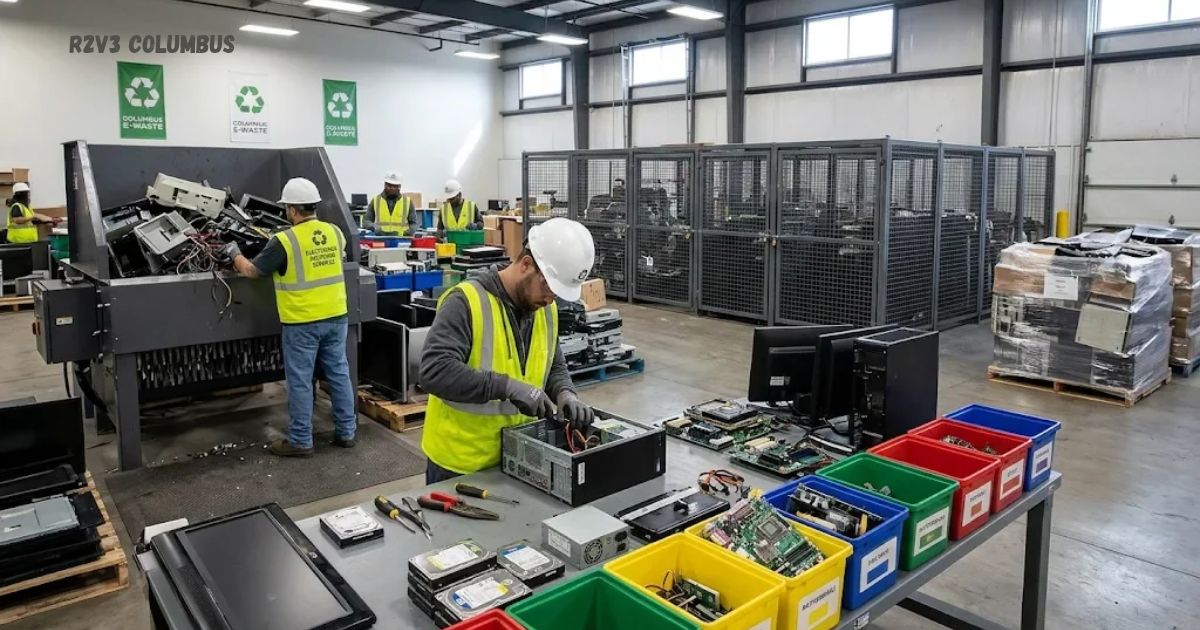
What happens to retired IT equipment after pickup?
A reputable provider tests retired IT equipment, resells or refurbishes what works, and recycles the rest. AVAY states that it sends items it cannot reuse to vetted downstream recyclers. It defines surplus and obsolete devices as electronics that no longer have a second life.
Telecom gear raises extra concerns, because flash modules and supervisor engines keep configuration data after power-off. Providers that handle networking and optical hardware should treat each module as data-bearing media. ROC Telecom lists Cisco, Juniper, Arista, Ciena, Infinera, Fujitsu, Calix, and Nvidia in its sell-equipment menu.
How does data center decommissioning work in the New Albany data center corridor?
Data center decommissioning retires a room or building of equipment on a planned schedule. ROC Telecom serves hyperscale data centers and enterprise data centers across Columbus, New Albany, Dublin, Hilliard, and Groveport. SunTech Recycle also lists data center decommissioning among its Columbus services.
ROC Telecom’s page names de-racking, rack extraction, cable mining, sub-floor extraction, and containment removal, and it describes slab-to-slab decommissioning. Its workflow starts with a hardware manifest and an inventory audit. It also states 48-hour mobilization with badge-vetted technicians.
Why does Central Ohio need specialized data center ITAD?
ROC Telecom calls Columbus the Midwest’s fastest-rising hyperscale cluster, and Central Ohio campuses retire racks constantly. Colocation facilities follow the same cycle of expansion and hardware refresh. Each retirement needs documentation as strong as the data on the drives it covers.
ROC Telecom states audit-ready compliance workflows, and its equipment menus also list Alcatel-Lucent and Tellabs next to the brands above. Those lists describe equipment it buys or sells, not a promise to handle every model. Confirm your hardware first.
How do recyclers support ESG reporting?
Providers that report weights and outcomes give your ESG reporting team usable numbers. ROC Telecom states Scope 3 emissions reporting support and mass-balance data on its projects. SunTech states landfill diversion and recovery data that drops straight into ESG reports.
Columbus Micro Systems shows energy saved and landfill space saved in its portal, based on EPA WARM v16 averages. Ask every provider how it measures carbon savings, because a circular economy claim means little without real weights. Request precious metal recovery details too.
Which laws and rules should my business consider?
Industry rules decide your paperwork: HIPAA compliance for hospitals and healthcare, GLBA for banks and financial institutions, and SOX for public companies. Columbus Micro Systems states that its certificate of destruction and chain of custody records support audits under all three. Ask for sample documents first.
State and federal regulations govern electronics disposal, and AVAY warns that the illegal export of e-waste misleads companies. Careless disposal can release toxic and hazardous materials and expose data, so sensitive data protection belongs in every contract. Weak paperwork leaves regulatory liability with you.
Who can use drop-off and pickup programs in Franklin County?
Columbus Micro Systems states that non-profits, schools, government agencies, and hospitals and healthcare organizations in Franklin County pay no logistics fees. It performs pickups for business entities only. It welcomes residents who drop off material at 5087 Westerville Road, Monday through Friday, 8:30 AM to 5:30 PM.
AVAY lists SWACO events under its electronics recycling menu, which helps households who wait for collection days. Event dates change, so check the website. AVAY’s logistics menu also lists telecom logistics, CPE testing, and kitting for telecom and ISPs.
How do I compare providers side by side?
Compare certificates first, then data methods, then paperwork, then logistics. Use the R2 directory search to confirm each address, and read each provider’s own pages for services. SunTech Recycle, ROC Telecom, AVAY, Columbus Micro Systems, and CCR Cyber each publish pages about Columbus services that you can compare this way.
Each brand offers the services listed on its own website, so any missing service deserves a direct question. SunTech lists local collection in Greater Montréal and serves Columbus through project collection and mail-in service. ROC Telecom processes data in San Antonio, so location shapes logistics.
What do readers ask most about recycling electronics in Columbus?
Does R2v3 certification guarantee my data is destroyed?
No certificate guarantees an outcome for your specific drives. The audit checks the recycler’s process, so you still need a certificate of destruction for your batch. Compare the serial numbers on that certificate against your own asset list, line by line.
How long does a business recycling job take?
Columbus Micro Systems states that it completes pickup, itemization, data destruction, and certificates within five to ten business days. It does not offer same-day pickup and asks for several days of notice. Other providers set their own timelines, so ask before you schedule.
How much does business electronics recycling cost?
Cost depends on item type, volume, and distance. SunTech states scheduled free collection for qualifying volumes, while Columbus Micro Systems states that most items recycle at no charge and lists fees for specific items. Request a written fee schedule from each provider.
Can residents recycle through these providers?
Columbus Micro Systems accepts resident drop-offs during weekday business hours, but it picks up only from business entities. SunTech states that its service targets enterprise, government, and commercial volumes instead of residential drop-off. AVAY lists SWACO events for households that want a scheduled collection day.
Where can I find the right provider for electronics recycling and data destruction in Columbus?
Start at this website, where you can compare r2v3 columbus providers, credentials, and documents in one visit. Use the checklist above to confirm the certificate, the data method, the paperwork, and the pickup process for each name. Then contact the provider directly, because each brand offers the services listed on its own website.