

This guide explains how Chicago electronics recycling works for households, from city drop-off sites to private providers. It covers where Chicago residents can take old gadgets, what each site accepts, and how to protect personal data first. Use it to pick the right option.
Chicago residential electronics recycling follows two tracks: free city programs for households and private services for businesses. The City of Chicago runs the household track, so most residents never need to hire anyone. Knowing your track saves a wasted trip across town.
Who runs e-waste recycling in Chicago, and who can use it?
The Chicago Department of Environment oversees e-waste recycling for the city, according to the 49th Ward’s recycling page. Free residential recycling covers household electronics that Chicago residents bring from home. ITECH’s guide adds that city sites and certified recyclers follow the Illinois Electronic Products Recycling and Reuse Act.
Businesses, schools, and non-profits cannot use the household program, and ITECH’s guide says they must hire private recyclers instead. Residents can compare those providers’ practices. I always check who a site serves before I plan a trip.
Where is the city’s permanent electronics drop-off site?
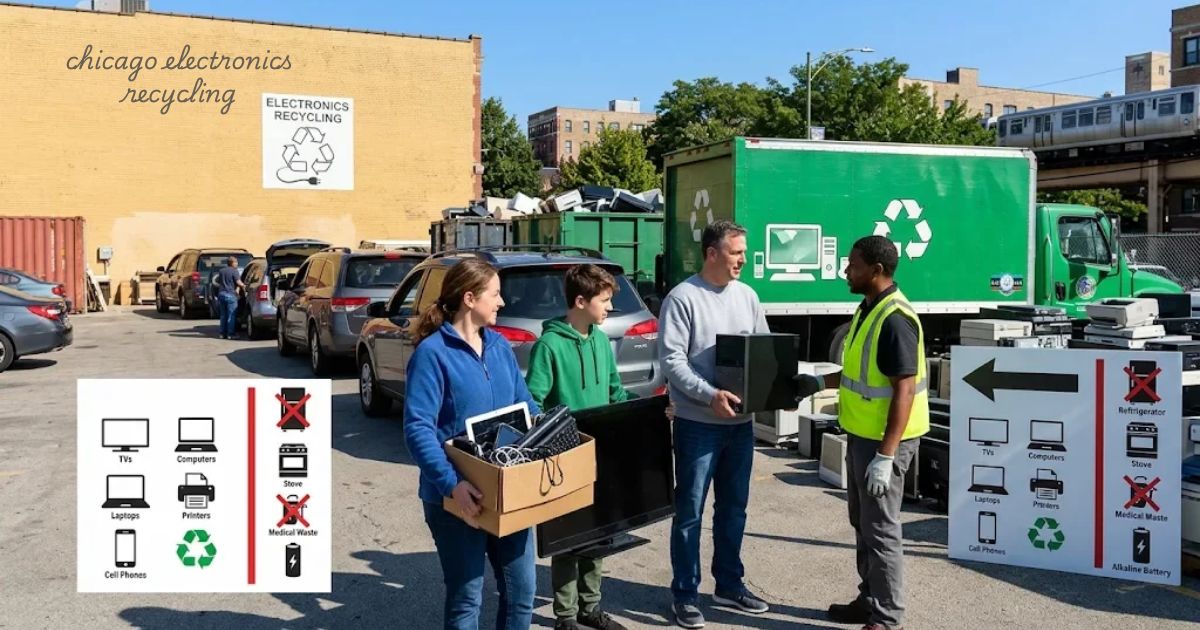
The City of Chicago runs the Household Chemicals & Computer Recycling Facility (HCCRF) as its permanent drop-off facility and year-round facility for electronics. Residents asking where to recycle electronics Chicago wide most often land here. ITECH’s guide places it at 1150 N. North Branch Street on the Near North Side.
The site sits two blocks east of the Kennedy Expressway at Division Street, according to ITECH’s guide. Look for the yellow building that handles electronics. The 49th Ward page prints the address as 1150 N. Branch Street, so confirm it with the city before you drive.
When is the facility open, and how does drop-off work?
The facility keeps three weekly windows: Tuesdays from 7 am to noon, Thursdays from 2 pm to 7 pm, and the first Saturday of each month from 8 am to 3 pm. Those Tuesday and Thursday hours never overlap, so pick your day before you load the car. The 49th Ward page lists these operating hours.
ITECH’s guide describes a drive-up drop-off where you stay in your vehicle while staff unload. An attendant inspection confirms the items qualify before anyone touches them. Never leave boxes at the gate after closing, because ITECH’s guide calls that fly-dumping and says it can bring fines.
How do the monthly neighborhood events work?
Beyond the permanent site, the city holds monthly drop-off events, which work as neighborhood drop-off events at rotating locations. ITECH’s guide describes a seasonal schedule (April through January), usually on Saturdays from 9 am to 1 pm. These residential electronics recycling events bring collection trucks close to where you live.
Trucks hold only so much, so arrive early; ITECH’s guide says an event stops accepting items once the trucks fill. Call 311 or check the city schedule before you go, because dates and sites change. I keep the confirmation in my phone so I never chase a moved event.
Which electronics do city programs accept?
City sites and certified recyclers generally accept computers, including desktops, laptops, and tablets, plus monitors, printers, fax machines, and scanners. ITECH’s guide also lists cell phones, portable music players, and video game consoles, along with DVD players, VCRs, and cable boxes. Most items with a cord or battery qualify.
Televisions need extra care: ITECH’s guide says the city site and events take CRT TVs and flat-panel TVs, but older sets weigh far more, so bring a helper. Peripherals such as keyboards and mice travel with your setup. STS recycles copiers, networking equipment, and ink and toner cartridges for businesses, so check your site’s list before you pack.
Which items do city programs refuse?
City electronics events refuse several categories, and ITECH’s guide lists the main prohibited items. They include large appliances, such as refrigerators and stoves, which the guide calls white goods. Latex paint and medical waste also stay home, so leave them out of the car.
ITECH’s guide also excludes alkaline batteries, small kitchen appliances like toasters and blenders, and business-generated waste. Residential use only applies at every city site. For a refused item, search Earth911 with the item name and your zip code.
Why does electronics recycling matter for the environment?
Old devices contain hazardous materials, including lead, mercury, and cadmium, that harm soil and water when they sit in landfills. Rain can carry these heavy metals into groundwater, which causes groundwater contamination. Landfill diversion keeps them out of the environment.
Recycling works as urban mining, because recyclers pull precious metals from circuit boards for material recovery. ITECH’s guide claims 99% material recovery and zero landfill outcomes at certified facilities, so treat those as vendor claims. Energy savings, environmental stewardship, and even CFL bulbs, which contain mercury, give residents reasons to recycle.
How do you protect your data before recycling?
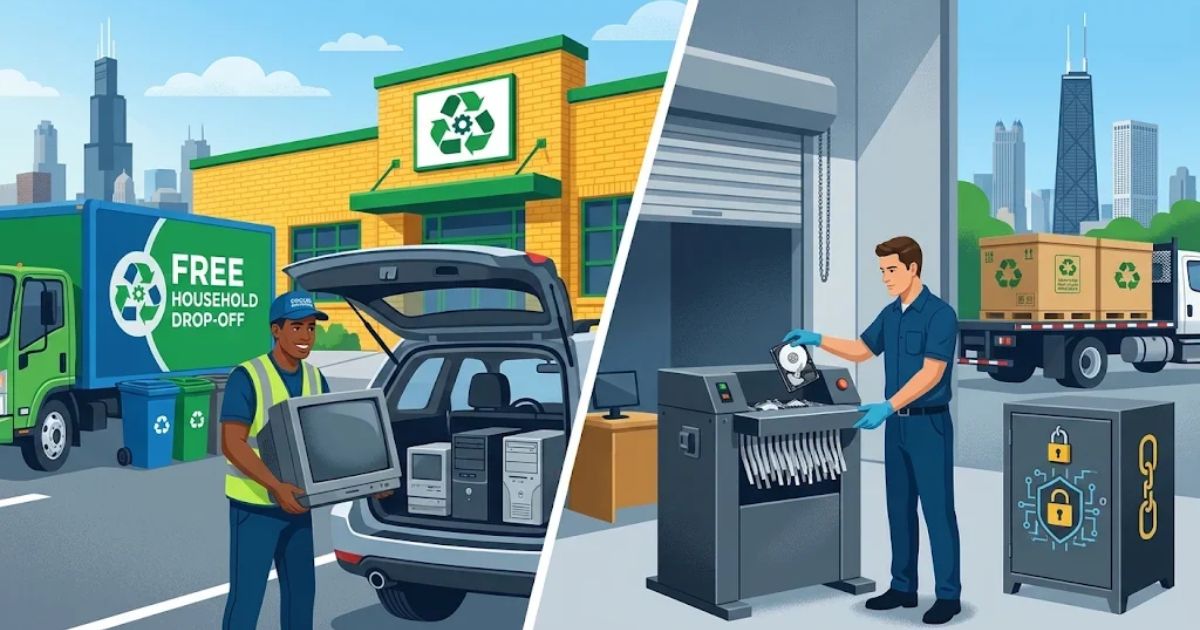
Data security starts at home, because the city facility handles hardware and you handle the information. Back up your data to a cloud service or external drive, then run a factory reset on phones and tablets. ITECH’s guide also recommends data-wiping software for computers.
Remove SD cards and remove SIM cards so personal information leaves with you. Data sanitization aims for unrecoverable data, meaning no tool can restore your files, which gives you real privacy protection. Power the device on afterward to confirm the wipe.
When should you choose hard drive destruction over wiping?
Choose hard drive destruction when a computer will not power on or holds sensitive records. Hard drive removal lets you pull the drive and hand it to a provider that offers hard drive shredding. ITECH’s guide says physical shredding suits healthcare and finance, while software wiping works for most residents.
Providers describe destruction in specific terms. STS offers on-site shredding with witnessed destruction, and AVA lists serial-number inventory with its drive shredding. STS cites NIST SP 800-88 and DoD 5220.22-M, and both brands describe secure data destruction and data destruction paperwork.
How should you handle batteries and cords safely?
Remove batteries when a device allows it, and treat lithium-ion batteries with care. A swollen battery or leaking battery needs extra caution, according to ITECH’s guide. Lithium-ion batteries never belong in a regular recycling bin, so keep them out of your blue cart.
Lithium-ion cells cause a fire hazard in collection trucks, so recyclers handle them separately. Bundle cords with a twist-tie so attendants sort faster; ITECH’s guide calls this optional. AVA lists battery recycling for household alkaline and rechargeable lithium-ion types, but confirm accepted items first.
Should you reuse a working device instead of recycling it?
Yes, responsible reuse beats recycling for devices that still work. Donation to local non-profits and schools gives them a second life and helps extend device lifespan. ITECH’s guide names Computers for Schools as one option, and it calls recycling the last resort for working devices.
Trade-in programs from Best Buy, Apple, and Dell may return store credit, and resale can bring in cash. Manufacturer take-back programs offer another route. Earth911 lets you search an item and a zip code to find specialty recyclers.
What should you look for in a service provider?
Look for certified private recyclers that document each step. Certifications such as R2v3 certified and RIOS certified status show an outside audit exists, and STS lists both on its site. Ask which standard the provider follows and request the certificate.
Then ask for proof. A certificate of destruction records drive shredding, a certificate of recycling records material handling, and chain of custody tracks equipment from pickup to processing. Documented processing, ESG documentation, and HIPAA compliance matter mostly to businesses, but they signal a provider that keeps records.
Which services do commercial recyclers list?
Commercial recyclers list services for offices, not households, and the names differ by brand. STS lists IT asset disposition (ITAD), lease buyout, computer liquidation, and data center decommissioning. These services describe e-waste recycling at business scale, which residents rarely need.
STS also describes IT asset recovery and free pickup throughout Cook County. AVA lists e-waste bins, office cleanouts, and paper shredding, and RTS describes on-demand collection. ITECH lists a local pick-up service.
Which Chicago organizations publish electronics recycling information?
Six organizations from this research publish useful material, and each offers the services listed on its own website. Their pages serve different readers, so match each one to your situation. Confirm any detail you plan to rely on with the organization directly.
Which brands focus on business customers?
STS Electronic Recycling, AVA Recycling, and RTS (Recycle Track Systems) focus on business customers. STS describes ITAD and data destruction for organizations in Cook County, and AVA describes business e-waste recycling and drive shredding. RTS describes on-demand collection and recycling management for companies.
AVA identifies itself as a brand of STS Recycling, LLC, so treat those two pages as related sources, not independent ones. ITECH Recycling lists residential electronics recycling, hard drive shredding, and a local pick-up service from its Wood Dale address. Its Chicago guide also describes the city program.
Which sources help residents most?
Chicago’s 49th Ward publishes the facility address, hours, and an Earth911 link. ITECH publishes a long Chicago guide with accepted items and preparation steps. Recycle by City publishes blue cart guidance, but it has moved its electronics events article offline.
I treat these pages as starting points and verify event dates with the city. ITECH lists residential electronics recycling as a service, although its guide does not spell out terms. Ask the provider directly before you travel.
Which suburbs do these providers serve?
Service areas extend well beyond the city limits, which matters for suburban readers. STS lists free pickup throughout Cook County, and its page names Evanston, Naperville, Aurora, and Schaumburg across Chicagoland. AVA lists Oak Park and covers DuPage County among six counties.
ITECH operates from Wood Dale and names Elk Grove Village among the business areas it serves, plus Evanston, Glenview, and Bolingbrook. Suburban residents should check their own village’s program first, since city sites serve Chicago residents. I check a provider’s service-area page before I call.
Why is this website the easiest place to compare options?
This website brings the city’s residential sites, event rules, and private providers together on one page, so you skip hopping between six sources. Each entry separates what a source confirms from what you should verify. That structure shortens your search.
The checklist above works anywhere. This site applies it to Chicago, with hours, accepted items, data steps, and provider credentials side by side. Start with your device type, check the city option first, and move to a private provider only when the city cannot take the item.
What do people ask most about electronic recycling Chicago?
Does it cost money to recycle electronics in Chicago?
City electronics recycling at the HCCRF and city events costs nothing for residents, according to ITECH’s guide. Some private retailers charge small fees for items such as large TVs. Call ahead before you visit a private site to confirm any fee.
Can a business use the city facility?
No, the HCCRF and the neighborhood events serve city residents only. ITECH’s guide says businesses, schools, and non-profits need certified private recyclers instead. STS and AVA both describe pickup, hard drive shredding, and data destruction services for those business customers.
Where do I confirm current event dates?
Call 311 or check the City of Chicago’s website for current event dates. Recycle by City once published event details, but that article is offline now. Event locations change, so confirm the date the week you plan to go there.
Where can I find the right Chicago residential electronics recycling option?
Start with the city’s permanent facility or a neighborhood event, protect your data, and bring only accepted items. Use the provider checklist if a private service fits better, and verify hours with the city. Visit this website to find the Chicago Residential Electronics Recycling Program Guide that matches your devices and your schedule.