
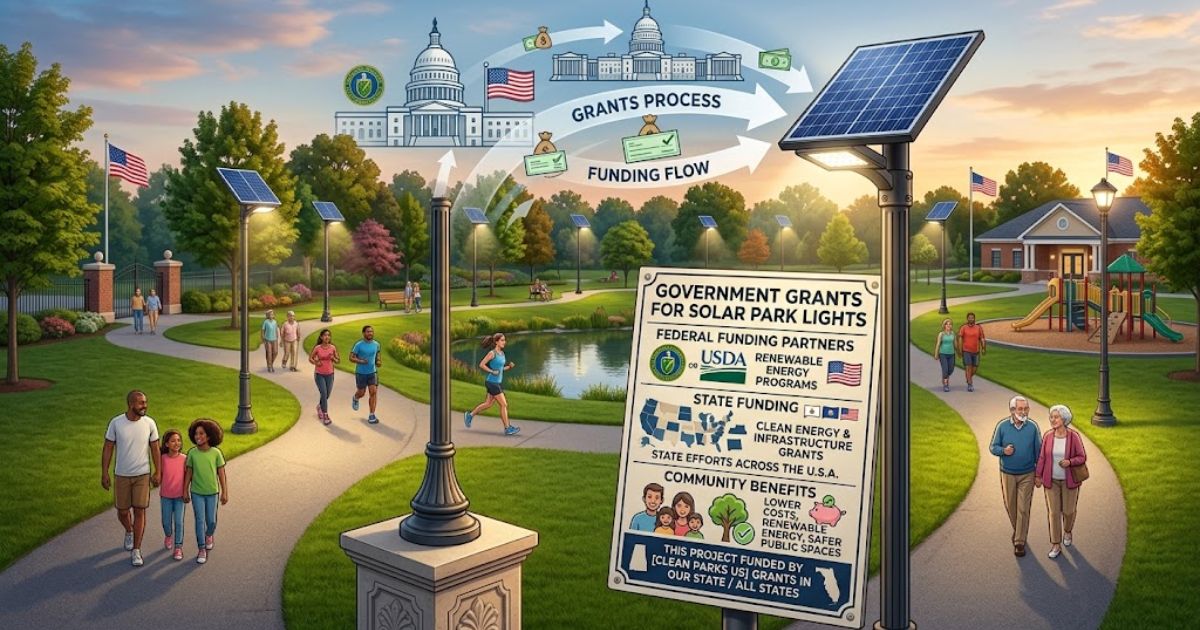
Government grants for solar park lights in US states can turn solar lighting in public spaces into one of the best upgrades a municipality can make, but budget worries slow down many plans. Whether you light parks, streets, trails, or other civic areas, the right funding can change the project’s economics for any city.
Government grants for solar park lights in US states
Municipal solar lighting often draws on federal infrastructure money, clean-energy programs, state energy-office grants, transportation safety funds, and utility rebates. Each program looks for something different, such as safety or resilience benefits, so match the funder’s priorities from day one. Programs change, so verify current availability before you lock in any numbers. A project that you frame and document well becomes a winning package.
Other funding options exist too. The USDA REAP grant is a competitive grant that helps farmers and rural businesses cover installation costs for solar energy systems, and it supports America’s energy independence. When you pair it with tax incentives and long-term electricity savings, investing in solar makes sense for sustainability and for your wallet. You still need to apply with care, and this guide on government grants for solar park lights in us states shows you how.
Funding Programs That May Support Your Project
The U.S. government spreads its funding sources across several agencies, and states add their own. The DOE, DOT, and EPA back federal infrastructure work that supports energy efficiency, emissions reduction, modernization, and grid independence for cities.
Federal and state funding also reaches resilience infrastructure, resiliency work, and public-space programs, and many of these public infrastructure funding initiatives welcome municipal solar lighting. Rules change and availability shifts, so check before you build your project budget around one source. Every grant carries project requirements and needs agency approval, and federally funded work must also follow Build America Buy America, or BABA.
State Resilience & Infrastructure Grants pay for climate adaptation, storm recovery, and energy modernization, and they often favor lighting that boosts public safety and disaster resilience. Transportation Enhancement Grants can cover solar path lights along bike lanes, greenways, sidewalks, and trails under mobility initiatives, especially when the lights improve pedestrian safety and pedestrian infrastructure.
Safe Streets and Roads for All, or SS4A, comes from USDOT as discretionary grants, and it names lighting improvements for roadway safety as an eligible use. That makes it a strong match for corridor lighting, crosswalk lighting, and busy corridors. The Highway Safety Improvement Program, or HSIP, is federal-aid money that state DOTs manage. It pays for roadway lighting at intersections with a nighttime crash problem, which lifts road safety and helps every pedestrian.
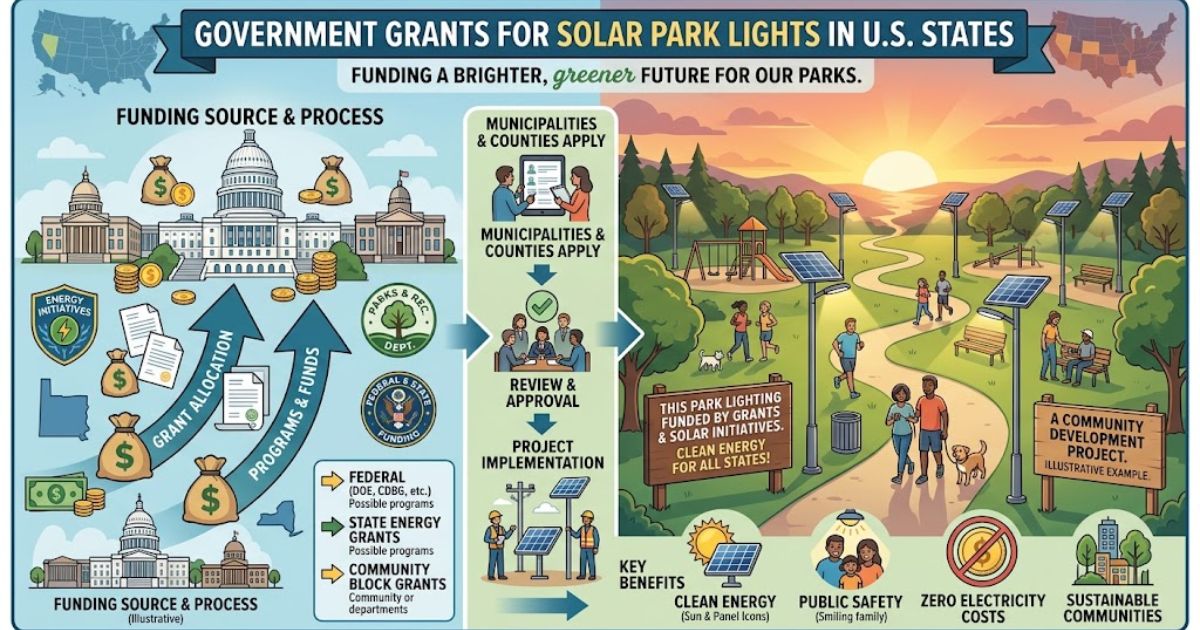
Local help matters too. Local Clean Energy or Beautification Programs let counties offer mini-grants for beautification, renewable energy, and crime prevention. Community Development Block Grants, or CDBG, run through HUD and serve underserved areas, neighborhoods, and public parks. Bexar County, TX set a precedent when it used CDBG money for lighting in outlying areas.
A tax-exempt city cannot claim the Investment Tax Credit itself, so Elective Pay, also called Direct Pay under IRA Section 6417, gives cities, counties, and tribal governments a direct payment on qualifying solar projects. Smaller grant programs, clean energy incentives, and efficiency offers add even more room to stack utility rebates and state energy-office grants with these larger awards. When you combine them, government grants for solar park lights in us states often decide whether a project gets built.
Why Consider Solar Lighting Grants?
Grant funding can offset or even eliminate upfront costs, which is the biggest hurdle for most towns. It lets you expand projects beyond your base budget and helps you accelerate timelines by cutting lengthy approvals.
It also helps you meet federal energy goals and state energy goals, and it can open the door to additional programs later. That is why government grants for solar park lights in us states and other solar lighting grants deserve a serious look before you commit any local money.
Match the Project to the Funder
The same project can tell several stories, and your framing should fit what each funder values. Safety funds respond to crash data and pedestrian data, so tie roadway lighting and crossing lighting to clear safety outcomes.
Clean-energy programs care about emissions and savings, so show the kWh you save and the CO2 avoided. Resilience programs want proof of outage ride-through, so explain how your lights keep working during emergencies. When you lead with the benefit the funder cares about, your application gets a warmer reading.
Build the Package
Funders want more than a price. A strong submission includes an engineered design with photometrics and sizing, plus a cost and savings analysis that shows real numbers. Add a project rationale that fits the program, and include compliance documentation such as BABA paperwork.
A bare quote rarely impresses a review panel, while a professional package shows the project is ready to go. Once grants and rebates reduce the upfront bill, your payback improves sharply, and that is exactly what reviewers want to see when they score government grants for solar park lights in us states applications.
What Is the USDA REAP Grant for Solar?
The USDA, short for the United States Department of Agriculture, runs the Rural Energy for America Program, known as REAP.
It helps agricultural producers and rural commercial businesses fund energy-efficiency improvements and renewable energy projects, including solar. In 2023, the Inflation Reduction Act raised coverage to 50% of the total installation cost of a solar panel system, with a maximum funding limit of $1 million.
That higher rate runs through 2027, and the older 25% option from the farm bill still exists. Keep in mind that REAP targets farm and rural business energy use, so a city park project usually will not fit it, and other government grants for solar park lights in us states will serve parks better.
Who Qualifies for the USDA REAP Grant?
The eligibility criteria changed a lot after 2023, and most farms and rural small businesses inside an eligible area can qualify. Still, meeting the rules does not guarantee a win, because this remains a competitive grant. Farmers who file Schedule F apply as an agricultural producer. They must earn 51% of their income from the farm, and farm operations must use 51% of their electricity, not their personal residences. Electricity for a residence does not count, and you cannot owe back taxes to the IRS.
Businesses that file Form 1065 or Form 1120 apply as a rural small business. They follow the same 51% rule for business purposes and cannot owe back taxes, and most home-based businesses do not qualify. The business must also sit in a qualifying area, which the USDA defines by a population of 50,000 or fewer residents. Check the Eligibility Map first, and if your site sits near the shaded portion, ask a USDA Grant professional before you apply.
FAQs
What government grants can pay for solar park lights in US states?
Cities can tap federal infrastructure funds, Safe Streets and Roads for All (SS4A), the Highway Safety Improvement Program (HSIP), and Community Development Block Grants (CDBG). State energy-office grants, State Resilience & Infrastructure Grants, and utility rebates also help. Each program has its own project requirements, so check which ones are open before you plan your budget.
Can a city use the USDA REAP grant for park lights?
Usually not. The USDA REAP grant serves agricultural producers and rural small businesses, so a city park project rarely fits. A municipality gets better results from transportation safety funds, CDBG, or Elective Pay.
How does Elective Pay help a city that wants solar lighting?
A tax-exempt city cannot claim the Investment Tax Credit on its own. Elective Pay, also called Direct Pay under IRA Section 6417, lets cities, counties, and tribal governments receive that value as a direct payment on qualifying solar projects. This can cut upfront costs a lot.
What should a strong grant application include?
Include an engineered design with photometrics and sizing, a cost and savings analysis, and a clear project rationale. Add compliance documentation, such as Build America Buy America (BABA) paperwork for federally funded work. A professional package beats a bare quote every time.
How do I match my project to the right funder?
Lead with the benefit the funder cares about. Safety funds want crash data and safety outcomes, clean-energy programs want kWh and CO2 avoided, and resilience programs want proof of outage ride-through during emergencies. Good framing gets your application a warmer reading.