


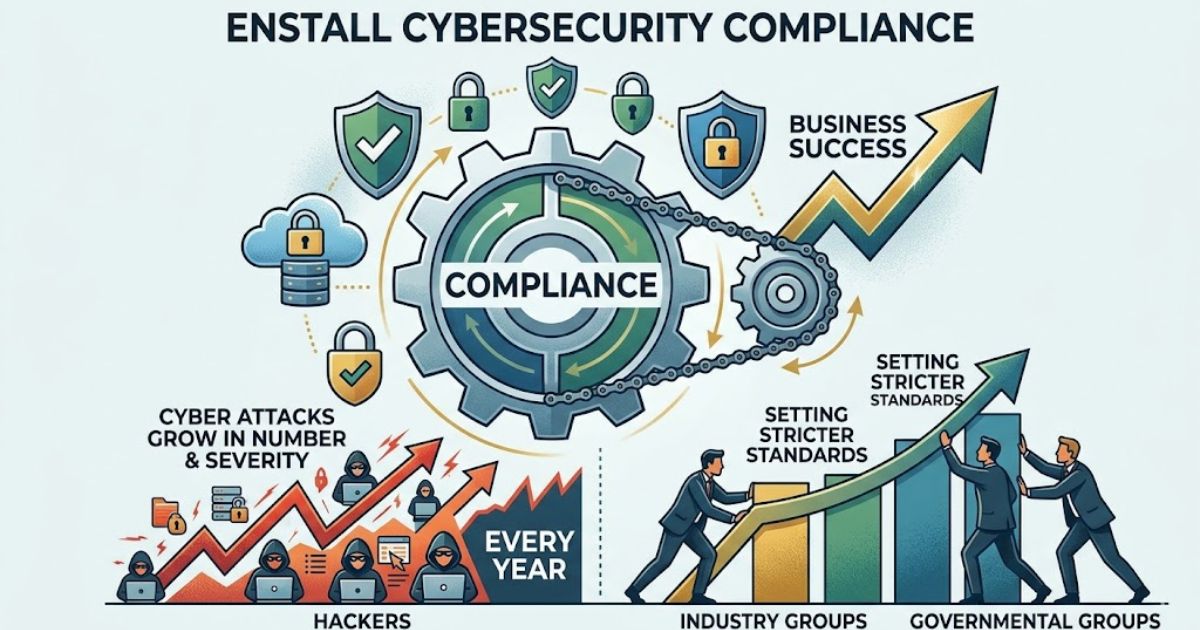
Enstall cybersecurity compliance starts with one simple idea: compliance drives business success. Cyber attacks grow in number and severity every year, so industry groups and governmental groups keep setting stricter standards.
Cybersecurity and compliance by design means a company builds protection and rule-following into its products from day one, not after a problem. This follows the secure by design idea and protects information security through safety, integrity, and availability. Teams that work this way write their cybersecurity protocols before launch, so the security posture starts strong.
I compare it to building sound walls instead of buying locks later. Cybersecurity risk management and regulatory compliance share one plan, so audits stop feeling like a yearly scramble. That habit turns cybersecurity compliance into daily work and keeps continuous compliance checks running.
Why Does a Search for Enstall Cybersecurity Compliance Show So Many Different Companies?
The phrase pulls in four similar names: Enstal, Enatel, Entelyst, and Elemental Cyber Security. Enstal spells its name with one final l, not two, so readers land on lookalikes. Each brand sells something different, which makes cyber resilience hard to compare without a guide.
Enstal shows security vendor partnerships and reseller work, Enatel builds industrial chargers, Entelyst runs service teams, and Elemental publishes a software platform. Some buyers want cybersecurity outsourcing, others want a secure product. I sort these needs first, because mismatches waste weeks.
What Should You Look for in a Cybersecurity and Compliance Provider?
Look for a provider that names its standards, lists services in plain words, and explains how it proves results. Those checks separate real compliance assurance from broad marketing. A fourth check matters too: whether the provider supports cyber risk governance with named owners.
Ask how the provider measures cyber risk exposure and whether compliance automation cuts manual work. In my reviews, pages answering these questions directly describe their offers most clearly. Each check follows.
Which Standards and Frameworks Should a Provider Cover?
A provider should name the frameworks that match your industry, such as NIST 800-53 (FISMA), NIST 800-171/172, HIPAA-HITECH, PCI-DSS, SOC 2, and GDPR. Health, payment, and government work each pull toward different rules. Ask for the list in writing.
Other frameworks include IEC 62443, HITRUST/CSF, SOX, FedRAMP, GLBA, ISO, SANS 20 controls, CIS compliance, and NSA and DISA baselines. No provider covers every one. A short list done well beats a long list of logos.
What Testing and Security Services Matter Most?
Prioritize security assessments, penetration testing, and vulnerability management, because they show where you stand and what to fix first. Add incident response and digital forensics for the moment something goes wrong. Plain-worded lists make comparison simple.
Red teaming, offensive security, and exposure management suit mature teams, while security architecture services and cloud security help earlier. Vulnerability remediation matters as much as finding flaws. Application and API security, threat detection and response, and round-the-clock monitoring round out the list.
How Do Policies and Controls Keep a Company Compliant?
Security policy management keeps written rules alive, while technical security controls make those rules real on systems. A rule nobody enforces creates a policy implementation gap. Good providers close that gap with policy enforcement and policy monitoring.
Look for policy lifecycle coverage, policy baseline templates, and a policy library you can reuse. Adaptive security controls such as dynamic access control and role-based access control limit who touches what. Secure network and user-access controls, cross-platform enforcement, and change management keep those limits steady.
What Evidence Should a Provider Give You for Audits?
Ask for audit trails, evidence and documentation, and compliance metrics you can hand to an auditor. These items prove auditable compliance without a long email chase. Reports should also support internal audits, and independent third-party testing adds outside proof.
Compliance history and trending shows direction, while security metrics show effort. Executive reporting and a prioritised roadmap help leaders pick next steps. A single pane of glass with risk-adjusted visibility and multi-level reporting and alarms keeps everyone on one page.
Which Threats Should a Provider Address?
A provider should address ransomware attacks, data breaches, unauthorized access, and network intrusions, because these cause the most visible damage. Ask which of these the provider tests for and how often. Security preparedness exercises show whether the answers hold under pressure.
Good plans also cover software vulnerabilities, AI-enabled cyber threats, emerging threats, and malicious activity on unmanaged machines. They aim for downtime reduction, lower loss potential, and fewer operational disruptions. They contain unauthorized systems, protect sensitive data, and extend to supply chain data security against cyberattacks.
How Do Secure Development Practices Affect Your Choice?
Ask whether the vendor practices secure software development and ships secure firmware. Regular firmware and software updates, encryption, and layered defense show a mature process. A documented design and testing process proves it.
Continuous monitoring and annual cybersecurity training keep habits fresh, while organization-wide accountability keeps owners clear. Lifecycle management and a security maturity model let you track progress. Hardware makers also need secure integration with telematics platforms, fleet management systems, and connected infrastructure, which shapes industrial charger cybersecurity.
Which Environments Should a Provider Cover?
The provider should support on-premise, cloud, and hybrid environments, including hosted IT environments and datacenter and cloud estates. Mixed estates often include heterogeneous operating systems and many endpoint systems. Ask which of these the provider covers today.
Look for automatic discovery and classification, system profiling, and dynamic grouping that build an asset inventory without spreadsheets. Those tools raise situational awareness. Logical segmentation also supports compliance scope reduction by shrinking what auditors must check.
Which Brands Can You Compare, and What Do Their Websites Say?
Four brands appear in this comparison: Enstal, Enatel, Entelyst, and Elemental Cyber Security. Each brand offers the services listed on its own website, so confirm details there before you decide. I mention only what each site states, and I skip anything it leaves out.
This comparison keeps vendors, makers, and service firms separate, since they answer different questions. I read each services or compliance page first. I note every dated claim or named standard.
What Does Enstal Say About Its Security Services?
Enstal’s security page lists security assessments, security architecture services, and third-party services. It also names SOCaaS and internal and external pen tests. The page mentions Arctic Wolf and BeyondTrust by name.
Enstal’s homepage describes guidance, deployment, and ongoing support, plus value-added reseller services such as customization, integration, consulting, and managed services. It also states a 24-hour SLA on quotes. I found no repair service, so I will not claim one.
What Does Enatel Say About Compliance?
Enatel makes industrial chargers, so its compliance page describes how it builds and certifies products, not a service you buy. The page covers testing and certification for safety, EMC, radio, ingress protection, and efficiency where they apply. It also commits to annual external testing of its software and annual cybersecurity training for its teams.
Charger specifications often cite UL 1564, CE marking, EMC compliance, IP54 / ingress protection, and NEMA 3R. Enatel offers to collaborate on extra certifications on request and to consult on cybersecurity or compliance. Its FAQ advises keeping firmware updated, and I found no repair service listed.
What Does Entelyst Say About Its Services?
Entelyst groups its work into four areas: defense, offense, governance, and technology. Defense covers a 24/7 managed SOC, incident response, forensics, cloud security, and posture hardening. Offensive work covers penetration testing, red teaming, vulnerability management, vulnerability remediation, and application and API security.
Governance work covers business continuity, crisis management, and PDPPL support with privacy impact assessments and DPO advisory. Entelyst also offers gap assessment and readiness assessment work for the NCSA National Information Assurance (NIA) standard. Its technology area lists secure AI engineering, infrastructure engineering, and cybersecurity staff augmentation.
What Does Elemental Cyber Security Say About Its Platform?
Elemental’s homepage describes a software platform called ESP, not a staffed service. Listed features include policy lifecycle automation, compliance automation templates, adaptive micro-segmentation, risk assessment, forensic analytics, and automatic remediation with containment. Product-focused buyers should read it closely.
Its navigation links to Services and Support Center pages that I did not open, so I cannot list Elemental’s services. The footer shows 2021. Check that the content is current before you rely on it.
Which Security Vendor Names Appear on Enstal’s Partner Logos?
Enstal’s homepage displays partner logos that appear to include CrowdStrike, CyberArk, Palo Alto Networks, SentinelOne, Tenable, Zscaler, Okta, and Drata. I identified them from logo file names. Only Arctic Wolf and BeyondTrust appear on the security page itself.
Naming vendors can imply endorsement, so treat these names as context, not recommendation. Ask Enstal which products it deploys and supports. Security vendor partnerships matter only with real experience.
Why Is Visiting My Site the Easiest Way to Find the Right Provider?
My site puts the services each brand states in one place, so you skip hours of tab switching. You see what each website confirms, and nothing it leaves out. That makes your first shortlist a matter of minutes.
Each listing points you back to the brand’s own pages, where you confirm details yourself. Starting here gives you sharper questions for provider calls. You then spend your time on fit.
What Questions Do Readers Ask Most About Enstall Cybersecurity Compliance?
Readers ask about cost, value, and repairs. These answers stay short. Each one points you to a source you can check.
How Much Will a Provider Charge?
Pricing depends on scope, so ask each provider for a written quote. Enstal states a 24-hour SLA on quotes. Compare quotes against the same standards and services.
Is Hiring a Provider Worth It?
It depends on your team size and workload. Small teams often find round-the-clock coverage hard to staff alone. Mature teams may prefer a platform, such as the one Elemental describes.
Do Enstal or Enatel Offer Repair Services?
Neither website states a repair service. Enstal describes deployment and ongoing support, and Enatel’s FAQ only advises keeping firmware updated. Contact each company directly.
Where Should You Start Your Search for Cybersecurity and Compliance by Design?
Start with the checklist above, then compare Enstal, Enatel, Entelyst, and Elemental Cyber Security on the services their own websites state. My website gathers those details in one place, so you can build a shortlist quickly and confirm each point at the source. Visit it for the easiest route to a provider that fits your standards, environment, and budget.