


Think of BYOE like locking your own front door instead of trusting the landlord’s spare key. Bring Your Own Encryption is a cloud security model where an organisation picks its own method of encryption and keeps control of it. A Hardware Security Module, or HSM, works as an intermediary and a proxy, and it handles all the cryptographic processing between the organization and the storage systems of the Cloud Provider.
In this cloud security model, your encryption software and your encryption engine stay under the customer’s control. The provider never gets a usable key, so data security stays in your hands. You also gain portability, because your encryption keys travel with you and not with the vendor.
What is Bring Your Own Encryption (BYOE)?
Cloud computing lets a company keep its data storage on a provider’s server instead of an on-premise server, which makes remote data storage simple for sensitive information. The catch is clear: without encryption, anyone with unauthorized access can read that stored data. Encryption acts as a protective layer that turns readable files into scrambling noise, and only the right key brings them back.
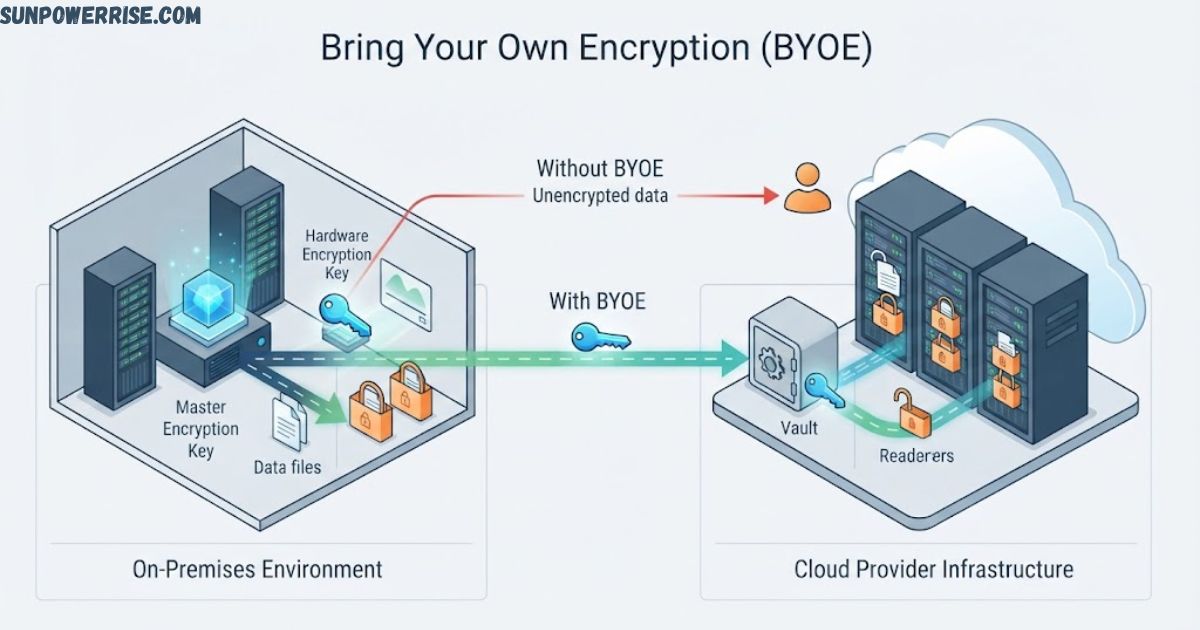
For years, cloud service providers ran encryption and decryption for their clients with a designated method of encryption. That is changing, and the growing trend of BYOE adoption shows it. With a cloud service offering that supports BYOE, users apply their chosen method of encryption inside their cloud computing account and skip the built-in encryption.
Many companies want direct key control because they fear vendor lock-in while they chase scalability and efficiency. In this customer-controlled model, the customer’s hands hold the encryption software and the key management, and a hardware security module acts as a proxy for the cloud provider’s storage.
You will often see BYOK, HYOK, and Bring Your Own Encryption used interchangeably, and HYOK means Hold Your Own Key. All of them keep the organization in charge and give the heightened level of security that customers’ data deserves. Applications keep running as usual, and the owner can still decrypt whatever matters.
Benefits of Using BYOE
The first win is enhanced data security. When you proactively safeguard data with your own encryption, you stop trusting the provider’s encryption and hoping it holds. Even if a compromise hits the provider’s keys, your stored data stays safe, and that gives you a robust defense against unauthorized access.
Control is the next big win. A customer who owns the encryption keys holds ultimate authority over sensitive data, and that is the core of data ownership. That full ownership matters under strict data governance rules and compliance regulations, where transparency and independent assurance count, and it lifts confidence and assurance while easing trust concerns about any third-party.
Customization and autonomy come next. Teams shape their own encryption policies, pick the cryptographic algorithms and other algorithms they trust, and choose encryption tools that match their security standards, protocols, and industry standards. This flexibility lets them run key rotation and revocation on their own schedule, without waiting on a cloud service provider.
Thales BYOE goes further than native encryption solutions. It pairs high-performance AES encryption with hardware acceleration, and it uses the Advanced Encryption Standard (AES) to lock data while granular access control policies, including privilege user access control, decide who sees what.
Teams with multi-cloud deployments get one more perk. CipherTrust Manager handles centralizing control of key management in one place. That keeps your rules the same across every site and saves staff from learning a new console each time.
Role of Hardware Security Modules (HSMs)
Hardware Security Modules, or HSMs, sit at the heart of BYOE. These specialized devices give you a tamper-resistant environment and a secure isolated environment for cryptographic operations. They handle secure key management through key generation and storing and managing keys, they keep every new generation of a key inside the box, and they keep every usable key away from the cloud provider’s infrastructure.
Power brings responsibilities, and BYOE is no exception. An organization must plan for storage, backups, and staff skills, but the additional layer of security pays off. It protects confidentiality and integrity, so your cryptographic keys and encryption keys stay private and unchanged.
The customer’s HSM acts as a proxy between the organization and the cloud. It performs encryption and decryption on secure hardware, so the data encrypted by your box leaves before the provider ever sees it, and your box decrypted it only on request. Because this work skips general-purpose systems, you keep tighter control and simpler management.
This collaborative approach adds to trustworthiness and flexibility, and it strengthens your data security measures. Even during security incidents or breaches at a cloud service provider, unauthorized access stays blocked. Most of all, compromises on the provider’s side cannot reach your keys.
BYOK vs BYOE: What Is the Difference?
Let’s compare the two on one aspect at a time. BYOK, short for Bring Your Own Key, covers what you control: the keys only, often called customer-managed keys. BYOE, short for Bring Your Own Encryption, adds your encryption software and encryption engine, so you control the whole encryption stack.
Where encryption happens also differs. With BYOK, work often runs in the cloud provider’s services, and key exposure to the provider stays possible. With BYOE, your HSM works as a proxy, so the provider never sees a usable key, and people also call this model HYOK, or Hold Your Own Key.
BYOK offers high control, while BYOE offers the highest. The complexity moves the other way, with lower effort for BYOK and higher effort for BYOE, since you run the encryption layer yourself. That trade-off is fair, but you should plan for it.
Crypto-Agility
Crypto-agility is where owning the engine really pays. Since you pick the algorithms, you can leave quantum-vulnerable algorithms like RSA and ECC behind and move toward post-quantum cryptography on your own timeline. FIPS 203 defines ML-KEM, one of the new standards for that shift.
For new deployments, choose validated HSMs that meet FIPS 140-3. FIPS 140-2 certificates move to Historical status on September 21, 2026, so don’t wait. The numbers 203, 140-3, and 140-2 may look dull, but the 21 and 2026 in that date matter for your planning.
Encryption is only a starting point. Most cloud service and encryption providers use the same encryption techniques, and the common choice is the Advanced Encryption Standard, or AES. You must weigh threats, set access controls, and handle key management and encryption keys across multiple cloud providers, not just one cloud provider.
FAQs
What is BYOE?
It stands for Bring Your Own Encryption. It is a cloud security model where you use your own encryption software and keys instead of the cloud provider’s, so the provider never holds a usable key.
How does an HSM work in BYOE?
A Hardware Security Module acts as a proxy between your organization and the cloud provider’s storage. It creates and stores your keys and handles all encryption and decryption inside tamper-resistant hardware.
What is the difference between BYOK and BYOE?
BYOK gives you control of the encryption keys only, while the other gives you both the keys and the encryption engine. That makes BYOE the higher-control option, but it also takes more effort to run.
What are the main benefits of using it?
BYOE gives you stronger data security, full key ownership, easier compliance, and less vendor lock-in. It also keeps your data safe if the cloud provider suffers a breach or an outage.
Is it the same as HYOK?
The two terms are often used interchangeably because both keep the keys fully in the customer’s hands. Strictly, HYOK stresses where the keys stay, while BYOE stresses bringing your own encryption engine.
Why does BYOE matter for crypto-agility and post-quantum security?
Because you run the encryption engine, you can adopt new algorithms on your own timeline instead of waiting for the provider. This makes it easier to move away from RSA and ECC toward post-quantum standards like ML-KEM.