


Software development outsourcing is not just about saving money; it is a full business practice where a company hands over technical work to an external partner instead of relying only on an in-house team.
I have watched startups and small businesses use this model to launch mobile apps and websites without building a full in-house team. Big companies do this too. Over 90% of Fortune 500 firms run multiyear business process outsourcing contracts, and 94% of companies building machine learning solutions bring in outsourced providers to help. AI has not replaced outsourcing it has made distributed engineering talent even more valuable for digital execution and innovation.
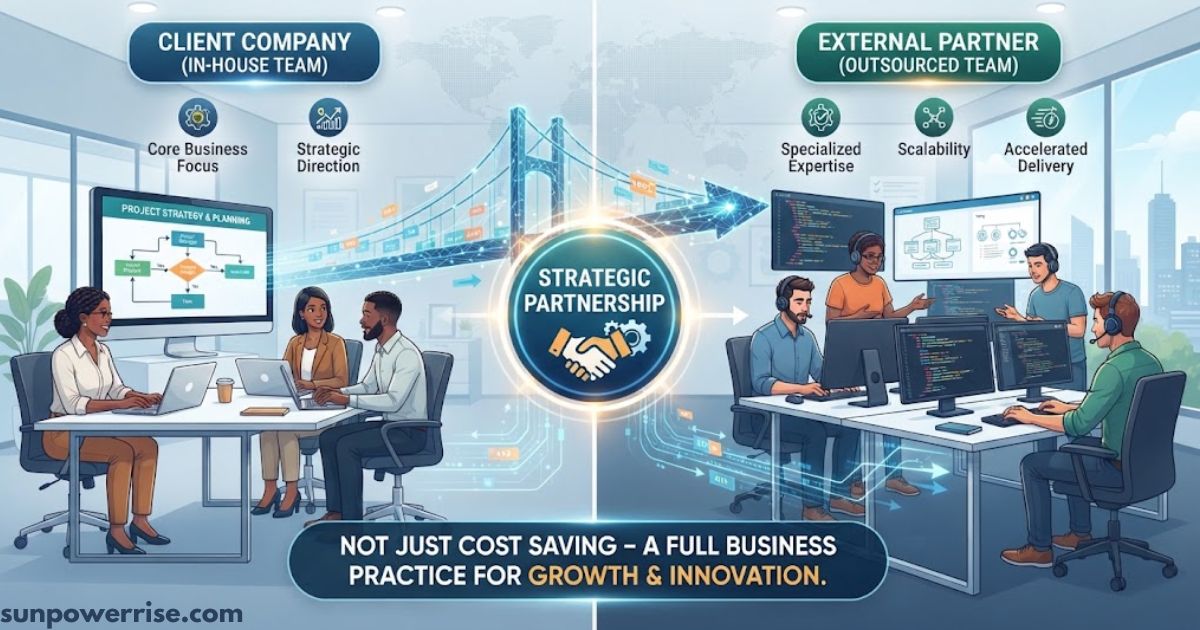
From my own project work, the biggest win is scalability. You can adjust team size as project needs shift, without any long-term commitment to permanent staff. This only works with clear communication, well-defined goals, and real alignment between your business and the outsourcing partner.
Done right, software development outsourcing becomes a strategic extension of your technology organization, helping you accelerate delivery and cut infrastructure costs without long recruitment cycles.
Benefits of Software Development Outsourcing
Cost savings remain the biggest draw. Hiring skilled developers in regions with lower rates cuts development costs without cutting quality, and it comes with real flexibility: you can scale up during peak workloads or scale down once a project calms, without dragging out onboarding.
Beyond price, outsourcing opens the door to a genuine global talent pool with specialised skills in DevOps, blockchain, machine learning, IoT, and UX design skills that are hard to build in-house overnight. Research shows 72% of companies outsource mainly for cost savings, and 61% point to agility and scalability as the top reasons distributed teams work so well, since they cut HR and operational overhead.
Delegating development tasks to external partners also lets internal staff protect their core strategic objectives. Using higher-seniority resources and proven delivery strategies, teams often reach faster time-to-market, sometimes twice as fast, while structured process management keeps everything visible and reduces exposure to resource shortages and technology gaps.
Engagement Models: Staff Augmentation, Dedicated Team, Project-Based
Picking the right model matters more than people expect. Staff augmentation works well when you need backend or UX skills added straight into your internal team, giving tight integration during major feature releases. I usually recommend this for hybrid teams sharing one delivery pipeline.
A dedicated team, sometimes called a managed team, takes full lifecycle ownership from discovery and architecture to design, development, QA, and maintenance. The provider handles day-to-day management while you keep strategic oversight and receive performance reports. This suits ongoing product development where continuity matters most.
For bigger builds, managed services or custom solution development puts the vendor in charge of the whole delivery. Technology consulting helps earlier, reviewing your project scope and infrastructure needs so you choose the right engagement model, whether for CI/CD, infrastructure development, or full-scope reporting.
Location-Based Models: Nearshore
Onshoring means staying in the same country, keeping coordination simple but raising costs; good for smaller projects or larger companies that can afford it. Nearshoring means picking nearby countries with similar time zones, like Latin America, balancing cost efficiency with easier management.
Offshore
Offshoring covers distant regions such as Eastern Europe and Southeast Asia. While it can bring communication challenges, it delivers the strongest cost efficiency for long-term projects.
I have personally worked with teams in Eastern Europe, and the deep pool of vetted engineers with strong STEM backgrounds is real, along with cultural compatibility with Western Europe and a wide tech stack covering DevOps, IoT, and automation, though language and cultural nuances still need attention.
Reshoring
Reshoring brings work back home when a company wants tighter oversight. Leading destinations today include LATAM (Argentina, Brazil, Colombia, Mexico) for strong English proficiency; Central and Eastern Europe (Poland, Ukraine, Romania) for engineering expertise; and Asia (India, Vietnam, the Philippines) for cost-competitive AI/ML and data engineering talent.
Choosing the Right Outsourcing Partner
My personal checklist always starts with real technical expertise across the tech stack, plus proven domain experience in healthcare, e-commerce, or blockchain. I also check process maturity through Agile or DevOps frameworks, fair engagement terms, and honest transparency on pricing and timelines.
A strong engineering team should cover backend and frontend, end-to-end development from UX design to test automation and cybersecurity, with specialists available for machine learning or blockchain work.
Before signing anything, I map out project scope clearly is this an MVP, full custom build, or legacy modernisation? Because that decision drives the right software development outsourcing model, backed by real testimonials and case studies.
Cost Efficiency and Scalability
Outsourcing lowers overhead costs fast, especially for startups scaling rapidly, since you avoid recruitment, training, and long-term in-house staffing costs. Staff augmentation suits short peak periods, while dedicated teams suit full builds; both smooth out budget spikes and protect against delayed launches.
Scalability is where outsourced teams truly earn their place. Need more developers or testers? Add them. Need to scale down? You can, without breaking your in-house workflow. This supports real-time adaptation to shifting business needs, letting founders protect their core product vision while outsourced specialists handle testing, automation, and quality assurance.
In-House vs. Outsourced Teams
In-house teams offer direct, in-person management of priorities and communication, while outsourced teams need structured alignment through clear requirements and defined outcomes. Hiring internally can take months, but outsourced vendors keep ready-to-deploy talent pools, letting you scale fast. Outsourcing also spreads delivery and operational risk onto the vendor, freeing internal staff to focus on long-term product strategy.
Pricing Models and Business Challenges
Common pricing options include fixed price for well-scoped work, time and materials for evolving projects, and dedicated team pricing for ongoing builds. Less common models include retainers, milestone-based payments, and outcome-linked pricing.
Software development outsourcing also solves real business problems by accessing niche skills in AI/ML, cloud, and cybersecurity, modernising legacy systems, scaling high-load infrastructure, and supporting round-the-clock operations through follow-the-sun coverage in regions like India.
Key Risks to Watch
No approach is perfect. Watch for vendor lock-in, cultural or language barriers, data security risks, inconsistent quality control, and hidden costs from scope changes. Strong governance and clear contracts protect against most of these issues, making software development outsourcing a manageable, high-value strategy when handled with care.
FAQs
What is software development outsourcing?
Software development outsourcing means hiring an external partner to handle application development instead of relying only on your in-house team. It gives businesses access to a global talent pool, cost savings, and faster time-to-market.
Is outsourcing illegal in the US?
No, outsourcing is completely legal in the US, and most Fortune 500 companies use business process outsourcing contracts every year. It becomes a concern only when data security risks or contracts are handled carelessly.
How much does it cost to outsource software development?
Costs vary by region and engagement model, but offshore talent can offer up to 72% in cost savings compared to hiring in-house. Nearshore and onshore options cost more but reduce communication challenges.
What are the biggest software outsourcing companies?
Leading players operate across LATAM, Eastern Europe, and Asia, offering staff augmentation, dedicated teams, and full managed services. Company size matters less than proven technical expertise and real case studies.
Is outsourcing a dying concept?
Not at all, outsourcing is actually growing, with 94% of companies building AI and machine learning solutions relying on outsourced service providers. If anything, digital execution today depends on it more than ever.
What is the top outsourcing country?
India remains the top outsourcing destination, known for massive talent availability, strong AI/ML and data engineering skills, and highly cost-competitive rates. Countries like Poland and Ukraine follow closely for technical depth.