


I still remember standing on a windswept walk along the British coastline in Cornwall, thinking about how few homeowners actually tap into home wind turbine energy this way, watching a lone turbine spin lazily against grey clouds.
Britain is famously the windiest country in Europe, and in 2020 alone, wind turbines produced enough electricity to cover more than half the nation’s needs. That fact alone convinced me that home wind power deserves a closer look, especially as rising energy costs push more households to search for green, renewable ways to power daily life.
Home Wind Turbine Energy
How Home Wind Turbines Work
A domestic turbine works like a miniature version of the huge wind turbines you spot in fields or just off the coast, only built to a smaller scale for a home wind turbine energy setup.
The basic science stays the same: wind pushes against the blades, forcing them to rotate, and that spinning motion turns a shaft connected to a generator inside. Even a light breeze can get sensitive blades moving, though a stronger wind naturally produces more electricity.
Converting Motion into Usable Electricity
Inside the turbine, gears link the moving blades to a generator, which changes the kinetic energy of that motion into real, usable electricity.
That power first appears as direct current, or DC, so an inverter steps in to turn it into alternating current, or AC, which is what runs the lights and plugs in your home. From there, a transformer takes over and transports energy onward, sending it either straight into the house or out to the wider grid.
Horizontal vs. Vertical Axis Designs
Turbines actually spin in two different styles, and each one has its own personality. Horizontal axis turbines are the default design most people picture, with blades shaped like a propeller, and they tend to be more efficient than the alternative.
Vertical axis turbines, on the other hand, look more like a kitchen whisk, take up less space, and can catch wind from any direction, though they usually run a touch less efficient.
Scale, Location, and Performance
Full-sized bigger wind turbines are usually very tall, with gigantic blades built to capture energy and squeeze out as much wind power as possible.
Fit one into a small back garden, though, and it simply cannot match that scale, which is why these systems suit rural areas and extra-blustery areas far better than a tight urban plot. A compact turbine still keeps spinning steadily in the right spot, proving that size is not everything when the location is truly windy.
Appeal of Domestic Wind Turbines
Cutting out the middleman and installing home wind turbine energy at home sounds appealing, yet it still feels like a big leap for many homes across the UK.
There’s a growing commitment to sustainability now, and domestic wind turbines are becoming a genuinely popular choice among people who want guilt-free green energy without relying entirely on the grid. Small micro wind turbines, like the Britwind H1, are compact enough to sit quietly beside a house while still doing real work.
Types of Home Wind Turbines
Roof-Mounted Wind Turbines
Choosing the right domestic turbine really comes down to two main styles of home wind turbine energy, and each one suits a different kind of home.
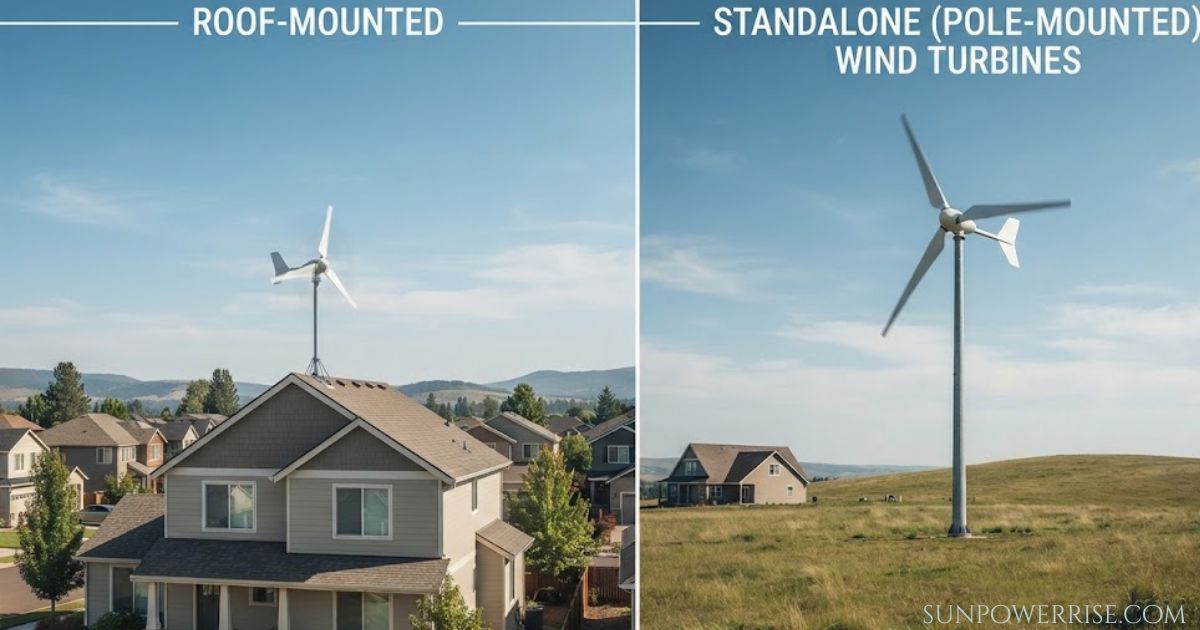
Roof-mounted wind turbines sit up top just like solar panels, catching the wind blowing over the house without needing extra land. They are generally cheaper to install, though small wind turbines on a roof usually manage only 1-2kW, which is less powerful than what you would get from a full setup on the ground.
Pole-Mounted and Standalone Systems
Pole mounted, or standalone turbines, stand apart from the house entirely and work best in the right place somewhere genuinely exposed to wind, with nothing around to slow down wind, much like a massive field or the top of a hill. These are also known as standalone turbines because they need a large open place or big open space rather than a cramped garden.
Free standing turbines, sometimes called free-standing wind turbines or mast mounted systems, stand much taller than a rooftop unit, and that extra height helps them capture far more energy.
Benefits of Home Wind Turbines
Owning a turbine can genuinely save money over time as part of a wider home wind turbine energy plan, because once the initial installation is paid off, the wind free resource itself costs nothing to use.
Across the UK, and especially in Great Britain and Northern Ireland, that means real cut back on monthly energy bills for every home willing to make the investment. Battery storage lets you store any excess electricity you don’t need straight away, so nothing generated on a wild afternoon goes to waste.
If your setup produces more than you use, the Smart Export Guarantee offers payments for sending that spare power back to the grid, a scheme that effectively pays households in GB for generating more electricity than they need.
This kind of export extra electricity arrangement is not available everywhere, so it is worth checking eligible areas before you commit. Beyond the numbers, cutting carbon dioxide emissions and carbon emissions matters too, since wind generated electricity and renewable energy don’t release anything harmful into the air.
Cost of Home Wind Turbines
The overall cost of a home wind turbine energy system depends heavily on the size of the turbine you pick and how it gets mounted, whether that is roof- or ground-based mounting. Building-mounted turbines generally cost less than free-standing ones, though that saving comes with a trade-off, since smaller units tend to run less efficiently than their bigger cousins.
A typical small roof-mounted turbine, somewhere between 0.5 kW and 2.5 kW, carries an average cost of around £2,000, though it will not generate electricity fast enough to recoup cost quickly.
Step up to a full 6kW setup and the figure jumps to roughly £35,000 for equipment and installation combined, covering everything an installer needs to fit a proper pole-mounted system.
A more modest 5kW wind turbine typically lands between £20,000 and £25,000, though a domestic wind turbine of this type and size always varies depending on the chosen pole-mounted model and smaller or larger blade options.
Do not forget the extra costs of planning permission, preparing site, and connecting turbine work to the electricity grid, since these can push the total bill to somewhere between £30,000 and £40,000.
Getting Paid for Exported Energy
Right now there are no specific schemes offering direct funding for home wind turbine energy installation, which surprises a lot of people looking for financial support before they commit. If cost feels like a barrier, a community-owned wind project is worth exploring, since projects like these sit among the top priorities for Great British Energy.
The old Feed-in Tariff scheme used to reward homeowners generously, but the government shut that closed scheme down back in 2018.
In its place came the Smart Export Guarantee, or SEG, which rewards households for exporting energy back to the National Grid rather than letting it go to waste.
If you are eligible, payments typically land 4 times a year, and the amount depends on the size of the turbine installed and how much electricity is used at home versus what is exported. Every reading is based on real meter readings, so the system tracks exactly how much a wind turbine generates before working out what is owed.
Planning Permission
Rules on planning permission change depending on where in the UK you live, and honestly, the situation gets complex fast. In Wales and Northern Ireland, you must install wind turbine equipment only after getting formal approval, no exceptions. England and Scotland allow more flexibility, though specific situations still apply, so it is always worth phoning your local planning officer before touching a spade.
A roof-mounted wind turbine in England can usually skip formal approval if it meets MCS standards, sits on detached houses surrounded by other detached house properties, and stays as one turbine without an air source heat pump already fitted.
It also cannot extend more than 3m above your chimney height, and a standalone wind turbine must keep its highest point below 11.1m to qualify, while Scotland applies its own rules requiring approval unless the turbine sits more than 100m from your next-door neighbour.
Wherever you live, steer clear of any world heritage site, listed building, or scientific research land used for archaeological purposes, and always confirm with the council before treating your property as ready to go.
FAQs
How much electricity can a home wind turbine generate?
A well-sited home wind turbine can generate anywhere from 1-2kW on a roof-mounted system up to 10,000 kWh a year from a full 10kW system, depending on your local wind speed.
Do home wind turbines actually work?
Yes, they genuinely work, turning wind into real electricity through spinning blades and a generator, though results depend heavily on your local wind speed..
Can a single wind turbine power a house?
Yes, one turbine can power a house if it is properly sized and well-sited, but it truly comes down to getting the size and wind speed right get that wrong, and even the best turbine falls short.
Is a home wind turbine worth it in the UK?
It can be worth it if you have the right space, strong local wind speed, and enough cash for the upfront installation costs, since long-term savings build up over the 20-year life of the system.
How much does a home wind turbine cost to install?
A small roof-mounted turbine starts around £2,000, while a full 6kW pole-mounted system can run between £35,000 and £40,000 once you add planning permission and grid connection.