

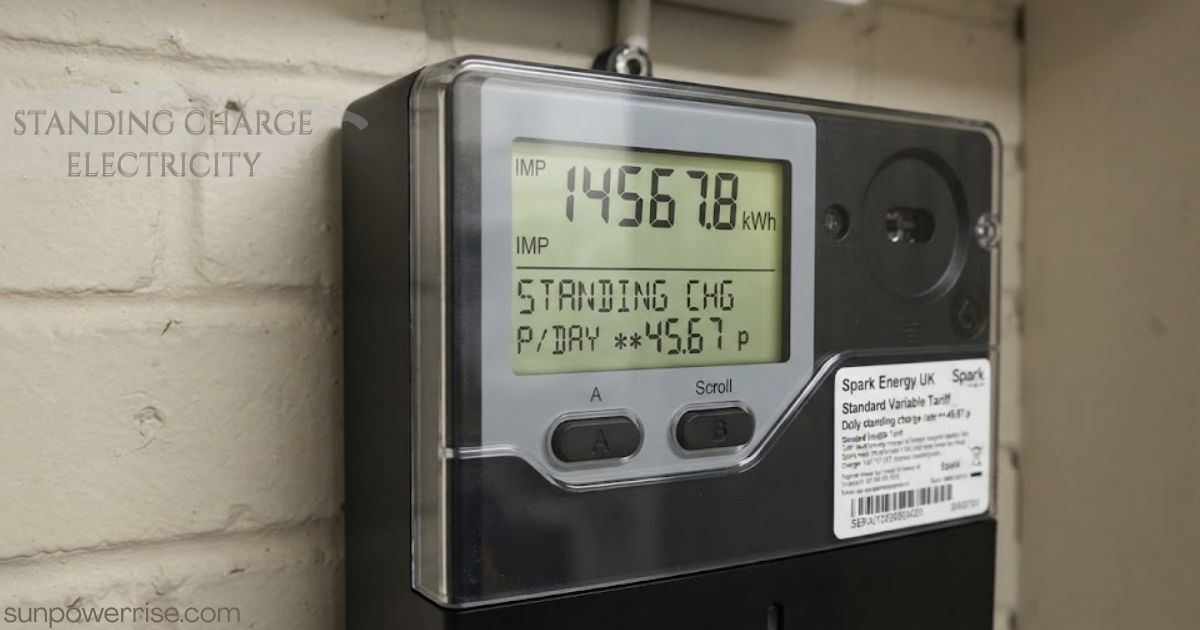
Standing charge electricity costs catch out anyone who has stared at an energy bill and wondered why a charge appears even on a day with the lights off. It sounds small on paper, yet it shapes almost every energy bill in the country, and once you understand it, budgeting gets a lot less stressful.
What Is A Standing Charge Electricity?
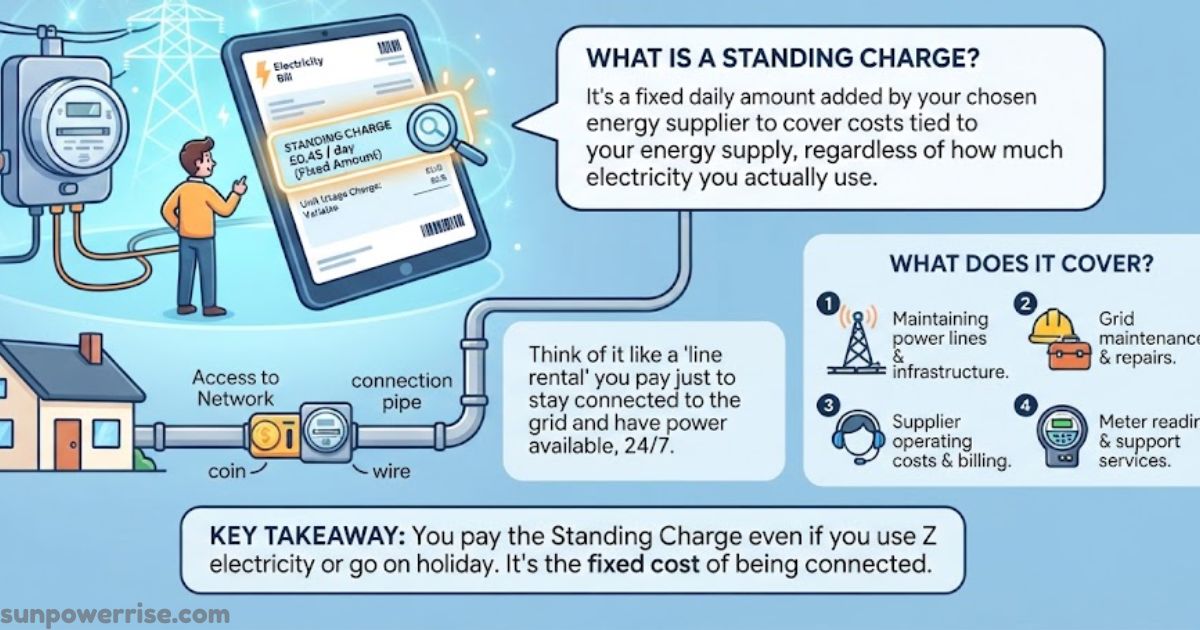
Standing charge electricity simply means a standing charge that sits on almost every bill, and your energy supplier the supplier you picked adds this fixed daily amount to cover energy costs tied to your daily energy use, no matter how much electricity or gas you burn through, much like a line rental you pay just to stay connected to the energy supply network.
Price Cap and Average Costs
Ofgem, the industry regulator, watches the current Price Cap closely, and under the average household paying by Direct Debit you might see 57p a day for electricity and 29p a day for gas, adding up to roughly £315 a year, while a PAYG customer on a prepayment meter pays through top-ups instead of receipt of bills.
Purpose and Structure of the Charge
This daily standing charge stays separate from the unit rate and the kilowatt hour (kWh) cost, protecting low energy users from paying a significant portion of overall energy costs just because their home or property sits empty, and it also funds meter reading visits and government support schemes, though higher costs can appear without a budget plan.
Variations and Supplier Alternatives
Since maintaining access to gas and electricity never comes free suppliers such as Utilita and E Energy even trial a zero standing charge setup for Pay As You Go customers, showing that standing charges don’t stay identical across all energy suppliers, especially when gas over summer use drops and the Price Cap shifts predictably each year for gas and electricity combined, on your bills.
When do I pay for my standing charge?
Every energy connection carries a standing charge, and this daily fee shows up differently depending on your payment methods an electricity and gas customer typically sees it as a daily rate on the bill, listed clearly on the energy bill for both fuels.
Pay As You Go customers, by contrast, watch it come out of the meter as a fixed weekly amount, taken automatically from top-ups tied to the property. Whether you use gas or electricity, most accounts show separate standing charges for each fuel, so you always know exactly what portion of your spending goes toward simply staying connected.
Why do standing charges increase?
Several factors inside the UK Energy Market push standing charge electricity rates and gas standing charges upward, and Ofgem points to the cost of failed suppliers that went bust during the energy crisis as one major driver, since someone still has to absorb those network costs.
The expansion of the Warm Home Discount scheme, along with new network charging reforms, adds further policy costs onto households already stretched thin, and these fixed costs don’t disappear just because energy retailers shut down. Our blog breaks this down further, but the short version is that standard variable energy tariffs under the Energy Price Cap absorb every fresh increase in gas and electricity overheads.
Low and zero standing charge tariffs
If you’re chasing the cheapest standing charge electricity uk deal, only a handful of providers offer a standing charge electricity tariff with a zero standing charge or a low standing charge, and among energy suppliers, Utilita and E Energy stand out, though Utilita costs more on a traditional prepayment meter than on a smart prepayment meter, and E Energy only works for prepay customers with the smart version, so check your meters before switching.
Higher Unit Rates and Trade-Offs
These options still add higher unit rates, including a steep higher unit rate charged on the first two units of gas and electricity used each day, before dropping to normal unit rates afterwards, meaning the real saving only appears for low energy use or unusual circumstances.
Alternative Discounts and Where to Compare
EDF Energy, meanwhile, runs a flat £50 discount (£25 for each fuel) off the standing charges under the Price Cap a genuine low standing charge route worth comparing through the Cheap Energy Club, alongside fixed deals and standard tariffs with a slightly lower rate, since a typical user with low to medium usage benefits most from any Price Capped tariff that trims usage-based costs.
Should I go for a ‘low’ or ‘zero standing charge’ tariff?
Deciding on standing charge electricity costs versus unit rates comes down to usage if you count as a high energy user, or a higher user generally, a lower unit rate paired with a higher standing charge usually wins, because the unit rate saving multiplies across your heavy energy usage of gas and electricity.
A low energy user, a low user, or anyone with an empty home for long periods, especially through the warmer months, finds the opposite true, since a higher standing charge would eat up a bigger proportion of a smaller total energy bill and simply negate savings.
That’s why zero standing charge tariffs suit households in one region but not another, and only a proper whole-of-market comparison tells you which route stays truly cost effective, alongside checking your annual standing charges before you decide.
What is the current standing charge of electricity?
The exact standing charge for electricity depends entirely on your supplier, so it pays to check your account directly, though Ofgem also publishes a table of averages every time the energy price cap updates.
From 1 July to 30 September 2026, average standing charges worked out at 29.04p per day for Gas and 57.19p per day for Electricity on Direct Debit or Prepayment, while anyone on receipt of a bill paid more, at 36.69p per day for gas and 65.74p per day for electricity. Our Energy Price Cap rates guide breaks these payment methods down by region-by-region rates, so wherever you live, the full Price Cap picture stays easy to find.
How do standing charges work?
Look at your energy bill and you’ll find your standing charge electricity cost listed as a daily unit rate, priced separately for electricity and gas. Suppliers keep it apart from the kilowatt hour (kWh) unit rate on purpose, so vulnerable houses with high energy use don’t end up paying proportionately higher sums just because they need more power.
When you sign up for a new energy tariff, that full quote already includes this daily figure, so you know the total cost before you commit.
How do I avoid electricity standing charges?
To dodge electricity standing charges completely, you need a genuine zero standing charge tariff, though very few suppliers offer one. Remember that the cost has to go somewhere, so these deals raise the unit rate you pay per kWh instead. For most households, sticking with a low standing charge plan turns out more economical than chasing zero altogether.
Why are energy prices so high at the moment?
High energy prices aren’t just a UK problem the same pressure shows up right across the globe. Rising demand, lingering operational issues left over from the pandemic, and ongoing political unrest all combine to push costs upward everywhere. None of these causes sit fully within any one supplier’s control.
Comparing tariffs
Ofgem requires every supplier to list the unit rate and the standing charge electricity cost separately on all tariffs, covering both gas and electricity. This rule makes it far easier to compare deals across the whole energy market, since you can see exactly what portion comes from standing charges versus usage. Without that split, spotting a genuinely good deal would be far harder.
How does the price cap affect standing charges?
Ofgem updates the energy price cap every three months, aiming to keep typical energy costs fair for households across the country. It doesn’t fix your exact unit rate or fixed daily charge, but it does cap the overall amount you’ll pay, so you could end up on a plan with a higher unit rate but a lower daily charge, or the reverse. Your final numbers still shift based on your payment method, your meter type, and your location.
Other ways to cut your energy bill
Plenty of practical MoneySaving tips can trim your bill beyond the standing charge electricity cost itself. Start with our free benefit checker to see if you’re missing out on benefits or grants, since the Warm Home Discount offers £150 to eligible households, and some pensioners may also claim up to £300 through the Winter Fuel Payment, alongside Cold Weather Payments during a harsh winter genuine energy bills help worth claiming.
Paying by Direct Debit through fixed monthly payments, rather than quarterly, can save 5% to 10%, and if your current deal feels expensive, you can switch to a cheaper energy tariff via the Cheap Energy Club, or simply ask your supplier for support if you’re struggling with energy bills.
Finally, small habits like adjusting your thermostat or tweaking your boiler flow temperature genuinely help you use less energy our Energy savers checklist, Heat the human guide, and Energy mythbusters page all offer easy, pain-free ways to cut costs further.
FAQs
How much is a standing charge for electricity?
Your electricity standing charge depends on your supplier, location, and payment method, but under the Price Cap it averages around 57p a day for most households.
How can I avoid paying electricity standing charge?
You’d need a genuine zero standing charge tariff, though very few suppliers offer one, and these usually carry a much higher unit rate instead.
Why is my standing charge for electricity so high?
Rising network charging reforms, the cost of failed suppliers, and wider policy costs across the UK Energy Market all push your electricity standing charge upward.
Can I get electricity without standing charge?
A handful of providers, like Utilita and E Energy, offer a zero standing charge option, but only for prepay customers with a smart prepayment meter.
Does a smart meter include standing charge?
Yes your smart meter’s In-Home Display still totals up the fixed daily charge, so you’ll see it even on days you barely use any power.