

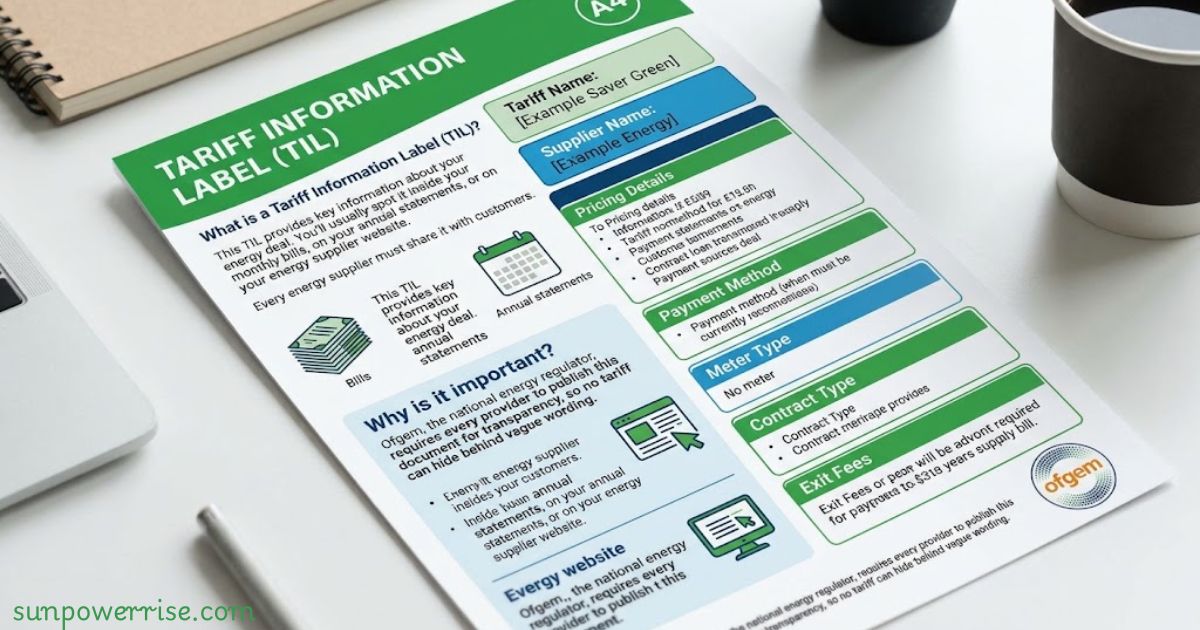
A Tariff Information Label (TIL) is a standardised document that breaks down the key costs, rates, and terms of a specific energy plan: the unit rate, the standing charge, the contract length, and the estimated annual cost, all laid out in one place so it can be measured against any other deal on the market.
Every UK energy supplier is required by Ofgem to produce one, in the same format, for every tariff they sell. That’s what actually makes an energy bill less confusing: instead of digging through pages of small print, you get one snapshot that tells you what you’re paying for.
Whether you’re shopping for energy for the first time or simply comparing gas and electricity offers side by side, this guide walks through what’s actually on a TIL, what it deliberately leaves out, and how to use it properly before switching.
What is a Tariff Information Label (TIL)?
A TIL exists to protect consumer choice by giving every supplier the same comparison format, so switching feels less like a gamble. If a switch is on your mind this year, it’s worth reading this label properly before signing anything.
From helping family members through a supplier switch, the label is consistently the first thing worth checking, not the flashy headline rate on the homepage.
Think of a TIL as a nutrition label for energy: it takes a tariff’s various moving parts rate, charges, terms and turns them into a format you can actually compare across suppliers.
You’ll typically find it inside your monthly bill, on your annual statement, or listed on your supplier’s website. Ofgem, the UK’s energy regulator, requires every provider to publish one for every live tariff, precisely so no supplier can bury the real cost of a deal behind vague marketing language.
Purpose of a TIL
Before this label existed, comparing energy deals meant lining up bills from different suppliers that used different formats, different units, and different assumptions a genuinely frustrating exercise. Ofgem introduced the TIL to force every supplier into the same structure, so a like-for-like comparison actually becomes possible.
This matters most at the point of switching. Instead of guessing whether a new deal is really cheaper, you can hold two TILs side by side and see the answer.
Who has to provide a TIL, and when
Every licensed supplier in Great Britain is required to hand over a TIL at specific points, not just whenever they feel like it:
When you sign up to a new tariff before or at the point the contract starts.
Whenever your tariff terms change partway through a contract (a rate change, for example).
On request, if you can’t locate yours, you’re entitled to ask your supplier for a copy, and they have to provide it.
Because Ofgem mandates a consistent format, a TIL from a small independent supplier should be laid out the same way as one from a large national provider. You shouldn’t have to relearn how to read the document every time you compare a new company.
If you want to see the exact structure Ofgem expects suppliers to follow, Ofgem publishes the official TIL template directly worth a look if you ever want to check whether a supplier’s version is missing something it shouldn’t be.
Key features of a TIL
Basic provider and rate details
Every TIL opens with the fundamentals: supplier name, tariff name, and tariff type standard variable or fixed. Beneath that sits the unit rate (price per kWh) and the standing charge, which is usually billed either as a fixed daily amount or shown as pence per day.
If you’re on a time-of-use tariff like Economy 7 or Economy 10, you’ll see separate on-peak and off-peak rates instead of a single flat figure.
Contract terms and supply identifiers
Further down, you’ll find the tariff end date and, for fixed deals, the date the price guarantee expires, plus any exit fees attached to leaving early. Dual-fuel and renewable tariffs carry the same information, along with contract length and payment method direct debit, quarterly billing, and so on.
You’ll also see your supply identifiers listed: the MPAN (Meter Point Administration Number) for electricity and the MPRN (Meter Point Reference Number) for gas.
Consumption baselines and cost estimates
Ofgem’s Typical Domestic Consumption Values (TDCVs) set the current benchmark for an average UK household at 2,500 kWh of electricity and 9,500 kWh of gas per year, following the update on 1 July 2026.
Older TILs and some guides that haven’t caught up yet still reference the previous figures of 3,200 kWh and 13,500 kWh, so it’s worth double-checking which baseline a supplier is actually using before comparing two tariffs.
From this baseline, suppliers calculate an estimated annual cost, an estimated monthly cost, and a Tariff Comparison Rate (TCR) in pence per kWh.
Some suppliers go further and break these estimates into low, medium, and high usage bands, rather than showing just one flat average worth checking for, since a single “average” household figure can be a poor fit if your usage sits well outside the middle band.
Additional fees, discounts, and bundles
Your Estimated Annual Consumption (EAC) is a 12-month forecast based heavily on a property’s historical usage rather than a generic guess. Alongside it, you might see extra charges, discounts, promotional offers, or bundled products, plus confirmation of whether VAT is already factored into the headline price.
Regulatory compliance
Every figure on a TIL exists because Ofgem requires it: the unit rate, the standing charge, the exit terms so that a fair, direct comparison is always possible without needing to request a bespoke quote first.
What a TIL deliberately leaves out
A TIL is thorough on the numbers, but it isn’t the whole picture of what a supplier offers. It typically won’t tell you about:
- Loyalty perks or reward schemes: some suppliers offer interest on credit balances or cashback-style rewards that never appear on the label itself.
- Customer service quality: response times, complaint handling, app usability none of it shows up in a rate comparison.
- Green credentials beyond the tariff name: a “renewable” tariff label doesn’t tell you how the supplier actually sources or matches that electricity.
- Smart meter compatibility or app features: these live in the terms and conditions, not on the label.
None of this makes the TIL less useful; it’s still the right starting point for comparing raw cost but it’s not designed to be the full picture of which supplier is actually the better fit for you.
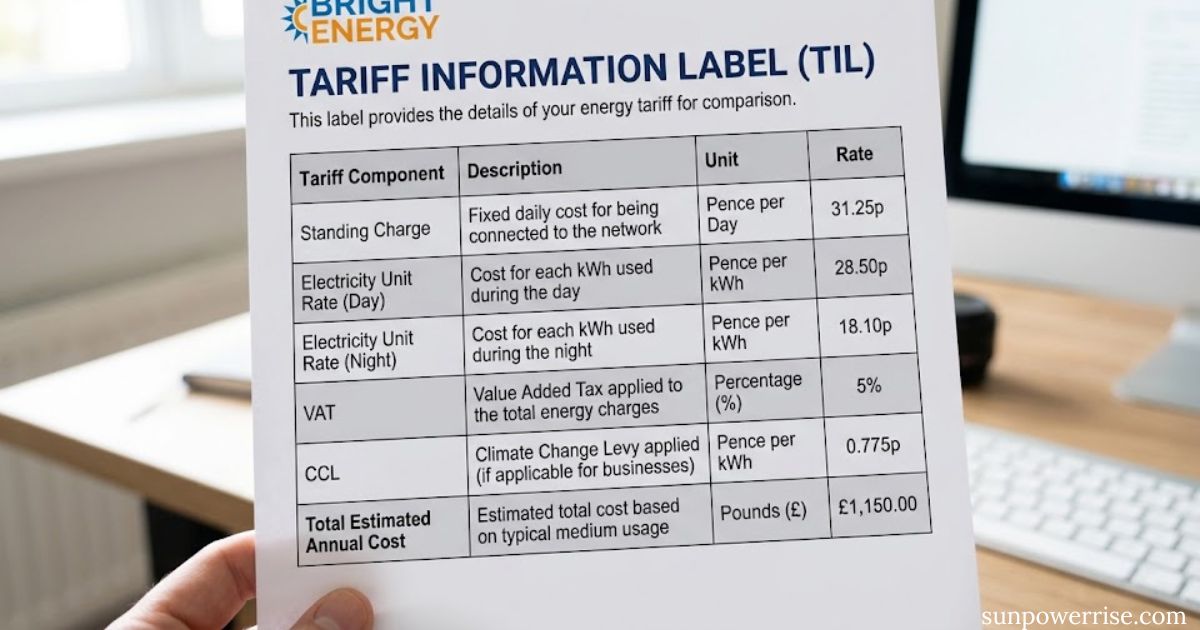
TIL breakdown: what does a Tariff Information Label look like?
A typical TIL places the supplier’s name at the top, followed by a table-style layout listing every rate underneath. Once you’ve seen one, the same pattern becomes easy to spot on any other supplier’s version, since Ofgem’s format doesn’t vary much from one company to the next.
Show Image
How to use your Tariff Information Label
Start with the unit rate and standing charge together
The unit rate is the price you pay per unit of energy, and it’s the number that grabs attention first. But a cheap unit rate paired with a high standing charge can still work out more expensive over a full year than a slightly pricier unit rate with a lower standing charge.
The Tariff Comparison Rate (TCR) exists specifically to fold both numbers into one comparable figure, so lean on that rather than the unit rate alone.
Working out your own annual cost
Here’s a worked example using different figures than the standard TDCV baseline, to show how the maths adapts to any household: say a supplier quotes a gas unit rate of 6.5p/kWh. Applied to a smaller household using around 7,000 kWh of gas a year, that comes to roughly £455.
If the same supplier’s electricity unit rate is 27p/kWh against a household using 3,100 kWh, that’s about £837 for electricity. Add the standing charges for both fuels, commonly somewhere between 25p and 60p a day depending on supplier and region, and you get a genuinely realistic annual figure, rather than one built purely on Ofgem’s average household.
Don’t stop at the headline number
Exit fees, standing charges, and regional distribution costs can all quietly turn an attractive-looking tariff into an expensive one. If your home has above-average appliance use or poor insulation, expect your real costs to run higher than the TIL’s estimate. Treat any average as a rough guide, not a promise.
The 49-day rule most people don’t know about
Here’s a detail that rarely gets mentioned: you’re entitled to switch tariffs without paying an exit fee if you do so within 49 days of your current tariff’s end date, even on a deal that otherwise carries exit penalties.
This means you don’t have to wait until the very last moment, and you don’t have to accept a fee-loaded tariff as a reason to delay shopping around. If your TIL shows an end date, count back 49 days from it and mark that as your real switching window.
FAQs
What information is included on a ScottishPower tariff information label?
Like every UK supplier, ScottishPower’s TIL lists the unit rate, standing charge, tariff end date, exit fees, and estimated annual cost.
What is tariff information?
It’s simply the content of your Tariff Information Label. Your rate, charges, and contract terms, laid out so you can actually compare them.
Who is the cheapest electricity supplier in Scotland?
This shifts week to week as tariffs launch and expire, so there’s no fixed answer. An Ofgem-accredited comparison tool will show the genuinely cheapest live deal for your postcode today.
Who has the cheapest electricity tariff in the UK?
Same story nationally: the cheapest tariff changes constantly with wholesale prices, so check a live comparison site rather than trusting any “cheapest” claim that isn’t dated.