

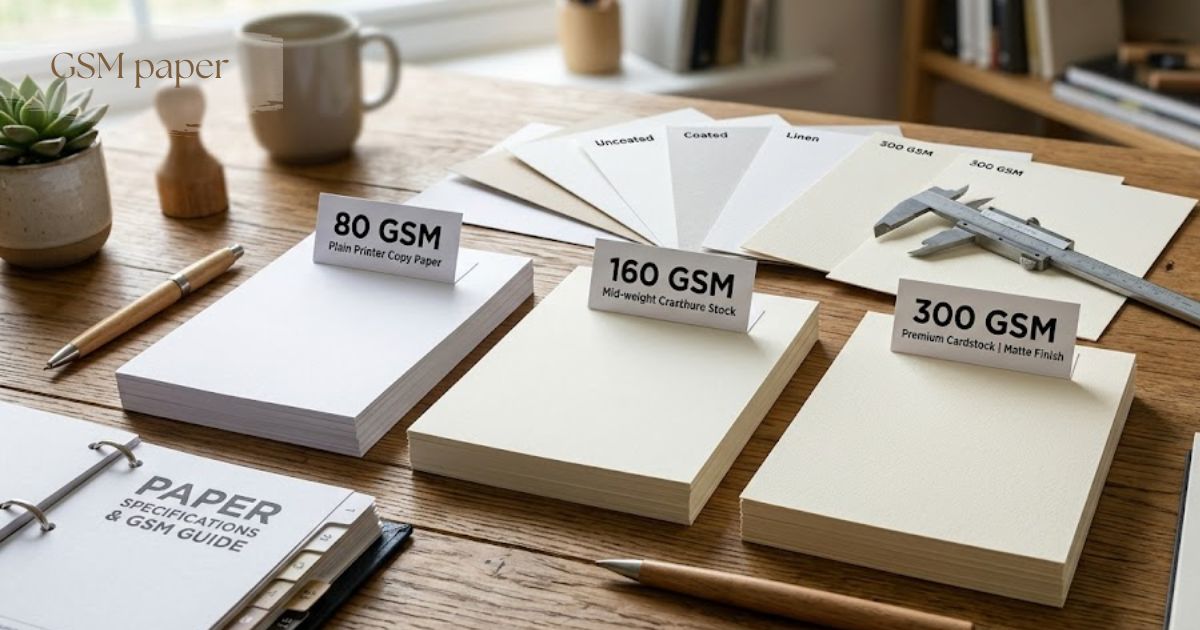
When people talk about paper, one term comes up again and again in the print industry: gsm paper. This stands for grams per square metre, and it is the standard measurement the paper industry relies on to describe how heavy or light a sheet feels.
This guide walks you through the different weight ranges you will come across, along with the paper sizing standards that go hand in hand with them.
Whether you need thick paper for business cards, sturdy card stock for posters, or something closer to flimsy paper for a quick handout, understanding GSM paper helps you avoid ordering bulky paper when you actually wanted something light or, worse, heavy paper when you needed flimsy.
What Is GSM Paper?
If you have ever asked what is gsm in paper, the short answer is that GSM is simply short for grams per square metre, and it comes from weighing a one square metre sample of a sheet to see its mass. Paper experts also call this number the grammage, and it works as the weight designation for every type of material you can print on.
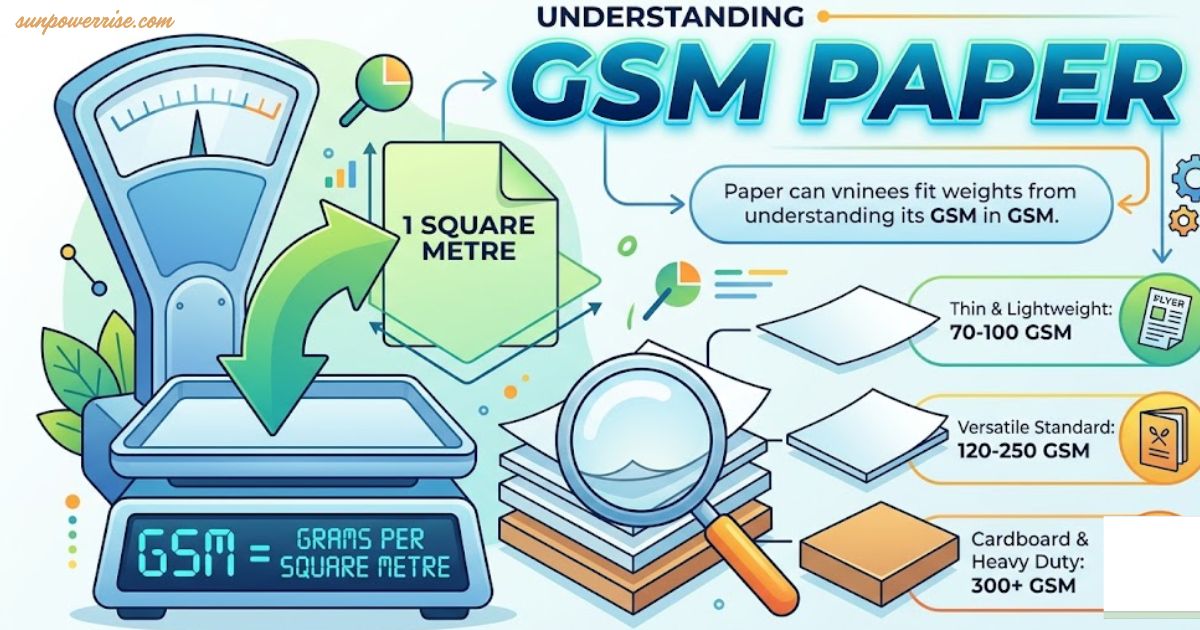
No matter what the final size ends up being, whether it is A4, A5, or something else entirely, the GSM stays constant because it is based on area, not on the length and width of the trimmed sheet.
This is where a lot of people get confused, because GSM looks like it should measure thickness directly, but it does not. There is a strong correlation between GSM and how thick paper feels, yet the real density depends on how compressed or fibrous the fibres are.
Two printed products can carry the exact same designation, say 35gsm or 450gsm and still differ slightly in sturdiness, simply because the cut sheet came from a different poster stock or paper blend.
Why Does Paper Weight/GSM Matter?
The weight of your paper affects both functionality and style, and honestly, this is where most people go wrong when they order in bulk. Thicker paper suits items that people keep as keepsakes, such as invitations and greeting cards, because these pieces need real durability to survive being passed around or stored in a drawer. Business cards fall into this same category; nobody wants a card with a cheap feel when it is meant to represent a brand.
On the other hand, disposable items like leaflets, takeaway menus, and quick flyers rarely need that same strength, so a lighter paper with a lower GSM keeps cost down without hurting the final result.
Choosing the right weight of GSM paper for these different applications also affects handling; nobody enjoys a stack of flyers that feels like unnecessary bulk in their hands. Get the balance right, and the perceived quality goes up even when you have not spent extra money.
GSM Weight Ranges and Common Uses
Once you start comparing paper GSM weights side by side, the range becomes much easier to picture. At the light end, around 35gsm to 55gsm, you get newsprint and thin tracing paper, which is also close to what most newspapers use because it needs to stay cheap and easy to fold.
Move up to 70gsm and 100gsm, and you land on ordinary printer paper and copier paper the kind sitting in almost every office printer, plus the paper for exercise book pages and everyday letters.
Between 150gsm and 200gsm, paper starts feeling more substantial, and this is the sweet spot for compliment slips, letterheads, thin flyers, and promotional posters, along with movie posters you might remember from a cinema lobby. Many printers also add UV coating to paper in this range for brochures and magazine covers, since it gives a glossy, tougher finish that survives handling better.
Push further to 300gsm and beyond, and you reach proper cardstock territory: think business cards, greeting cards, postcards, and formal invitations. This heavier range also works well for card crafting and die-cutting, and by the time you hit 450gsm, you are looking at luxury packaging and premium stock strong enough for repeated use.
Even watercolour paper and art paper sit in a similar heavy bracket, while lighter flyers, takeaway menus, everyday menus, and posters for shops usually stay lower down the scale.
Paper Sizing Standards (ISO A/B/C)
Once you have the gsm meaning paper size sorted, size is the next thing to get right, and it follows its own set of rules; the easiest one to remember is ISO 216, the standard behind the entire ISO A family. It starts with A0, a full square metre sheet, and every step down A1, and A2 at 420 x 594mm come
from folding the sheet before it in half. You will recognise A4 at 210 x 297mm for everyday documents, letters, and magazines, while A5 at 148 x 210mm suits flyers and notepads, and A6 at 105 x 148mm works for postcards and photo prints.
ISO B sizes step in mainly for posters and larger prints, running from B0 at 1000 x 1414mm down through B2 at 500 x 707mm and B4 at 250 x 353mm. These larger formats also suit catalogues, maps, and diagrams that need extra space to stay readable.
Then there is ISO C, which exists purely to match envelopes to A-size paper so nothing feels loose inside. C2 measures 648 x 458mm, C4 comes in at 324 x 229mm, and C6 sits at 162 x 114mm, small enough for a folded letter or a simple card.
Other Ways Paper Weight/Thickness Is Measured
GSM is not the only measurement system paper professionals use. In the United States, printers often turn to U.S. basis weight instead, a method that weighs a ream of 500 sheets in a paper’s basic sheet size to work out its basis weight.
The tricky part is that the basic sheet size changes depending on the paper category; bond paper and copy paper use one size, while cover stock, index stock, Bristol stock, and tag stock each use their own.
Another approach measures physical thickness directly with a calliper or micrometre, recording the result in 1/1000-inch increments. Printers sometimes translate that figure into points, so a sheet measuring 0.008in becomes an 8-point stock.
What Is GSM in Paper
Once you have the GSM paper meaning clear in your head, a few extra points are worth knowing before you place an order.
Deciding on the lowest GSM to cut costs works fine for single-use items like an event flyer that only needs to survive one evening, but it is not always the smartest move for cost effectiveness overall.
Paper with a short lifespan does not need much durability, yet if that same flyer ends up stuffed into a goodie bag and carried around all day, a heavier GSM will hold up far better.
Many printers now offer premium options above the usual 350gsm, going up to 450gsm for a noticeably thicker feel and better quality overall. I have found this makes a real difference for business cards that are meant to impress.
Before ordering anything in bulk, it is worth asking print shops for free samples or a sample pack for their customers, since many keep swatch packs on hand specifically so people can compare weights by touch before they save money on the wrong stock.
FAQs
What is the GSM of paper?
The GSM of paper is its weight, measured in grams per square metre a simple number that tells you how heavy or light a sheet feels.
Which is better, 80 GSM or 70 GSM?
Neither is truly “better” 80 GSM feels slightly thicker and more solid, while 70 GSM is lighter and works fine for everyday printing, so it really depends on your use case.
What does 300 GSM paper mean?
300 GSM means the paper is a heavy, rigid stock the kind of weight you’d trust for business cards or formal invitations that need to last.
What is a good GSM for paper?
A good GSM depends on the job: around 90-100 GSM works well for everyday printing, while 250 GSM and above suit anything that needs to feel premium and durable.
What does 200 GSM paper look like?
200 GSM paper looks crisp, substantial, and slightly stiff to the touch heavier than office paper, with a quality feel close to light cardstock.