

Most people planning a solar energy setup for their home first bump into two odd-looking terms: G98 and G99 certificates. Both connect your setup to the grid, and both decide how much export energy your home can safely send back down the line.
Most standard home solar installs breeze through without drama, but bigger inverters, higher export limits, and modern battery systems change the maths fast.
Three-phase homes get a bigger allowance up to 11.04kW before anyone even mentions extra forms. We handle the admin pain ourselves, from system design to the DNO application, so your setup stays fully compliant, and your savings start on day one.
This whole idea sits inside a wider system built around integrated microgeneration and storage units, where every home’s solar PV systems feed into a shared grid network through a defined PV installation process, and this guide walks through the documents you’ll actually need.
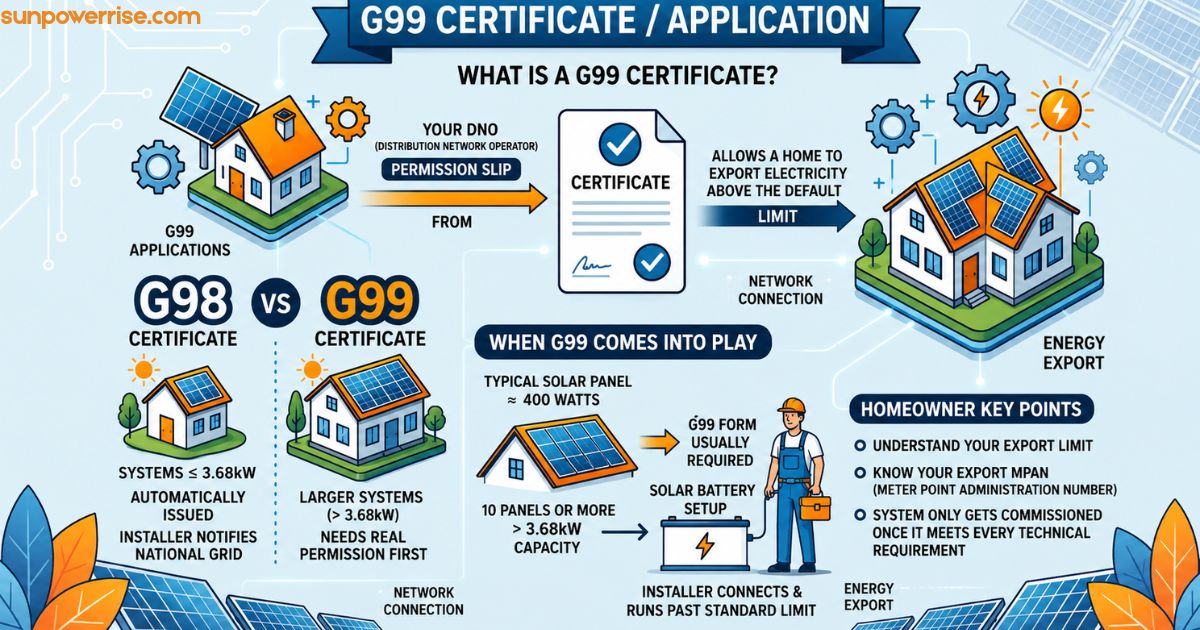
What Is a G99 Certificate?
A G99 certificate works like a permission slip from your DNO, the Distribution Network Operator, and it allows a home to export electricity above the default limit.
Systems that sit at or under 3.68kW normally only need a G98 certificate, which gets automatically issued once your installer notifies the national grid, while larger systems need real permission first.
System Size Thresholds and Export Limits
A typical solar panel produces close to 400 watts, so once a roof carries 10 panels or nudges past 3.68kW capacity, the G99 form usually comes into play, and your installer will connect and run the solar battery setup past that standard limit. As a homeowner, understanding your export limit and your export MPAN matters, because a system only gets commissioned once the PV system meets every technical requirement.
Technical and Connection Requirements
The physical connection itself has to match strict rules for generation equipment running in parallel with public low voltage networks, since these networks host plenty of other microgenerators too, and every one of them needs proper certification before installation even finishes.
EREC Standards, Application Process, and Timelines
Approval covers the inverters themselves, checking their total potential output against a cap of 3.68 kW, or 16A per phase, under Engineering Regulation EREC.
The actual paperwork gets pulled from the National Grid website and posted to your regional office; a firm like Otovo handles this daily, and depending on the region, approval can take 35-45 working days for full notification, sometimes ending in rejection if the local network can’t cope.
Different grid operators run different systems, so response time varies a lot between individual DNOs, and both regular distribution network operators and independent distribution network operators follow slightly different playbooks.
Why Is a G99 Certificate Important?
Getting this right isn’t optional; a G98 certificate or G99 certificate is genuinely mandatory, and treating it as essential paperwork saves real headaches later. For any system exceeding 3.68kW, the export limit becomes the thing standing between you and a solar setup that lets you maximise its full potential.
Once your system gets authorised, you can sell surplus electricity past that old threshold, which unlocks bigger financial returns and stronger environmental benefits at the same time.
Bigger capacity simply means bigger profit on your original investment, but skip the certificate step and the consequences get serious fast: a non-compliant home can end up permanently cut off from the grid.
Beyond the admin, this paperwork decides how much power you’re allowed to export, whether you get paid properly, and whether your export limit fits correctly alongside your export MPAN; skip a step and payments get delayed by your DNO. Getting this sorted early protects your savings, which is why we always design systems that stay fully compliant from day one.
How Do You Get a G99 Certificate ?
You don’t have to chase a G99 certificate alone; your installer usually handles the whole application process on your behalf. The application itself stays free, though many companies add an administration fee for managing the paperwork.
A good solar installer keeps proper hardware documentation on file and will happily confirm installation details if you ever ask. This falls squarely under the installer’s responsibility, and companies like Otovo take real pride in it, handling everything from completion of the applications to actively chasing DNO for updates until approval lands.
G98-sized projects simply register paperwork post-installation, while G99-size projects need genuine pre-approval from your local grid operator before anyone switches anything on. Ask for a copy of everything; future you will want proof this step actually happened.
G98 vs G99
Here’s the simple version: G98 covers smaller installs, and G99 covers anything with more export capability. What actually matters is your inverter-rated output crossed 3.68 kW per phase, roughly 16A, and you’ll need DNO approval before you commission anything.
Stay under that line, and you can install first and notify after, because what matters legally is the on-paper export figure, the potential output rated at 3.68 kW or under 16A, not what the panels actually push out on a cloudy Tuesday.
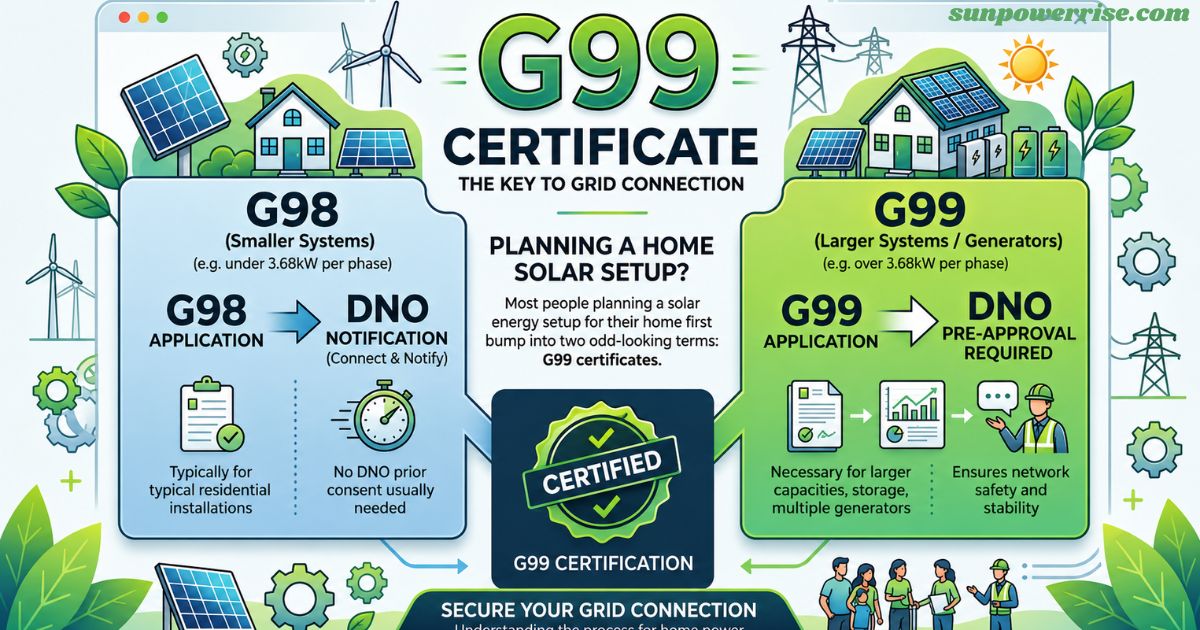
Your installer submits details to National Grid, usually within 28 days of commissioning, and different grid operators send back confirmation at different speeds; some reply within a single business day, others take up to 30 working days. That paperwork also unlocks your Smart Export Guarantee payments. A company like Otovo files the G98 application for you, and in most cases it gets automatically approved almost immediately, per phase or otherwise.
The G99 application process (step-by-step)
Treat it like a checklist, not a puzzle; your installer carries most of the weight. First, they design system choices around the right inverter size and battery setup, deciding whether you’ll need an export limit to keep the grid happy.
Next, they submit the full G99 pack to your DNO, complete with proper forms and supporting docs. The DNO’s review then lands one of three ways: approved, approved with conditions, or a request for changes.
Once you get the green light, the system gets installed and commissioned, and some fast-track routes even allow install first. Finally, your export settings get confirmed and unlocked, and you receive your G99 approval paperwork to keep on file.
Application Timelines
Most applications land somewhere between 4–8 weeks, though fast-track, sometimes called SGI, can shrink that down to roughly 2 weeks in the right circumstances; a busy area can push things out to 8–12 weeks instead.
Different grid operators move at different speeds; some run a genuinely streamlined online system, and UK Power Networks in particular offers a speedy approval process, while others still lean on slower manual application processes riddled with small inefficiencies around interpreting national guidelines set by the Energy Networks Association, or ENA.
Only around 3% of jobs hit truly unique situations, maybe a shared management structure or overloaded capacity distribution nodes, that genuinely slow things down.
The rest usually comes down to documentation: location plans, connection designs, site layout plans, and full manufacturer specifications, and if a DNO asks for extra supplementary documentation, expect delays.
In practice, most Otovo projects receive DNO approval within 10-20 working days, though it’s fair to plan for up to 45 working days once your local grid operator confirms the application is complete.
Conclusion
G98 certificates and G99 certificates sit right at the centre of installing solar panels and putting solar energy to work properly.
They’re mandatory, which is exactly why it pays to talk everything through with your solar installation provider early; doing so avoids unpleasant surprises down the road.
FAQs
What is a G99 certificate?
A G99 certificate is the permission your DNO grants to export electricity above the default limit of 3.68kW, confirming your inverter and PV system meet every requirement for safe connection to the national grid.
How much does a G99 application cost?
The G99 application itself stays free to submit to your DNO; most homeowners only pay an installer admin fee for handling the paperwork.
How long does G99 approval take?
Most G99 certificate approvals land within 4–8 weeks, though fast-track or SGI routes can shrink that to around 2 weeks.
Do I need a G99 certificate for a home battery?
Yes, if your battery or hybrid inverter can push export power past 3.68kW per phase, you’ll usually need a G99 certificate unless a hard export limit keeps you under the threshold.
What’s the difference between G98 and G99?
G98 covers systems under 3.68kW, installed first and notified after, while G99 covers anything exceeding 3.68kW, which needs DNO approval before you commission it.