

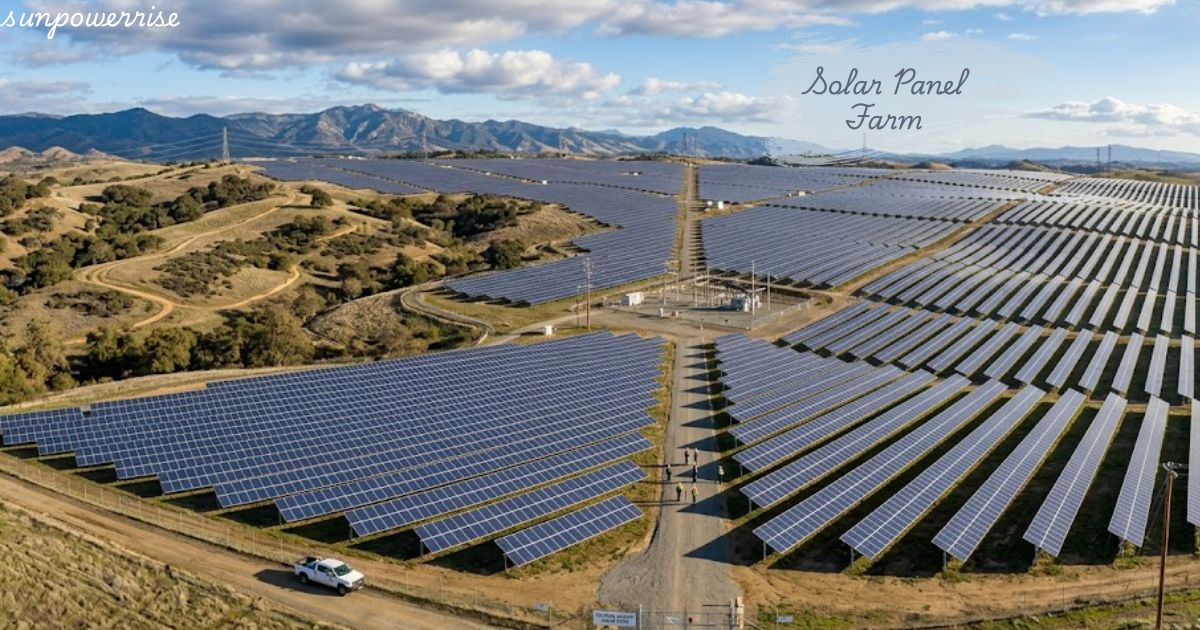
A solar panel farm is a large, ground-mounted array of photovoltaic panels that feeds electricity into the national grid rather than powering a single building. Most start at around 1 MW, and the biggest now run to hundreds of megawatts. The UK has 1,336 operational solar farms. This guide covers how they work, the land and money involved, how planning permission works, and where the sector goes next.
What’s Inside a Solar Panel Farm
Panels capture sunlight, and mounting frames hold them at the right angle. Inverters convert the direct current the panels produce into the alternating current the grid uses. Cabling carries that power to a substation, while monitoring systems track output and flag faults.
Batteries increasingly sit alongside the panels, soaking up surplus power and smoothing out the swings in sunshine. With so little that moves, upkeep stays light.
How the UK Got Here
Large-scale solar took off in 2010, when the Feed-in Tariff made big arrays worth financing, and new sites kept arriving until about 2015. Subsidy cuts around 2016, including the end of the Renewables Obligation for new solar, slowed the pace. Falling equipment costs kept projects moving anyway. From 1 January 2020, the Smart Export Guarantee paid smaller generators for the power they exported.
A fresh wave is now under way. More than 20 large schemes have applied for development consent, together worth roughly 11 GW, and all of them feed the target of 70 GW by 2035. Farms are only part of the picture: solar of every size, rooftops included, reached 18.1 GW across about 1.8 million installations by March 2025.
Utility-Scale and Community Farms
Utility-scale farms, usually 1 MW and above, sell power under power purchase agreements (PPAs), either to utilities at wholesale prices or directly to a business. Community farms are smaller and owned by local groups or cooperatives. They aim to keep affordable, locally generated power within the area, and they let people take part when their own roof isn’t suitable.
Land: How Much, and What Kind
A workable rule is four to six acres per megawatt. A 1 MW site needs about four to five acres, a 5 MW site about 25, and a 50 MW array around 300. In context, ground-mounted solar covers roughly 230 square kilometres. That is about 0.1% of the UK, around 0.5% of farmland, and about a fifth of the space golf courses take up (Solar Energy UK and Carbon Brief).
Developers favour brownfield, unused industrial or commercial land, and poorer farmland graded 3b, 4 or 5, which leaves Grade 1 and 2 soil for crops. The ideal plot is flat or gently south-sloping, with little shade, firm ground, road access and a nearby substation to keep connection costs down.
The south has the strongest sunshine, though Scotland and the north of England are drawing more investment as panel costs fall. Every scheme also needs environmental assessments covering visual impact, noise and wildlife.
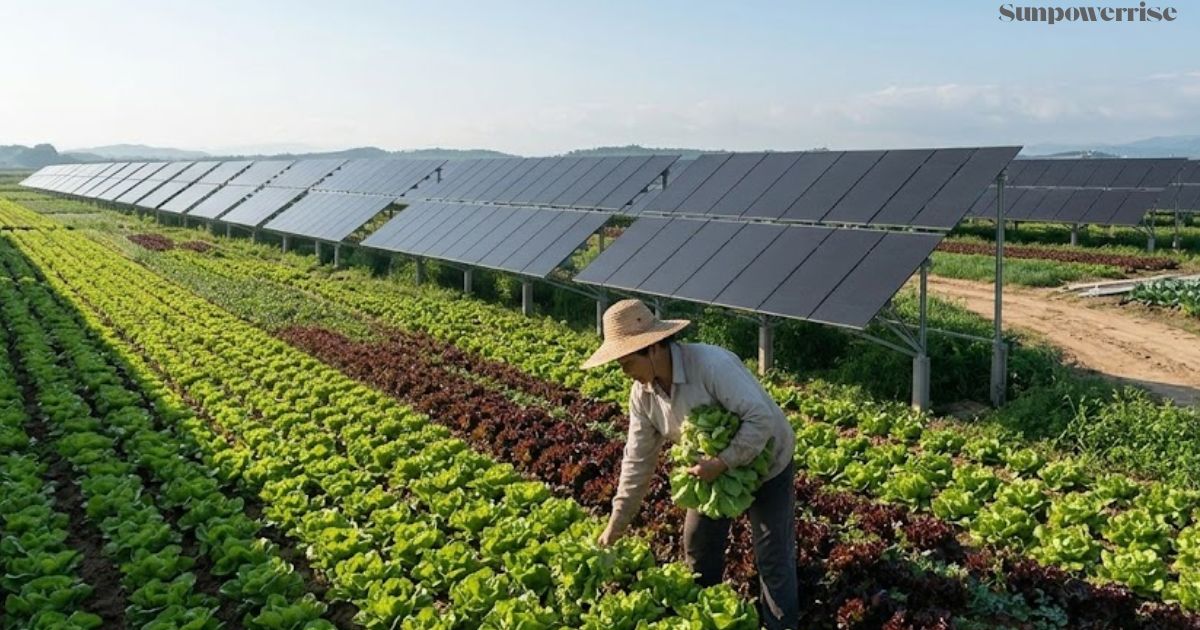
The land isn’t lost for good. Solar panel farms are considered non-permanent structures. Many developers plant wildflower meadows and hedgerows and add bird and bat boxes, as Statkraft describes. Last spring I walked past a site where sheep grazed calmly between the rows, and it showed me how easily farming and generation can share a field. At Eveley Farm in Hampshire, soil fertility and biodiversity have improved since commissioning. Longfield’s developers have also committed to a research programme on the wildlife benefits of large solar panel farms.
What a Solar Farm Costs
Expect around £1 million per megawatt, so a 50 MW farm on 300 acres comes to roughly £50 million. Annual upkeep runs at about 1% of startup cost, or around £12 per kW, which is £500,000 to £600,000 a year for that 50 MW site. Councils gain too, because a farm can contribute millions in business rates over its life.
Real output can beat the paperwork. The 4.5 MW Marston farm in Lincolnshire, built on 12 hectares with 19,599 panels and connected in 2011, generated 4,790 MWh in its fourteenth year, 16.7% above forecast. That suggests forecasts can be cautious, which matters to anyone judging a site’s return.
Planning Permission
Ground-mounted farms always need consent. Anything under 50 MW goes to the local planning authority. Anything larger is a nationally significant infrastructure project (NSIP) and needs a development consent order from the Secretary of State for Energy Security and Net Zero.
That line shapes the market. There are 18 projects online at 69.9 MWp with 49.9 MW export capacity, a size that sits just under the threshold. Many developers see the consent order route as slower and pricier, so mid-sized schemes of 50 to 150 MW often struggle on cost. Reforms due in 2026 raise the threshold, so more projects should be decided locally.
The Biggest Sites
Cleve Hill (373 MW, Kent): It was completed in July 2025 and is the UK’s largest co-located solar and battery project. During commissioning, its exports peaked at 0.7% of national demand.
Springwell (800 MW, Lincolnshire): The government approved it in April 2026 as the largest power-producing solar farm in the UK, and it could supply over 180,000 homes.
Llanwern (75 MW, Newport): It held the size record until Cleve Hill. It has a 20-year PPA with Anglian Water covering 90% of its output.
Shotwick (72 MWp, 51 MW export, Flintshire): It was built in six weeks in 2016 and supplies the UPM paper mill nearby.
Larks Green (Bristol area): In 2023 it became the first solar farm to connect to the transmission network. It added a 49.5 MW, 99 MWh battery in late 2024.
Corporate buyers: Medebridge in Essex supplies about 65% of the University of Manchester’s electricity under a 10-year deal. South Farm has a PPA with the City of London Corporation.
Where It Goes Next
The 70 GW target for 2035 is the anchor. Soon after taking office, the government approved three schemes totalling 1.35 GW, and more than 20 further applications, worth about 11 GW, are waiting. The Solar Taskforce is working on cost-cutting, skills and grid access, and the push extends to commercial roofs, car parks and new homes.
FAQs
How much land do you need for a solar panel farm?
It depends on scale; a 1MW site needs around four to five acres, while a 50 MW farm can need up to 300 acres. As a rule of thumb, plan for about six acres per megawatt.
Do you need planning permission to build a solar panel farm?
Yes, always. Farms under 50 MW go through the local planning authority, while larger ones need development consent from the Secretary of State as nationally significant infrastructure projects.
What is the biggest solar farm in the UK?
Cleve Hill Solar Farm in Kent, at 373MW, is currently the UK’s largest, having overtaken Llanwern Solar Farm (75MW) after coming online in July 2025.
How much does it cost to build and maintain a solar farm?
Setup typically costs around £1 million per megawatt, with annual maintenance running about 1% of that initial investment.
How does the UK plan to grow its solar capacity?
The government aims to hit 70 GW of solar capacity by 2035, backed by initiatives like Great British Energy and the Solar Taskforce to speed up approvals and grid access.