

For a typical solar panel installation cost, most households pay somewhere between £6,500 and £8,000 for a 3-4 kilowatt-hour solar PV system.
A 4kw solar panel system on a three-bedroom house costs around £7,505 as of April 2026, while a 2.1 kilowatt-hour setup for a 1-2-bedroom property typically runs about £4,000 for six panels.
A solar battery in the UK costs between £2,500 and £5,000, depending on capacity and brand, pushing a combined solar panel system to anywhere from £6,000 to £15,000, and premium batteries can push that even further.
The good news is that financing options and government grants make this more manageable, and the new Warm Homes Plan is set to offer 0% loans for solar installation regardless of income.
When you factor in the return on investment, the payback period averages around 10 years, after which your solar system essentially works for free. Hook up to the Smart Export Guarantee and your panels can actually earn you money.
Solar Panel Installation Costs: Key Facts
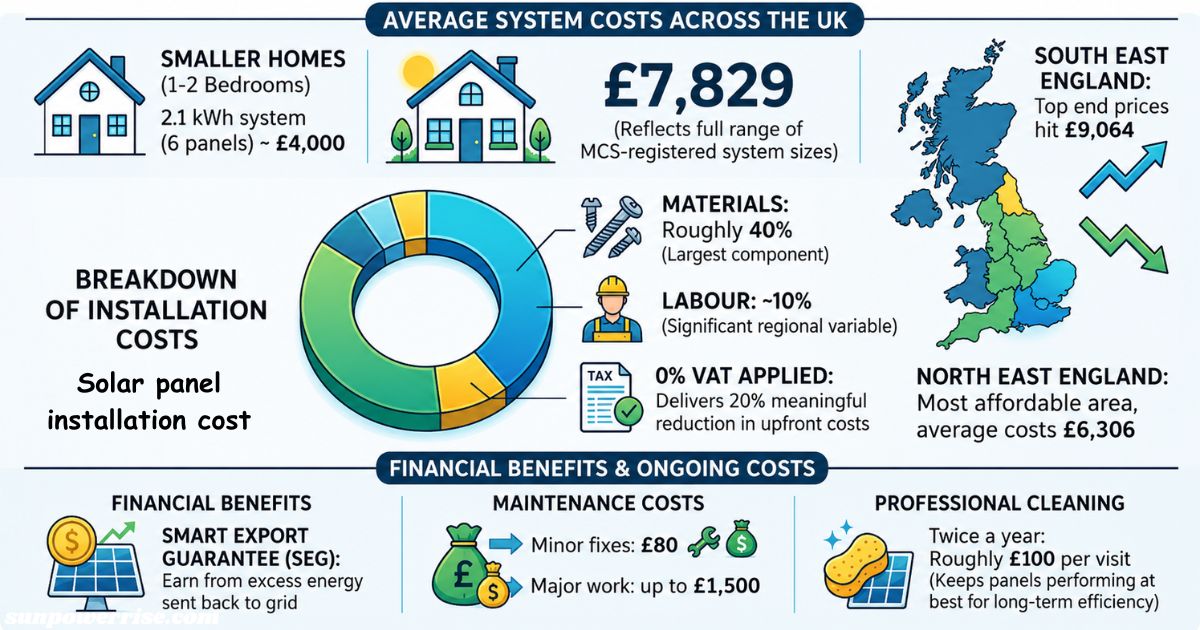
As of April 2026, the average cost of a solar panel system across the UK is £7,829, a figure that reflects the full range of system sizes registered through the MCS.
For smaller homes, a 2.1 kWh system suited to a 1–2-bedroom property typically costs around £4,000 for six panels, while at the top end, prices in South East England reach £9,064. Meanwhile, the North East remains the most affordable area, with average costs sitting at £6,306.
Breaking down where the money actually goes, materials account for roughly 40% of the overall bill, making them the single largest cost component.
Labour costs average around 10%, but they are the most significant variable across regions, which explains the wide price swings you see between postcodes. The 0% VAT applied to solar panel installations delivers a meaningful 20% reduction in upfront costs, which is one of the most straightforward financial benefits available right now.
Once your system is running, the Smart Export Guarantee lets you earn from any excess energy you send back to the grid.
On the maintenance side, costs range from £80 for minor fixes up to £1,500 for major work, so it’s wise to budget accordingly. Professional cleaning twice a year at roughly £100 per visit keeps your panels performing at their best and is a small price to pay for long-term efficiency.
Cost by House Size
Scale and Investment: Pricing by Property Size
The average cost of a solar panel system for a three-bedroom house in the UK sits at £7,505 as of March 2026, with the typical range falling between £4,000 and £10,000 depending on system size.
Most three-bedroom homes fit best with a 3.5 kilowatt-peak (kWp) setup, which the MCS recognises as standard for a standard three-bedroom house.
A smaller 2.1kWp system designed for a 1-2 bedroom home with just six panels runs around £4,000, making it one of the more accessible entry points into solar.
Variable Cost Factors and Long-Term Yields
When calculating your actual cost, installers look at your roof size, electricity usage, whether you want to factor in a solar battery, the number of solar panels needed, your roofing type, the height of your home, and even where your electric cables run.
Costs and savings shift by property size for a 1-2 bedroom house using around 1,800 kWh annually, 6 panels cost roughly £4,216, saving around £272.67 a year, with a break-even window of 6-10 years and a 25-year profit of £3,026.
A 3-bedroom house at 2,700 kWh with 10 panels costs £7,026, saves £454.45 annually, breaks even in 6-12 years, and delivers £4,335.11 in profit, while a 4-bedroom house consuming 4,100 kWh with 14 panels costs £9,837, saves £636.23 per year, breaks even in 7-11 years, and generates £6,069.16 over 25 years.
Benchmark Data and Regional Deviations
These figures draw on MCS cost data from March 2024, aligned with the average price of electricity for April-June 2024 and Ofgem’s typical domestic consumption values for 2024, with solar battery excluded from all totals, though Smart Export Guarantee payments are included in savings.
Zooming out to the broader MCS Dashboard picture for 2026, the UK-wide average lands at £8,677 at roughly £1,686 per kW for a fully installed system, with a typical 4 kW residential photovoltaic system ranging from £6,800 to £8,200.
Regional breakdowns show England averaging £8,380 at £1,696 per kW, Scotland at £7,632 and £1,748 per kW, Wales at £7,183 and £1,547 per kW, and Northern Ireland at £7,482 and £1,258 per kW, with domestic installations on a complex roof sitting above these averages and a straightforward setup often coming in below.
Solar Panel Installation Cost Breakdown
Component Costs vs. Installation Services
Materials make up 40-50% of a typical solar panel installation cost, covering panels, brackets, inverter, cables, and all associated equipment; for an average three-bedroom home, expect the materials bill to land around £3,150, with installers applying a standard 30% markup for profit.
Business costs account for another 30-40% and cover planning permissions, approvals, scaffolding setup, transport, and fuel, adding roughly £2,450 to the total for a 3.5kWp system.
Labour sits between 10-30% and covers physical installation, wiring, and system setup, scaling with system sie and complexity
Itemised Bill for a 4kWp System
A typical 4kWp system breaks down more granularly like this: modules cost around £1,002 (16%), the inverter runs £667 (11%), a mounting kit adds £520 (8%), and electrical equipment accounts for £758 (12%), totalling the kit side at £2,947.
On the services side, scaffolding comes in at £800 (13%), design and installation at £1,965 (30%), testing and commission at £435 (7%), a structural survey at £150 (2%), and MCS registration at £35 (1%), bringing services cost to £3,385 and the total system cost to £6,332 ex.
Most solar panel installations take one to two days for systems up to 14 panels, stretching to four days for larger setups, with much of that time spent on scaffolding, so don’t worry if hours pass before panels actually appear on the roof.
Benchmark Allocations and Smart Inverter Choices
Stepping back to the fuller £8,677 average for 2026, panels represent roughly 45% at around £3,900, the inverter sits at 10% (about £870), mounting and wiring at another 10% (£870), labour and installation at 25% (£2,170), and scaffolding, certification, and paperwork at the final 10% (£870).
A standard string inverter for a 4 kW system costs £600 to £1,000, while a hybrid inverter that’s battery-ready runs £1,000 to £1,800 worth considering if you plan to add storage later.
Fixed labour costs mean the crew spends roughly one to two days on your roof, whether you’re installing 3 kW or 6 kW, and scaffolding varies; a simple bungalow might need minimal setup, while a three-storey terrace or steep-pitch roof can push that line past £1,500 on its own.
Every MCS-certified job bakes in DNO notification, building regs compliance, and an MCS certificate; these aren’t optional extras, so when you compare quotes, ask each installer to split their numbers across these five categories to make like-for-like comparison genuinely meaningful.
Cost Per Solar Panel
Wholesale Trade Rates vs. System Context
A single 350 Wp solar panel installation costs in the UK between £200 and £350 at trade prices, with monocrystalline panels at 400-450 Wp sitting at the upper end and standard-efficiency panels closer to £200.
That per-panel figure is useful for comparisons between brands, but it can mislead if taken in isolation.
The panels themselves account for roughly 45% of the total system cost, meaning an £8,677 install includes around £3,900 just for the panels, with the rest split across the inverter, mounting hardware, electrical work, labour, scaffolding, and certification.
Hardware Proportions and Shading Solutions
For a 4 kW system using ten 400 Wp panels, the panel cost alone sits somewhere between £2,500 and £3,500, a useful sanity check when comparing quotes. Higher-efficiency panels reduce the total number you need, which simplifies installation on smaller or shaded roofs and can lower labour costs slightly.
Premium Tier-1 Economics and Roof Dynamics
Solar panel installation cost calculations show that premium tier-1 panels typically carry a 15-25% premium over mid-range equivalents, a worthwhile investment for roofs with limited space, but less critical for properties with ample room where additional panels can compensate for lower per-panel output.
Solar Panel Installation Costs Explained
The MCS is the primary source of reliable pricing data across the UK, but it’s important to understand what that data actually represents and how it’s built.
Because not all solar panel installers register with the MCS, the figures aren’t fully comprehensive; they reflect registered installation costs only, which means the true market picture may differ slightly.
The average is calculated by totaling the every registered solar panel installation cost and dividing by the number of system sizes recorded, a clean methodology, but one with an inherent caveat.
The average cost per kW figure follows a similar process: the MCS divides the average solar panel installation cost of each individual system by that system’s size, then divides again by the total count of solar panel system installations.
FAQs
What is the average cost of fitting solar panels?
The average fitting solar panel installation cost in the UK sits around £7,829 in 2026, though a typical 4kW system for a three-bedroom house runs between £6,500 and £8,000, depending on your roof type, location, and labour costs.
What is the cost of installing a solar system?
A fully installed solar system in the UK costs roughly £8,677 on average in 2026, covering panels, inverter, mounting, scaffolding, and certification, with smaller 3kW systems starting around £4,900 and larger 6kW systems reaching £10,900.
How many AC can a 3kW solar system run?
A 3kW solar system can typically run 1 small AC unit (around 1–1.5 ton) comfortably during daylight hours, though actual performance depends on your energy usage, roof orientation, and how much solar generation the system produces on a given day.
Can I get a grant for solar panels?
Yes, the Warm Homes Plan offers 0% interest loans, Solar Together saves 30–50% through group buying, and schemes like the Warm Homes Local Grant and Home Energy Scotland Grant support low-income households with poor EPC ratings across the UK.
What is the cheapest way to install solar panels?
The cheapest route is combining 0% VAT savings with a group buying scheme like Solar Together, comparing quotes from at least five MCS-certified installers, and exploring government grants or interest-free financing to spread your upfront cost without paying a premium.