

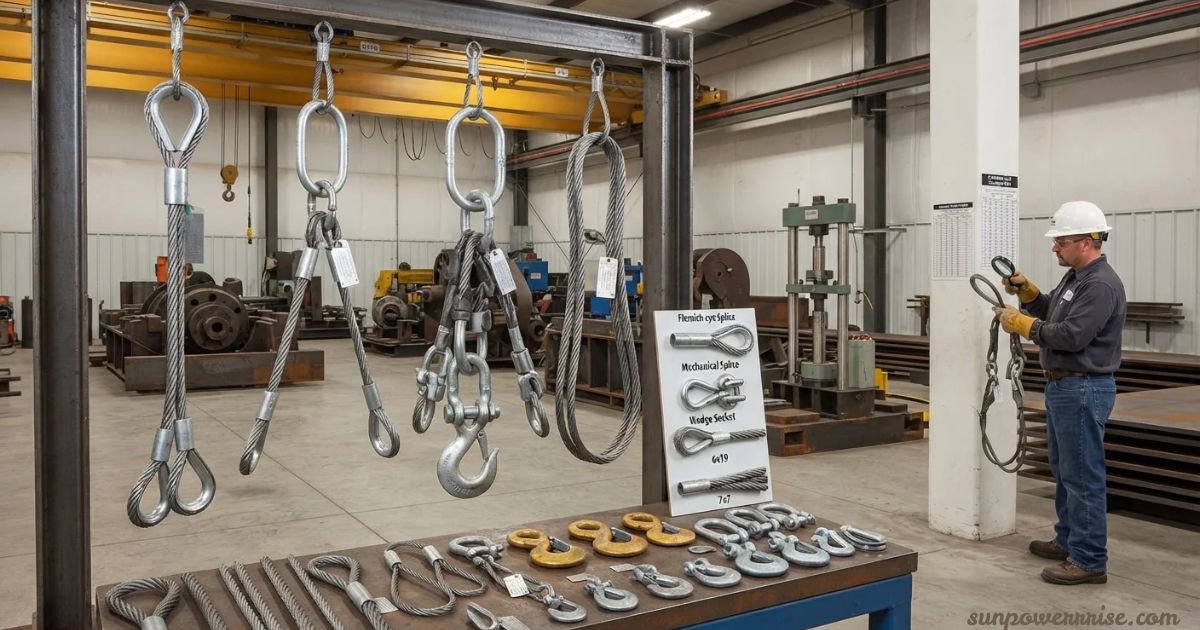
The most common types are the single-leg sling, the bridle sling with two to four legs, and the endless, braided, and grommet styles. Each one solves a different problem in industrial lifting. Pick the style that matches your load and lift points.
Providers label configurations differently, so vocabulary prevents wrong orders. Certex organizes its catalog by leg count, from a single-leg wire rope sling to a double leg wire rope sling, a triple leg wire rope sling, and a quadruple leg wire rope sling. Heavy lifting crews stock a few styles.
What Is a Single-Leg Wire Rope Sling?
A single-leg wire rope sling is one length of rope with an eye or fitting at each end. It links a hook, master link, or shackle to one lift point. Riggers use it alone or as one leg inside a larger assembly.
Dynamic Lifting Solutions calls this layout a single-leg bridle sling and lists models such as DLS 100 EE. Buyers most often picture the eye-and-eye sling, which Tri-State Rigging Equipment lists with a vertical capacity from 1,300 to 11,200 pounds. Compare tags across listings.
How Do 2-Leg, 3-Leg, and 4-Leg Bridle Slings Differ?
A 2-leg bridle sling lifts from two points, a 3-leg bridle sling from three, and a 4-leg bridle sling from four. More legs spread the weight and steady the load, but they demand careful rigging. The right count depends on the load’s lift points.
Dynamic Lifting Solutions lists DLS 210 for two legs, DLS 310 and 330 for three, and DLS 410 and 430 for four. A multi-leg wire rope sling suits irregularly shaped loads, because each leg shares the weight. Tri-State Rigging Equipment filters by 2-leg bridle configurations.
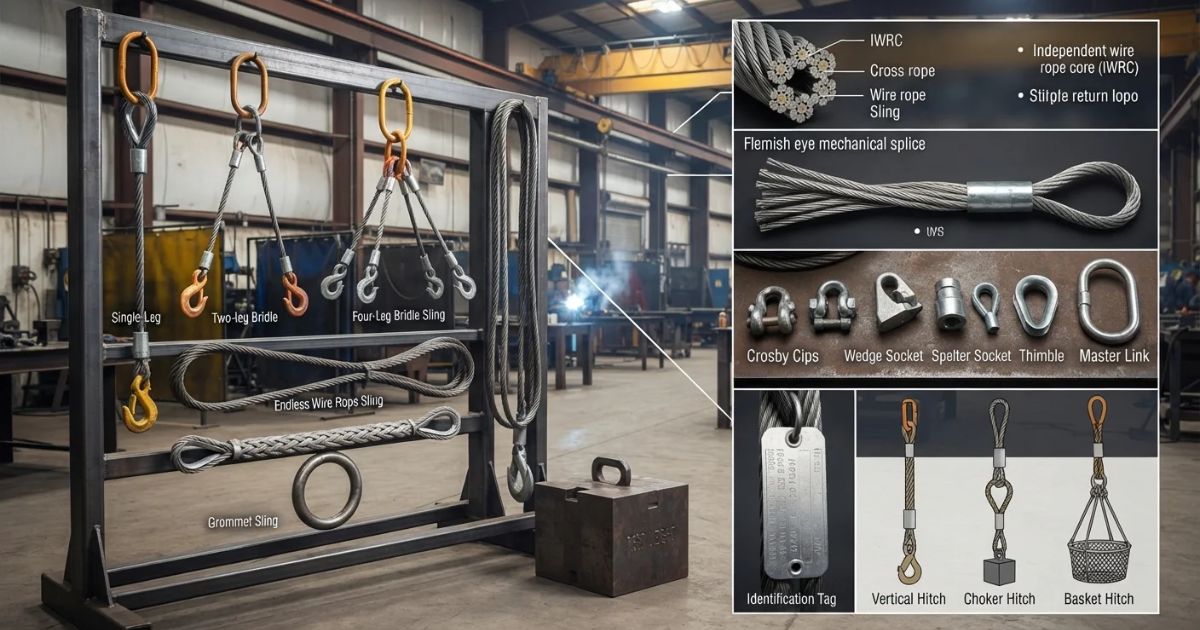
What Are Endless, Braided, Cable Laid, and Grommet Slings?
An endless wire rope sling forms one continuous loop, and a braided wire rope sling weaves several ropes together. A cable laid sling twists smaller ropes into one flexible rope, and a grommet sling shapes strand-laid rope into a ring. Each style trades some abrasion resistance for bendability.
Lift-All builds its endless sling from one 6×19 or 6×37 rope, and crews can shift wear points to handle turning loads. Dynamic Lifting Solutions lists a 9-part braided eye-to-eye sling, model DLS 900 EE. I&I Sling shows Gator-Laid and Tri-Flex products in its handbook.
How Do Hitches and Sling Angles Change Lifting Capacity?
A vertical hitch pulls straight up, a choker hitch squeezes the load, and a basket hitch cradles it, so each carries a different rated capacity. Capacity also falls as the angle from horizontal shrinks. Lift-All tells riggers never to use a sling below 30 degrees.
Lift-All’s table for 1/4-inch EIPS IWRC rope shows 0.65 tons for vertical capacity, 0.48 tons in a choker hitch, and 1.3 tons for vertical basket capacity. Read the capacity chart and effect of angle chart before every lift, because sling angle changes each leg’s load.
What Parts and Materials Make Up a Wire Rope Sling?
A wire rope sling combines steel wire rope, a core, and two end terminations. Most use an independent wire rope core (IWRC) because it adds crush resistance. The rope’s grade and construction then set its strength, flexibility, and wear behavior.
Common grades use extra improved plow steel (EIPS), and common builds include 6×19 construction and 6×37 construction. Fewer, thicker wires improve abrasion resistance, while thinner wires improve kink resistance and flexibility. Larger wire rope diameter raises capacity, and Trester Hoist builds Tough-Lock in 6×26 construction.
Which Rope Finishes and Specialty Options Exist?
Galvanized wire rope carries a zinc coating that adds corrosion resistance, while stainless steel wire rope suits wet or corrosive sites. Specialty builds include rotation resistant wire rope and aircraft cable. Pick the finish that matches your environment, not just your load.
Lift-All’s E-Z Flex line uses machine laid rope in 7x7x7 construction and 7x7x19 construction, offered as a galvanized wire rope sling. Lift-All also sells a black wire rope sling for entertainment stage rigging, adding heat resistance. Match the finish to the job.
Why Does a Flemish Eye Splice Matter?
A Flemish eye splice forms the eye by relaying rope strands around each other before a steel sleeve locks it. This gives the eye reserve strength, so the loop does not depend on the sleeve alone. Lift-All contrasts it with a return loop that puts all strength on the swaged sleeve.
Trester Hoist builds Tough-Lock and Cable-Flex as mechanical splice sling lines and reports a 100% efficiency splice, matching the rope’s full breaking strength. A hand spliced sling uses another method, and Trester Hoist warns it carries a lower working load limit. Read that limit on the tag.
Which Hardware Do Riggers Pair With a Sling?
Riggers connect slings to a master link, a shackle, or a hook, depending on the lift point. A thimble eye lines the loop to protect the rope from wear. A heavy duty thimble does the same job at bearing connections that carry more load.
Trester Hoist pairs its bridles with an alloy eye hook and a latch kit, and Lift-All uses alloy steel hardware. A sliding choker sling carries a sliding choker hook, which speeds rigging of bundled materials. Certex lists hook latch parts, swivels, eye bolts, and swivel hoist rings.
How Do Terminations and Identification Tags Work?
A termination ends the rope, and common types include the swage fitting, U-bolt wire rope clip, fist grip clip, and wire rope grip. Sockets include the wedge socket, spelter socket, and swage socket. A field installable termination lets crews finish a rope on site.
Certex lists a ferrule among its terminations, and Tri-State Rigging Equipment sells a sling protector for sharp edges. Trester Hoist states that Tough-Lock slings carry a permanent metal ID tag listing manufacturer, ratings, diameter, length, and warnings. Read that tag before every lift.
Where Do Industries Use Wire Rope Slings?
Industries use wire rope slings wherever rigging operations meet abrasion, heat, or rough handling. Typical settings include construction sites, manufacturing plants, and metalworking and fabrication shops. Offshore and subsea crews depend on them too, because the rope tolerates harsh handling.
Dynamic Lifting Solutions serves offshore lifting, subsea rigging, and petrochemical projects. Lift-All publishes industry pages for construction and for metalworking and fabrication. Certex keeps an oilfield category in its catalog.
What Damages a Wire Rope Sling?
Kinking, crushing, and severe abrasion cause most damage to a wire rope sling. Trester Hoist names these three as the main drawbacks of the style. Any one can cause a loss of strength the eye cannot see from across the yard.
Sleeve damage needs special attention, since a damaged sleeve ends a sling’s service despite its reserve strength. Wear points near eyes and hooks show up early during a walkaround. Pull any sling from service when you doubt its condition.
How Do You Choose the Right Wire Rope Sling for a Lift?
Start with the load weight and its center of gravity, then count the number of lifting points. Those three facts narrow the choice between a single-leg and a multi-leg set. Add the sling angle and your environmental conditions to finish the shortlist.
Dynamic Lifting Solutions names load stability, sling angles, and environmental conditions as selection factors, and a written lifting plan ties them together. Lift-All says bridles improve load control and balance. Trester Hoist adds that wire rope offers the lowest cost per capacity, and reusable fittings cut replacement costs.
What Other Lifting Equipment Works With Wire Rope Slings?
A wire rope sling rarely works alone. It hangs from an overhead crane, a chain hoist, or a lever hoist, and it often attaches to a spreader beam or a lifting beam. Both beams count as a below-the-hook lifting device.
A chain sling handles heat and rough edges, a synthetic sling protects finished surfaces, and a roundsling offers a soft wrap. Tri-State Rigging Equipment sorts these under lifting slings, and Certex lists them separately. Compare materials before defaulting to steel.
What Should You Look for in a Wire Rope Sling Service Provider?
Look for a provider that publishes clear sling specifications, names its testing and inspection services, and explains its standards. Ask how the provider documents each sling it supplies and who answers technical questions. A provider that answers these plainly deserves a call.
Practical checks include a sample tag, a written capacity chart, and a named contact who can discuss your lift. One phone call about a damaged sling often teaches more than a catalog. Ask which services the provider performs itself.
Which Standards and Certifications Should a Provider Meet?
A provider should state its OSHA compliance, build slings to ASME B30.9, and describe any certifications it holds. These references let you check claims against public documents. Silence on standards is itself a warning sign, so ask directly.
Trester Hoist says its Tough-Lock slings meet OSHA, ASME B30.9, and Associated Wire Rope Fabricators specifications. Dynamic Lifting Solutions lists DNV certified offerings, and an ISO certified provider shows documented processes. Add rigger safety training, safe lifting practices, load securement, engineering judgment, and one rule: do not exceed rated capacity.
Which Testing and Inspection Services Should You Ask About?
Ask whether the provider offers proof load testing, pull testing, and load testing, on site or in a lab. Ask about inspection and recertification for slings already in service. Each answer shows how the provider supports a sling after the sale.
Dynamic Lifting Solutions lists pull testing, proof load testing, and on-site testing capabilities, and Certex lists load testing, inspection, repair, and recertification. Tri-State Rigging Equipment lists OSHA rigging inspections, and Trester Hoist lists inspection and preventative maintenance. Lift-All proof tests 100% of rope with swaged terminations used as slings.
Which Brands Offer Wire Rope Slings and Related Services?
Several brands publish wire rope sling information, including Lift-All, Tri-State Rigging Equipment, Dynamic Lifting Solutions, Trester Hoist, Certex, and I&I Sling. Each brand offers the services listed on its own website, so confirm details there. This article names only services those websites state.
Tri-State Rigging Equipment lists OSHA rigging inspections, and Trester Hoist lists hoist repair and on-site service. Dynamic Lifting Solutions lists custom fabrication and testing services, and Certex publishes rigging layouts. Lift-All offers a sling calculator, and Columbus McKinnon (CM) equipment appears in several of these catalogs.
Why Is This Website the Easiest Way to Find a Provider?
This website helps you find providers by gathering what each one states on its own site into one place. You compare them side by side and skip the guesswork of opening a dozen catalogs. You then contact the providers that match your needs.
Use it to build a short list, then verify every detail with the provider directly. Bring your load weight, lift points, and environment to each call. Preparation shortens the call.
What Do People Ask Most About Wire Rope Slings?
These answers stand alone. Each covers a common buyer question. Verify numbers with your provider.
How Often Should You Inspect a Wire Rope Sling?
Inspect a sling before every use and remove it when you find damage. OSHA guidance also calls for periodic inspections at intervals no longer than 12 months. Follow whichever schedule your site and provider set more strictly, and keep written records.
Is a Wire Rope Sling Better Than a Chain Sling?
Neither wins every time. Lift-All describes wire rope as the least expensive steel sling per capacity, while chain slings tolerate heat and rough edges well. Match the material to the load, the environment, and the handling conditions you expect.
Where Can You Find the Right Wire Rope Sling Provider?
Use this website to find the Common Wire Rope Slings Type for Industrial Lifting that fits your project and the provider that supports it. Browse the providers, compare the services each lists on its own website, and confirm the details before you buy. Start with your load, lift points, and site.