


An ac compressor replacement cost in North Texas is roughly $1,200 to $2,800 installed, according to Jupitair HVAC’s 2026 pricing. Smaller electrical repairs cost less, so the diagnosis matters as much as the price. This guide explains what drives the quote and how to choose a provider whose claims you can check.
How much does compressor replacement cost in North Texas in 2026?
Jupitair HVAC, a Plano company, reports that most compressor-related repairs in North Texas run $150 to $600, while a full compressor replacement runs $1,200 to $2,800 installed. HVAC Project Cost lists a national range of $1,100 to $4,650 without a warranty. Treat both as planning figures, because your own system sets the final quote.
Home Rangers, a Pennsylvania contractor, publishes a national average near $1,600. The numbers differ because Jupitair prices jobs in the DFW Metroplex, while the other guides blend markets across the country. Ask every provider which market their figures describe before you compare quotes.
What does a compressor replacement include?
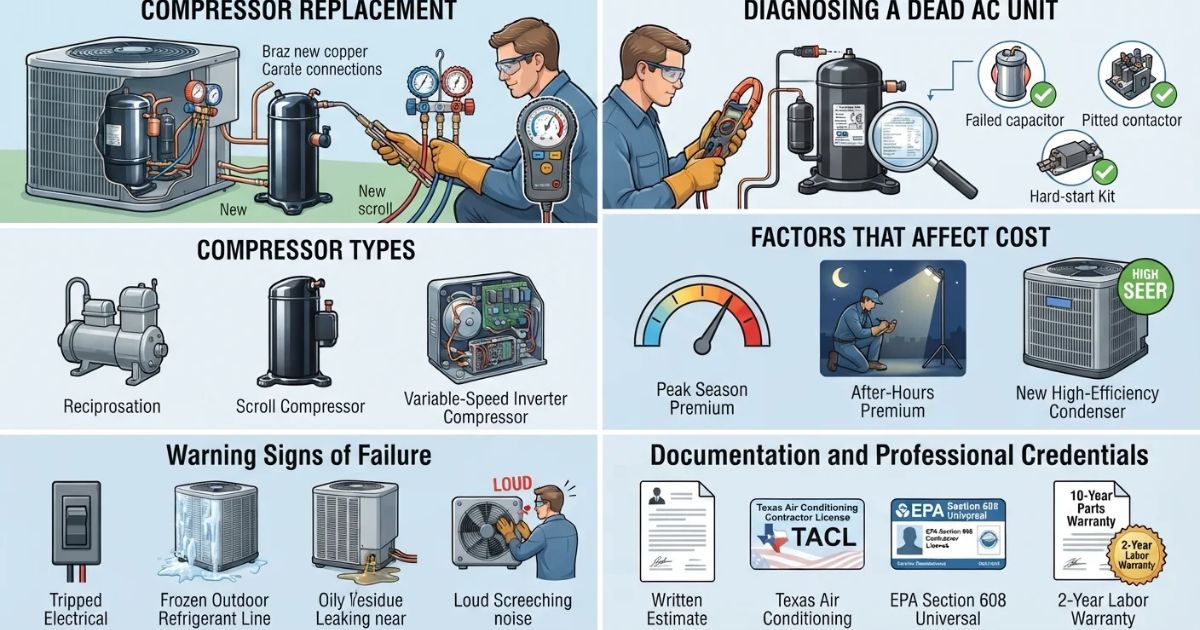
A compressor replacement involves more than bolting in a new part. The technician starts with refrigerant recovery, cuts the old unit out of its brazed copper connections, and installs the new one with brazing. The crew then runs nitrogen pressure testing, deep vacuum evacuation, and a refrigerant recharge by refrigerant charge weight.
Published estimates put the whole job at four to eight hours inside the outdoor condensing unit. The crew installs a filter drier, usually a liquid-line drier, plus new Schrader valve cores and often an accumulator. After a compressor burnout, the crew adds a suction-line drier and a system flush, and a micron gauge confirms the vacuum at 500 microns, HVAC Project Cost’s target.
What factors change a compressor replacement quote?
Five factors move a quote the most: system tonnage, compressor type, refrigerant, labor rate, and warranty status. Installers set tonnage with a Manual J load calculation, and your home square footage hints at the size you own. Jupitair pairs 2.5-to-3-ton systems with homes of 1,200 to 2,000 square feet.
A single-stage compressor costs the least, a two-stage compressor sits in the middle, and a variable-speed inverter compressor costs the most. Older systems often hold a reciprocating compressor, while most newer ones use a scroll compressor. Jupitair adds a peak-season premium of 10 to 20 percent from May through August, charges an after-hours premium of $199 to $250, and cuts 15 to 25 percent through off-season scheduling between October and February.
How do I confirm the compressor is the real problem?
Ask the technician to test before diagnosing. A failed capacitor or a worn contactor can mimic compressor failure, and Jupitair estimates that 30 to 40 percent of its “dead compressor” calls end in cheaper parts. Request a second opinion when a quote tops $1,500.
A careful technician runs an amp draw test and compares the result with the rated load amps on the data plate. The same visit checks the run capacitor, start capacitor, contactor, and condenser fan motor, and a refrigerant pressure check shows whether a refrigerant leak or low refrigerant charge caused the symptoms. After any repair, the crew verifies superheat and subcooling, and burnout jobs also call for an acid test.
What warning signs point to a failing compressor?
The strongest signs include blowing warm air, banging, screeching, or rattling noises, and an outdoor unit not starting. Home Rangers adds humming without starting, short cycling, and a tripped breaker to its list. Turn the system off when you hear metal noises, because hard starting can lead to a locked rotor.
Smell and sight matter too. A burnout or acid smell can signal electrical winding burnout, and oily residue near the unit often signals a refrigerant leak. Jupitair links clicking sounds to the contactor, grinding noise to motor trouble, and ice on refrigerant lines to low charge.
What causes a compressor to fail in North Texas?
Heat, dust, and storms cause most failures here. Jupitair reports that North Texas shortens compressor life to eight to twelve years, against ten to fifteen nationally. A dirty condenser coil full of cottonwood buildup raises head pressure, and a summer voltage surge can trigger electrical winding burnout.
A refrigerant leak leaves low refrigerant charge, while restricted airflow and extreme-heat hard starting add stress. These conditions lead to thermal overload, lubricant breakdown, liquid slugging, mechanical seizure, and valve failure. A compressor burnout also spreads acid contamination and internal contamination from the motor windings through the whole refrigerant circuit, which is why Jupitair limits its guarantee on burnout repairs to 90 days.
Is it worth repairing the compressor or replacing the system?
Repair a young system with a modest quote, and replace an older one when cost and age climb together. Jupitair applies the 50 percent rule at eight years or older, while HVAC Project Cost multiplies age by repair cost in its age-times-cost rule. A result above $5,000 leans toward full system replacement.
This repair vs replace decision has a middle path, outdoor unit replacement, and HVAC Project Cost prices a new condenser with matched coil at $3,200 to $6,500 for a 3-ton system. A compressor swap keeps the evaporator coil, line set, air handler, and blower motor, and Jupitair warns that an expansion valve often fails next. Weigh the system age, the system service life of 15 to 20 years per the Department of Energy, any energy efficiency gain, the new SEER2 rating, and utility rebates before you sign.
How do refrigerant rules affect compressor costs?
Refrigerant rules raise service costs by tightening supply. The AIM Act drives a refrigerant phase-down, and R-410A falls inside this HFC phasedown. HVAC Project Cost lists 60 percent of baseline production for 2024 through 2028 and 30 percent for 2029 through 2033.
R-22 (Freon) systems carry the biggest risk, because production stopped in 2020, reclaimed refrigerant supplies the rest, and no conversion to R-410A or R-454B exists. Newer systems use R-454B or R-32, which are low-GWP refrigerants in the A2L mildly flammable refrigerants class. The Technology Transitions rule dropped the R-410A installation deadline, but the 25C energy efficiency tax credit ended for installations after 2025.
Does a warranty cover compressor replacement?
A warranty usually covers the part but not the labor. A manufacturer parts warranty lasts ten years with warranty registration within 60 to 90 days, and five years without it. Jupitair says labor alone runs $600 to $1,200 on a covered job.
The installer’s labor warranty typically runs one to two years, and an extended warranty can add coverage. Amana and York Affinity offer lifetime compressor coverage on registered units, according to HVAC Project Cost, although the parts warranty never covers labor. Jupitair lists missed maintenance records, late registration, and unapproved parts among the warranty-voiding mistakes.
What should I look for in a service provider?
Look for an itemized estimate, a written estimate, and a diagnostic assessment before you approve a compressor quote. Confirm a TACL (Texas Air Conditioning Contractor License) and EPA Section 608 certification, which federal rules require for refrigerant work. Ask for the labor warranty in writing.
A good quote lists ancillary parts, the labor rates (Jupitair reports $70 to $140 per hour across the DFW Metroplex), and whether the unit is a remanufactured compressor. Providers that offer emergency AC repair, preventive maintenance, an AC tune-up, or a maintenance plan also help you avoid the next failure. Ask whether the crew tested the run capacitor and contactor first, since capacitor replacement, contactor replacement, refrigerant recharge, and hard-start kit installation all cost less than a compressor.
Which companies publish compressor guidance, and what do their websites confirm?
Four websites informed this guide, and each company offers the services its own website lists. Only Jupitair HVAC serves North Texas, so check availability before you call any of the others. Their blogs still help you judge a quote, though prices reflect other markets.
Equipment brands shape parts costs too. Jupitair prices Goodman and Amana units below Carrier, Trane, and Lennox, and it names Carrier Infinity, Trane XV, and Lennox iQ Drive as variable-speed lines. Jameson calls itself a Rudd Pro Partner, HVAC Project Cost covers Daikin R-32 air conditioners, and Trane Climatuff is a proprietary compressor design.
What does Jupitair HVAC confirm?
Jupitair HVAC lists AC repair, emergency AC repair, AC installation, and AC maintenance. Its compressor guide names capacitor replacement, contactor replacement, hard-start kit installation, refrigerant recharge, compressor motor repair, and compressor replacement. It serves Plano, Frisco, McKinney, Allen, Prosper, and other North Texas cities, and its owner holds EPA Section 608 certification and a TACL.
What does Jameson Heating and Air confirm?
Jameson Heating and Air lists air conditioning, heat pumps, furnaces, mini splits, package units, and maintenance. Its compressor article states emergency repairs, free estimates on new system replacements, financing options, and a maintenance program. The company’s address sits in Missouri and its article quotes Billings prices, so treat those numbers as reference points rather than North Texas benchmarks.
What does Home Rangers confirm?
Home Rangers lists AC repair, AC installation, AC compressor replacement, AC maintenance, and an AC tune-up, plus emergency HVAC service. Its guide describes a free diagnostic assessment with a line-by-line quote and maintenance plan discounts on repair labor. The company serves Bucks County, Montgomery County, and Philadelphia, so North Texas readers should use it as background only.
What does HVAC Project Cost confirm?
HVAC Project Cost publishes cost guides and an estimator tool, and its site states no repair or installation services. It discloses that it may earn commissions from qualifying referrals. Use its tables to sanity-check a quote, and use contractor sites to confirm services.
How does this site help me find a provider?
This site gathers what each provider’s own website states, so you compare confirmed services in one place instead of reading several blogs. You can see whether a company lists emergency AC repair, a maintenance plan, or a diagnostic assessment before you call. That saves time during a breakdown, when comparing providers feels hardest.
Each listing points back to the provider’s own website, which remains the final source for services and prices. Build a shortlist of two or three companies, and ask each one for a written estimate that names the compressor type, ancillary parts, and labor warranty. Compare those documents line by line before you book.
What else do readers ask about compressor replacement cost?
Can I replace an AC compressor myself?
No. The job needs EPA Section 608 certification, a recovery machine, a certified recovery cylinder, a vacuum pump, manifold gauges, a nitrogen regulator, and an oxy-acetylene torch. Handling refrigerant without certification violates federal rules, and improper installation can destroy the new compressor within weeks.
Does homeowner’s insurance cover a failed compressor?
Usually not. Homeowner’s insurance coverage excludes normal wear and tear, though lightning or storm damage may qualify, according to Jupitair. A home warranty plan may cover the repair, but Jupitair says plans often cap payouts and may exclude R-22 systems.
How long does a compressor replacement take?
Most jobs take four to eight hours once the part arrives. HVAC Project Cost says stocked units ship in one to three days, and Jupitair says warranty parts take two to five business days. Special-order inverter models can take one to three weeks.
Is a hard-start kit or surge protector worth it?
Jupitair says a hard-start kit cuts startup amp draw by up to 50 percent in extreme heat. It also recommends surge protector installation to guard against summer storm spikes. Both cost far less than a new compressor, so they make sense in North Texas.
Where can I find AC Compressor Repair Cost in 2026 (North Texas Prices)?
Visit this website to compare North Texas providers by the services their own websites confirm, then request an itemized estimate from two or three. Use this guide’s checklist to judge each quote: diagnosis first, itemized costs, and written warranty terms. With that groundwork, you can read any ac compressor replacement cost in context and decide on facts instead of pressure.