

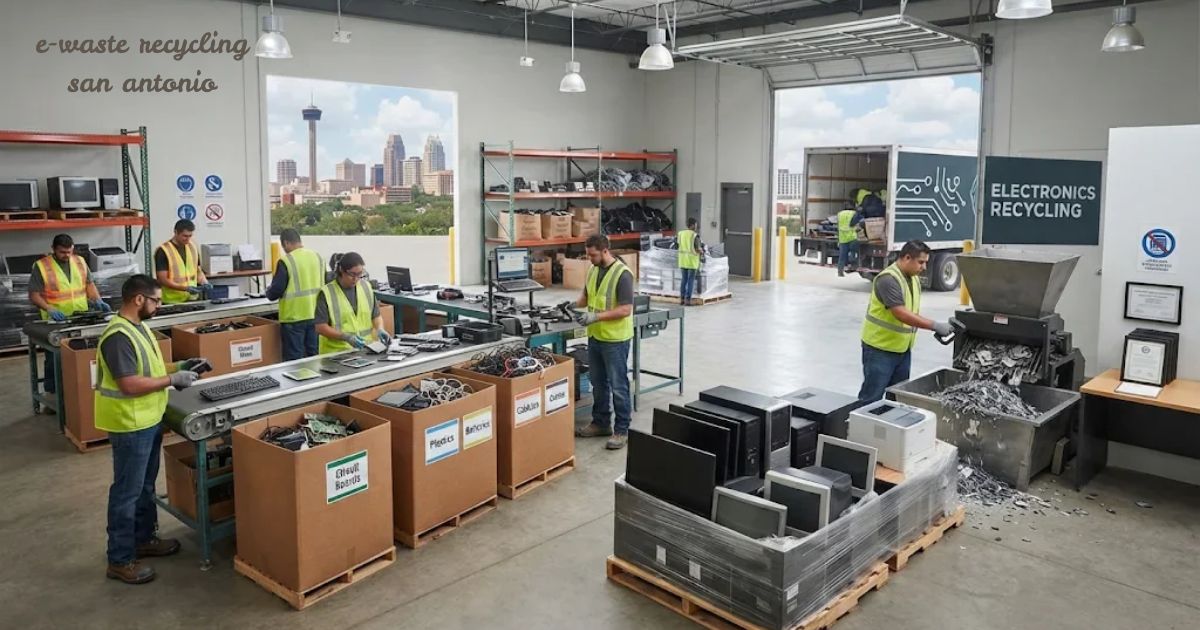
Electronics recycling San Antonio TX services collect, process, and responsibly dispose of devices that no longer work or fit your needs. Searches for e-waste recycling San Antonio return many providers that differ on who they serve, what they accept, and how they protect data. This guide shows you which questions to ask before you hand over a single device.
What Counts as E-Waste in San Antonio?
Electronic waste (e-waste) means any unwanted device that plugs into a wall or runs on batteries. Recyclers call it electronic scrap (e-scrap) when they treat it as raw material. Household electronics recycling covers the gadgets that most families already own.
Most homes around the Alamo City hold old computers, laptops, desktop computers, and computer monitors in a closet somewhere. Add flat-screen TVs, CRT monitors, cell phones, tablets, and e-readers, and the pile grows fast. Smartwatches, game consoles, digital cameras, headphones, smart home devices, and even VCRs belong in the same category.
Which Office and IT Equipment Can Businesses Recycle?
Offices recycle far more than computers, and most providers say so on their websites. Providers commonly list servers, network switches, routers, and modems alongside printers, copiers, and scanners. Every provider publishes its own accepted-item list, so read it before you schedule anything.
United Electronic Recycling lists fax machines, PBX systems, mainframes, and lab equipment on its San Antonio page. MARRS adds VoIP phones, point-of-sale systems, UPS systems, and toner cartridges to its accepted items. A quick call about an unusual item takes two minutes and prevents a long, wasted trip.
Why Do Circuit Boards, Batteries, and Metals Matter?
Recyclers value devices for the materials inside them. Printed circuit boards (PCBs) usually hold copper and lead, with smaller amounts of gold, silver, and palladium, according to Great Northwest Recycling. That mix explains why recyclers sort boards by grade and handle each grade separately.
Great Northwest Recycling accepts motherboards, processors (CPUs), and power supplies, and it explains how low-grade scrap PCB differs from computer boards. Computer boards also include expansion cards and memory cards. MARRS accepts hard disk drives (HDD), solid-state drives (SSD), lithium-ion batteries, sealed lead-acid batteries, button cell batteries, power banks, and AC adapters, while dismantlers separate plastics and pull CRT glass and mercury lamps out of older equipment.
Where Can Residents Find an E-Waste Drop-Off Location?
A residential drop-off works only where the provider accepts households. Basura Bash partners with SA3 Community Recycling, which takes e-waste at 210 Probandt Street during the Basura Bash event. MARRS also points residents to retail drop-off programs at Best Buy, Staples, and Verizon stores.
Confirm hours and accepted items at any e-waste drop-off location before you load the car and drive across town, because MARRS says its Verizon site takes only cell phones and streaming devices. Searching electronics recycling near me returns consumer and business-only providers together, and ATR states that its San Antonio facility no longer accepts residential customers. MARRS says San Antonio hosts community recycling events, so check the City’s website for dates, and verify any business that the 2015 Springs Apartments blog names.
How Do Businesses Arrange E-Waste Pickup?
A business e-waste pickup usually starts with an inventory list and a phone call or web form. The provider then schedules a truck, collects the equipment, and documents the transfer. An e-waste pickup service saves staff time, especially when the load includes heavy servers.
STS Electronic Recycling advertises free pickup across Bexar County, including New Braunfels and Boerne, and MARRS offers free pickup to businesses. All Green takes pickup requests through its website and offers pack and ship data destruction. Secure collection matters most, so ask how the provider tracks each pallet from your dock to its facility.
Before the truck arrives, photograph the loaded pallets and save a list of serial numbers. That simple record settles most disputes about missing items later. Reputable providers match your list against what they receive and report any differences.
How Does the Electronics Recycling Process Work?
Reputable recyclers follow a repeatable sequence: pickup, tracking, sorting, data removal, dismantling, and final processing. Each stage creates a record that you can request later. Knowing the sequence helps you spot providers that skip a step, hide their methods, or answer vaguely.
All Green uses asset tagging at pickup, and ATR’s portal supports serial number tracking along a documented chain of custody. At the facility, crews handle sorting and inventory first, then mechanical disassembly and material separation, and MARRS names magnetic sorting and eddy current separation among its methods. United Electronic Recycling calls its resource recovery commodity value processing, MARRS describes precious metals recovery and end-of-life processing, STS promises downstream tracking and a zero landfill policy, and All Green offers reverse logistics.
How Do Recyclers Protect Your Data?
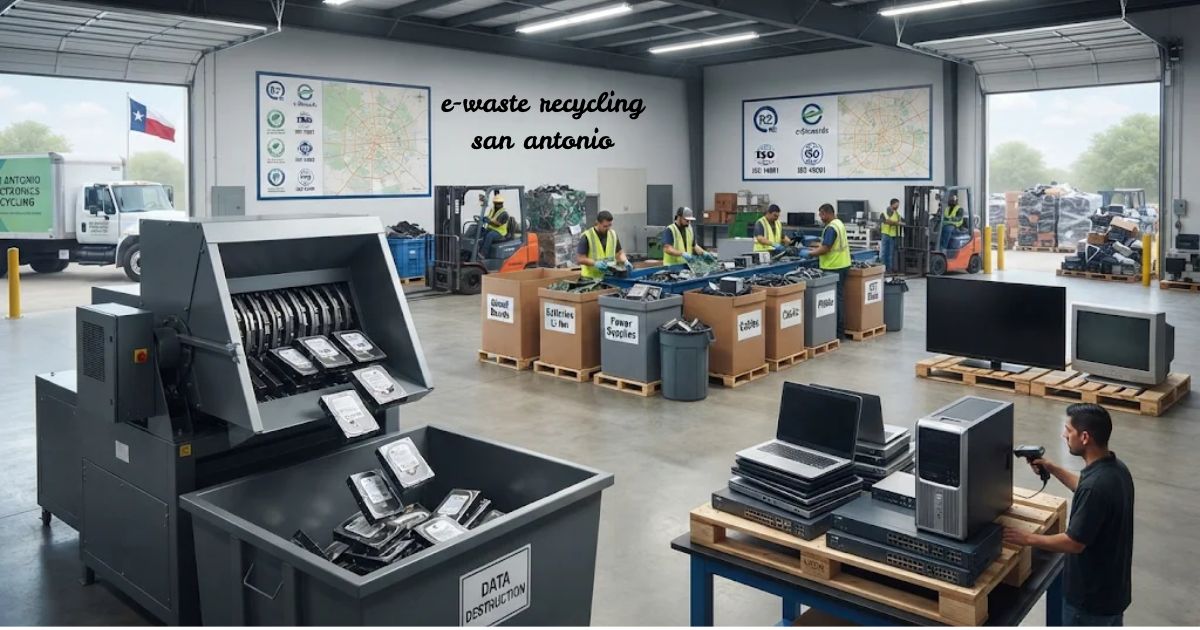
Deleting files does not remove them from a drive, so recyclers rely on data destruction. Methods include data wiping, hard drive shredding, and physical destruction. Ask for a written record, because data security promises mean little without paperwork that names your devices.
STS and All Green both describe on-site witnessed shredding, and All Green sends mobile hard drive shredding trucks around San Antonio. A certificate of destruction documents each drive, and a certificate of recycling documents the equipment, which ATR’s portal lets customers download. Providers cite standards such as NIST 800-88, DoD 5220.22-M, and media sanitization guidelines, STS mentions cryptographic erasure, and United Electronic Recycling adds paper shredding for documents.
What Is IT Asset Disposition, and When Does a Business Need It?
IT asset disposition (ITAD) manages a company’s retired technology from pickup through data removal, resale, or recycling. Businesses need it when they retire equipment in volume or handle regulated data. Most San Antonio ITAD providers bundle several related services under that label.
STS lists computer liquidation, lease buyout, and IT asset recovery, while ATR describes value recovery and remarketing for retired equipment. United Electronic Recycling offers data center decommissioning and warehousing and pallet storage, and ATR handles ITAR recycling for defense-related equipment and tracks assets in its online reporting portal. MARRS describes refurbishment, resale, and donation of working devices, and reuse extends their useful life.
Which Certifications Should a Recycler Hold?
Choose a certified e-waste recycler that holds third-party certification rather than relying on self-description. R2v3 certified status and e-Stewards are two widely cited responsible-recycling programs. Ask for the certificate number, confirm which facility holds it, and check the expiration date before you sign anything.
MARRS lists R2v3 certified status with ISO 9001, ISO 14001, and ISO 45001, ATR operates an R2-certified San Antonio facility, and STS shows a RIOS certified badge. Healthcare clients should ask about HIPAA compliance, a Business Associate Agreement (BAA), and FACTA handling, which STS addresses on its page. All Green’s compliance pages cover EPA regulations, the Universal Waste Rule, the Basel Convention, and Texas disposal laws, and it calls itself a Microsoft registered refurbisher.
Why Does Proper E-Waste Disposal Matter?
Improper disposal lets hazardous materials and toxic chemicals escape from broken devices. MARRS warns that lead and mercury can cause groundwater contamination when electronics break down in landfills. Responsible electronics recycling keeps those substances out of soil and water, and it recovers metals for reuse.
Responsible recyclers pursue landfill diversion and help reduce illegal dumping across the city. MARRS says San Antonio bans electronics in curbside recycling bins, so confirm the current rule with the City’s Solid Waste Management Department before you rely on it. United Electronic Recycling and All Green both address e-waste exports to developing countries, while businesses use recycling records for ESG and sustainability reporting and STS discusses electronics circularity in its news.
Which Industries and Neighborhoods Do Local Providers Serve?
Provider focus varies, so match each company’s stated clients to your own situation. STS serves military installations, including Joint Base San Antonio, and healthcare facilities across Bexar County. All Green notes that San Antonio hosts several data centers and offers on-site shredding for them.
STS also lists government agencies, the oil and gas industry, and the banking and financial sector on its industry pages, and it names Stone Oak, the Medical Center, and Downtown San Antonio in its service area. All Green names local universities that repurpose retired IT equipment. A hospital and a household need different services, so read each provider’s industries page before you call.
How Do the Local Providers Compare?
No single provider fits every need, and each one targets a different customer. Each brand below offers the services listed on its own website, so confirm details there before you commit. This summary covers only what each site states, so treat it as a starting point.
United Electronic Recycling lists collection and pickup, data destruction, hard drive shredding, ITAD, and paper shredding, and it invites San Antonio businesses to contact it directly. Great Northwest Recycling focuses on scrap electronics such as boards, computer towers, cell phones, and laptops at 7386 Grissom Road, where weekday hours run 8 to 5, and it does not accept computer monitors. All Green lists ITAD, data destruction, e-waste recycling, and mobile shredding, and it processes material at its Corona, California facility.
MARRS lists free business pickup, ITAD, and certified data destruction, and it points residents to retail partners. ATR lists IT asset disposal, media sanitization, and remarketing at its Loop 410 facility for business customers. STS lists free Bexar County pickup, NIST 800-88 data destruction, server recycling, and computer liquidation, and it processes equipment at its Jacksonville and Houston facilities.
What Should You Look for in a Provider, and Why Use This Website?
Check six things: accepted items, who the provider serves, certifications, proof of data destruction, pickup or drop-off options, and downstream handling. A provider that answers each point clearly deserves a closer look. This website walks you through those questions and points you to each provider’s own page.
Phone calls reveal more than web pages do, especially for unusual items. When you call, ask for the facility address, the certificate number, and a sample report, and notice how quickly the answers arrive. Because each provider publishes its own accepted-item list and service menu, this website sends you to those pages instead of guessing.
What Do People Ask About Electronics Recycling in San Antonio?
Can I recycle a TV in San Antonio?
Yes, but accepted sizes and conditions vary by provider. MARRS lists flat-screen TVs and CRT monitors among its items, and United Electronic Recycling lists televisions of several sizes. Call first, because some drop-off sites limit how many televisions you can bring.
Do I need to wipe my hard drive first?
You can, but providers also offer data destruction. STS offers on-site witnessed shredding, and All Green’s trucks visit businesses and shred drives while customers watch. Request a certificate of destruction either way, and keep it with your records in case an auditor asks.
Can households use every provider?
No. ATR states that its San Antonio location no longer accepts residential customers, and MARRS offers free pickup to businesses. Households should start with retail drop-off programs or event-based collection such as Basura Bash and its partner, SA3 Community Recycling.
How long does business recycling take?
MARRS estimates three days to two weeks from scheduling to completion, depending on volume and data destruction needs. Larger projects take longer than small pickups, and added services such as shredding add time. Ask each provider for its own timeline in writing before you book.
Does recycling electronics cost anything?
Fees depend on the provider, the item, and the volume of equipment. STS and MARRS advertise free pickup, while United Electronic Recycling’s page notes charges for some items. Ask for a written quote before the truck arrives, and confirm what the quote includes.
Where Should You Start Your Search for Electronics Recycling San Antonio TX?
List your equipment, your data risks, and whether you represent a household or a business. Then visit this website to compare providers, and open each company’s page to confirm accepted items, certifications, and services. Bookmark this website for e-waste recycling San Antonio searches, because it keeps the key questions together.