

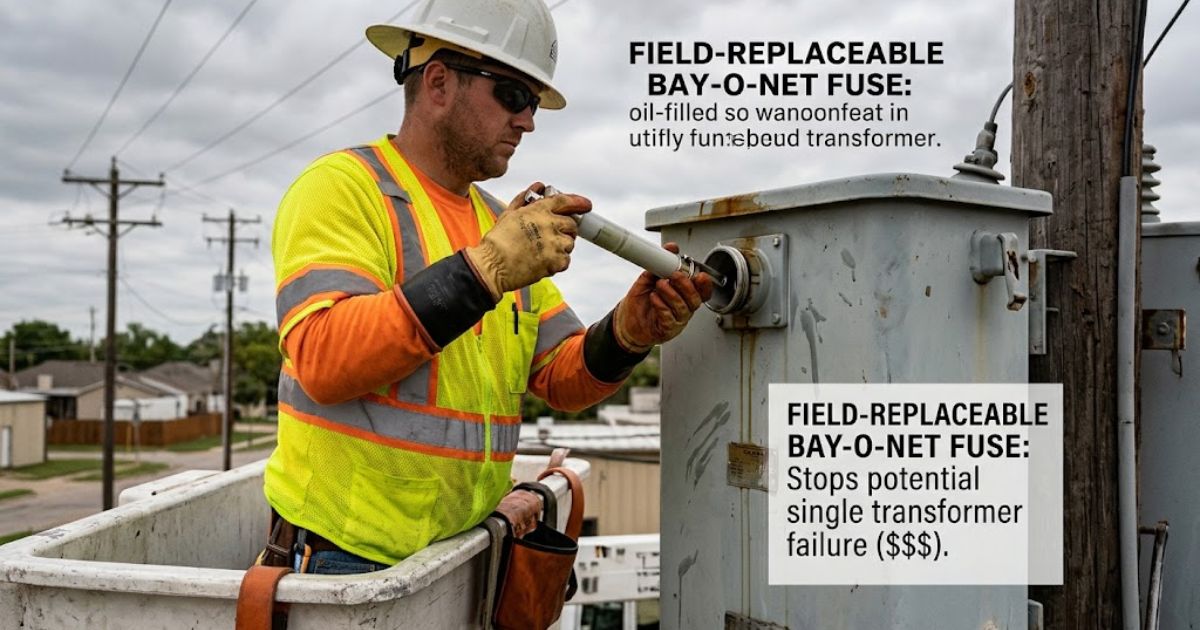
A bay-o-net fuse can save you from a single transformer failure, which can cost tens of thousands of dollars, so every utility takes damage prevention seriously. The Bay-O-Net fuse is a small but important protective device that sits inside oil-filled distribution transformers and stops trouble early. Crews trust it because it is field-replaceable, so they can fix a problem without hauling the whole unit away.
In underground electrical distribution systems, padmount transformers face overcurrents, short circuits, and other faults year after year. Bayonet fuses guard the equipment and shield the wider electrical systems from failed transformers. This guide covers bay-o-net sizing, replacement, and transformer fusing basics for single-phase and three-phase units, with a focus on protection for transformers in daily service.
Eaton’s Cooper Power series gives you a full protection package that mixes hotstick operation with deadfront construction. Line personnel pair it with an isolation link so they avoid closing into a fault after they swap a blown Bay-O-Net link. We will also look at common bayonet transformer fuses, popular fusing setups, a simple transformer fuse protection strategy, and the reliability and safety gains that follow.
What Are Bay-O-Net Fuses?
A Bay-O-Net fuse is an expulsion fuse, and most bayonet fuses live in padmount transformers. Utilities call it the industry standard for transformer fusing across electrical distribution systems, and the same style shows up on utility poles. It protects transformers from overheating, overloading, secondary faults, and low level short circuits whose magnitude and duration could hurt the unit.
The assembly has two main parts: a holder and a fuse link. The link slides into the transformer tank, and the bayonet mechanism uses a twist-and-lock motion for quick installation and removal. That speeds up field work, and hot-stick operation with deadfront construction keeps linemen out of harm’s way, so safety stays high.
h
This expulsion-type fuse works in a simple way. When excessive current or high current hits the circuit, the fusible element melts and turns to vapor. That creates an electrical arc, or just an arc, and the heat from the arc breaks down the oil and the liner material. The special lining inside the fuse housing then releases gasses and high-pressure gas, which form a gas bubble that helps extinguish the arc and prevent current flow, even at high temperatures.
Experienced electrical workers can usually trace the cause of the trouble. If the fuse clears the fault fast, the transformer rarely suffers lasting damage. The crew gets the fuse replaced, and the unit gets energized again.
Types of Bay-O-Net Fuse Links
The usual classification splits Bay-O-Net fuse links into three series: current sensing, dual sensing, and dual element. A high-amp option also exists for heavier duty, and every bay-o-net type has its own job. Eaton builds these links for its Cooper Power series fuse assemblies, and each link protects distribution apparatus from damaging currents. It also protects distribution systems from failed apparatus.
Current sensing links work on single-phase conventional and self-protected distribution transformers up to 500 kVA. They also fit three-phase equipment up to 1500 kVA. They react to secondary faults, excessive load currents, and transformer faults.
Dual sensing and dual element links watch more than current. They also track transformer fluid temperature, so they limit long-term transformer heating caused by overloads and high temperature environments.
Why Bayonet Fuses Are Commonly Used
Bayonet fuses are a popular transformer fuse choice because they are cost-effective and easy to replace in the field. Bay-O-Net fuses are comparable in cost to internal cartridge fuses, yet they are field-replaceable, and that saves real time and money. That is why crews pick a bay-o-net design again and again.
The fuse assembly hides its fuse inside a cartridge at the end of a tube. That tube reaches down into the transformer tank and sits under the oil. A crew pulls it like a bayonet from outside the transformer, and engineers like that the fuse is easy to keep coordinated with upstream devices.
How Transformer / Bayonet Fuses Are Sized
Start with the rated voltage, which the manufacturer lists. Pick a fuse with a matching voltage rating. Then check the inrush current, the quick spike that hits when the unit gets energized. Choose a fuse whose time current characteristic curve, or TCC, sits to the right of the inrush curve. Next, match the current rating to the transformer rated current under normal operating conditions, and make sure the fuse can interrupt the available short circuit current in any short circuit or other faults.
Size matters in both directions. A fuse too small trips on startup currents, and a fuse too large reacts too slowly, which weakens protection. Careful transformer fuses selection and good transformer fuse sizing keep the unit safe from overloads too.
A three-step process makes the math easy. First, find the full-load amperes, or FLA, with this formula for a three-phase transformer: kVA divided by voltage kV times 1.732. Second, apply a sizing factor of 150% to 200%, which equals 1.5x to 2.0x. Third, choose the next standard fuse size that is commercially available, with equal or higher amperage.
Here is a worked example. Take a 750 kVA unit with 12.47 kV primary voltage. The FLA comes out to 34.7 Amps, and 1.5x gives 52.05 A, so a 65A fuse fits. The same method works across voltage classes like 15kV, 25kV, and 38kV, for units from 75 kVA to 2500 kVA.
Bayonet Fuse Replacement
Bayonet fuse replacement on a pad mount transformer follows a safe replacement procedure built on best practices from field personnel, and a bay-o-net swap is no different. Warning: only qualified electrical professionals with proper training and personal protective equipment, or PPE, should do this job.
Check de-energization first. Many fuses are load-break rated, so you can open them on a live transformer, but utility rules, site rules, and local safety protocols often demand otherwise.
Hook the eyelet on the bayonet fuse holder with a hot stick. Use a twist-and-pull move: turn the holder counter-clockwise by a quarter turn to unseat it, then pull it out of the housing.
A flapper valve closes and limits oil spillage. Carry the holder to a safe area and swap the blown fuse link for a new fuse link of the same type and amperage rating, because a wrong rating ruins the whole protection scheme. Re-insert the holder with a firm push and turn it clockwise until it locks in place with a clear positive lock.
Why do transformer fuses blow
Overloading a transformer is the first common cause. Every unit has overload limits for its electrical load, and too many electrical devices or a sudden surge in demand can push it past them.
External short circuits happen when a live part touches another part or a conductive object. Faulty equipment, rodents, and damaged power lines cause many of them, and so do aged insulation and degraded insulation between conductors. Most start near malfunctioning motors and faulty devices.
Internal short circuits come from a breakdown in the insulation between the windings. That triggers a ground fault and excessive current flow, which marks a transformer failure, and a working fuse will blow at once.
Bayonet Fuse Limitations
Bayonet fuse limitations matter, even though the fuse is the industry standard for most distribution transformers. A bay-o-net fuse is a single-use expulsion device, so the unit stays out of service until a crew swaps the fuse. It usually cannot protect units at 3,000 kVA and above.
For high-capacity jobs where you must restore power right away, you need something heavy-duty and resettable. A load interrupting switch or a vacuum interrupter fills that role.
Common Applications
Most people link bayonet fuses with pad-mounted distribution transformers, but the common applications go wider. You also find them in subsurface transformers, medium-voltage switchgear, and wind turbine step-up transformers. All of these are medium-voltage setups, and many are oil-filled.
FAQs
1. What is a bay-o-net fuse?
A bay-o-net fuse is an expulsion fuse that protects oil-filled distribution transformers, mostly padmount transformers, from overcurrents and short circuits. It sits in a holder that slides into the transformer tank, and crews can remove and replace it from outside the unit with a hot stick.
2. How do you size a bay-o-net fuse?
Start by finding the full-load amperes (FLA) with this formula for a three-phase transformer: kVA divided by voltage kV times 1.732. Then apply a sizing factor of 150% to 200% to handle inrush current, and pick the next standard fuse size that is commercially available.
3. Why does a bay-o-net fuse need an isolation link or a current-limiting fuse?
A bay-o-net fuse handles secondary faults and overload currents, but it cannot clear every high level fault by itself. A backup current-limiting fuse covers the very high short circuit current, which gives you a full range of protection.
4. What is the difference between dual sensing and dual element bay-o-net fuse links?
A dual sensing link reacts to current and oil temperature, so it gives overload protection and primary circuit protection. A dual element link combines both types of protection. Both limit long-term transformer heating caused by overloads and high temperature environments, while a current sensing link only reacts to current.
5. What are the limits of a bay-o-net fuse?
A bay-o-net fuse is a single-use device, so the transformer stays out of service until a crew replaces it. It usually cannot protect transformers rated 3,000 kVA and above. For high-capacity jobs where you need to restore power right away, a load interrupting switch or a vacuum interrupter works better because they are resettable.