

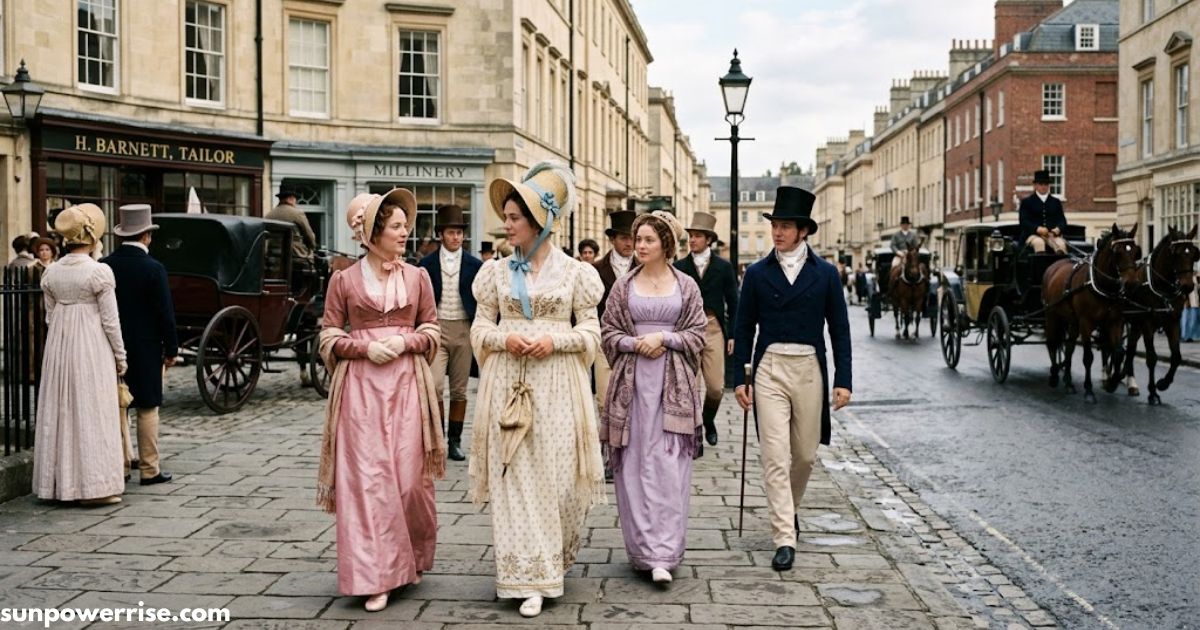
I still remember the first time I flipped through an old fashion plate showcasing regency era fashion from Great Britain and wondered how nine short years could leave such a mark on style.
Fashion in this window borrowed from classical antiquity, showed up in an Egyptian sphinx motif here and there, and blended classicism with Romanticism so smoothly that Romanticism and refinement felt like the same idea wearing two different coats.
Anyone digging into regency era fashion for the first time will notice quickly how tightly clothing, politics, and art were woven together.
Regency Era Fashion
I like to think of the fashion of the regency era as a conversation between comfort and status, and the chemise dress sits right at the center of it. Credit for that silhouette often goes to Marie Antoinette, the former queen of France, though by the time it reached England it had grown far more modest, largely because cotton replaced silk after battle losses cut supply.
The Industrial Revolution pulled country-dwellers into the cities, and that shift gave riding jackets and an equestrian flair a permanent place in fashion plates, complete with women shown holding riding crops with knee-length hemlines.
Influences
Politics shaped the wardrobe too, since the French Revolution and the Napoleonic Wars pushed some women toward practicality and comfort, while Napoleon and his wife, Empress Joséphine Bonaparte, turned French society back into the arbiter of style and luxury for the whole British Empire.
She acted as a true patron of the arts, encouraging French artists and craftsmen to build masterpieces with rich embellishments and an opulence borrowed from the classical era, drawing on ancient Greek and Roman civilizations for their aesthetic.
Joséphine also brought back necklaces and tiaras for aristocratic fashion, and a convertible set from around 1810, holding 95.00 carats of Old Mine-cut white diamonds arranged in eleven rosettes.
A similar diamond necklace sits in the Smithsonian, and King George IV gave another to his mistress, Lady Conyngham, which tells you everything about the British Regency era fashion connection to social movements and political movements across the Channel.
Regency Era Women’s Fashion
Anyone studying fashion in the regency era soon learns that women got dressed in layers most of us would never guess at from a single glance at a portrait.
A shift, or chemise, made from linen garment fabric went on first, often sleeveless or short-sleeved, followed by stays, then a petticoat, cotton stockings or silk stockings held with garters, and sometimes a chemisette with a high collar; drawers stayed out of the picture for propriety reasons, and pantyhose simply did not exist yet.
Wardrobe Requirements
Kalen Hughes wrote a wonderful piece on Word Wenches about this whole process, and Candice Hern listed the many outfits a lady needed across one day, including morning gowns, visiting gowns, walking gowns, promenade dresses, carriage dresses, riding habits, dinner dresses, and ball gowns, each tied to specific engagements.
The words undress, half-dress, and full-dress described formality, not coverage, so casual dress or informal dress ran from early morning to noon, dressy casual or casual business attire filled the middle ground, and full-dress, worn at evening concerts, card parties, soirees, and balls.
Innovations in Corsetry and Shape
Square necklines on the empire gown needed help staying modest, so a stiff panel style called the Divorce Corset appeared around 1810 to separate the breasts and support undergarments beneath the empire-line dresses, giving the whole fashion revolution its romantic shape and its enduring natural body shape appeal, a far cry from the heavier corset of the Georgian Era or the Victorian Era.
Regency Men’s Fashion
Regency era men’s fashion leaned into precision rather than flash, and honestly, that restraint is what makes regency era fashion men wore back then feel so timeless today.
A simple shirt, cut from muslin, went on first, followed by a waistcoat and a jacket shaped much like a modern tuxedo jacket with tails, and this combination built the base of every well-dressed gentleman’s look.
Choices for the legs ranged widely, from knee-length breeches worn with stockings, to trousers with suspenders that became fashionable for the upper class around 1807, to fitted pantaloons worn with tall boots, to buckskins made from deerskin, prized for being rugged and comfortable, and even the daringly tight inexpressables, which left little to guess at.
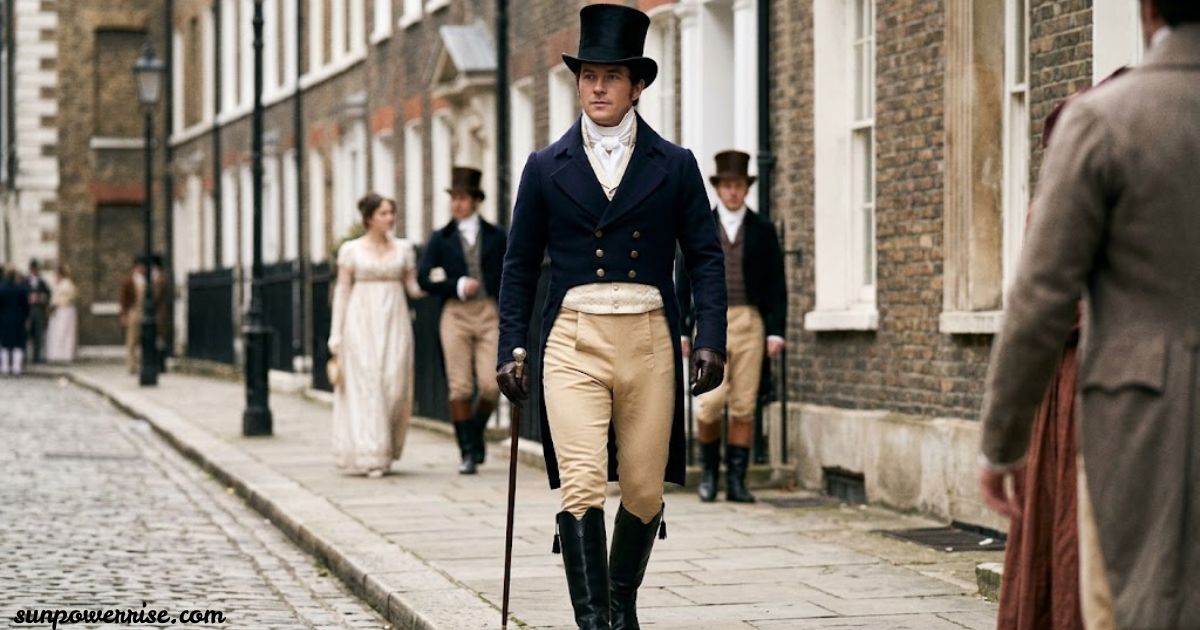
Beau Brummell pushed dandyism into the mainstream, championing tailored coats, high collars, fitted waistcoats, and elegance built on attention to detail, and his tailored suits basically wrote the rulebook for men’s fashion standards that designers still reference today. Cravats, styled neckwear, and top hats rounded out the signature accessories every gentleman needed to complete the picture.
Accessories
No Regency outfit felt finished without the right accessories, and women had plenty to choose from. A fichu, sometimes called a tucker, tucked into the bodice of a gown to cover too much cleavage, while gloves protected against sun exposure and satisfied strict propriety, and a reticule, occasionally teased as a ridicule, served as a lady’s purse.
Hats and bonnets kept a woman’s hair covered and protected her porcelain complexion, turbans and bandeaux suited older women, and a parasol guarded against spots and freckles, since being unfashionable meant showing either.
Tippets, also called a boa, along with pelerines, a collar-like cape for the shoulders, and muffs worked as practical warming aids that still looked stylish, and veils appeared mainly with widows during mourning.
Finishing touches included ribbons, feathers, flowers, fans, cameos, pearl necklaces, and hair ornaments, while men carried a walking stick, or cane, an accessory of distinction collected even today as antique canes, alongside riding gloves.
Outerwear
Layering up for the weather never meant sacrificing style during this period. A spencer, a close-fitting, tight-sleeved, waist-length jacket without tails, covered a woman’s shoulders for warmth, while a pelisse worked as a fitted coat or coat dress, following the high-waisted lines of the gown beneath and trimmed with fur, swansdown, and contrasting fabric using frog fastenings.
A redingote, a belted version of the riding coat, opened to reveal the skirt underneath, and a cloak, or mantle, sized as a hip-length cape or thigh-length cape and sometimes called mantelets, suited an evening at the opera or the theatre thanks to their upstanding collars.
Wraps and shawls added warmth on their own, and capes, though a fading fashion by this point, still made occasional appearances, often replacing the older fur-lined cloaks entirely.
Footwear
Shoes stayed simple but never plain. Slippers, or simple pumps, followed a ballet slipper shape and came in kid leather, satin, or velvet, while mules offered backless slip-on shoes with just a slight heel for easy wear indoors.
Half-boots, built from sturdy leather, handled conditions outdoors, and softer versions in satin or velvet suited evening wear instead. Pattens, a metal contraption strapped over regular shoes, lifted a lady above mud, snow, and rainwater on the street during rough weather.
Culture and Lifestyle
Fashion never grew in a bubble, and the culture around it shaped every stitch. The Prince Regent, once called the First Gentleman of Europe, spread his influence across clothing, values, and culture, acting as a serious patron of art and collecting fine paintings while backing new architecture.
Britain stayed at war for much of the era, and England fought to defend conquered lands and resist Napoleon, with English forces under Arthur Wellesley, later the Duke of Wellington, winning the Battle of Talavera in Spain in 1809, followed by the decisive Waterloo victory in 1815 that confirmed England’s own standing as the dominant European power and ended fears of invasion.
Traces of Revivalism, Orientalism, and Romanticism ran through art, architecture, and clothing alike, and the Egyptian influence visible everywhere traced back to the Royal Navy defeating Napoleon at the Battle of the Nile in 1798.
The Regency Ballgown: Epitome of Grace and Style
If one garment sums up the entire era, it has to be the ball gown. Built for formal occasions, this ubiquitous fashion trend reached its pinnacle with floor-length, flowing skirts, embellished with delicate embroidery and trimmings, and it stood as the centrepiece regency era men’s fashion in every fashionable lady’s wardrobe among high-class women.
Some versions added off-the-shoulder necklines for a hint of sensuality, while the high waistline created a flattering silhouette, often described as an ethereal silhouette, and a few gowns used ruching at the back to form sinuous shapes and rounded shapes that echoed the romantic femininity everyone wanted, all while keeping grace, style, and elegance front and centre.
FAQs
What is regency style fashion?
Regency style fashion means high-waisted empire silhouette gowns, delicate muslin fabrics, and empire waistlines paired with tailored coats for men, all reflecting classicism, grace, and refinement.
Is Bridgerton Victorian or Regency?
Bridgerton is set in the Regency era, not the Victorian era, and its empire waist gowns and ball gowns closely echo real 1810–1820 fashion.
Are Regency and Victorian era the same?
No, they are different the Regency era ran from 1811 to 1820, while the Victorian era followed later and brought heavier corsets, fuller skirts, and a very different silhouette.
Why did they call it the Regency era?
It’s called the Regency era because King George III could no longer rule due to mental illness, so his son, the prince regent, later George IV, ruled in his place.
How to dress up as Regency era?
Aim for an empire waist gown with delicate fabrics like muslin or silk, add gloves, a bonnet, and a reticule, and finish with soft curls for a truly timeless look.